

Education in 2026 stands at a breaking point where cognitive overload, emotional fragility, and ethical drift have replaced clarity, resilience, and character. True learning is revealed not through accumulation of information but through liberation of the mind, body, and values—an insight long understood by the Gurukula system and now validated by neuroscience. Practices such as Chankraman—learning through disciplined walking—restore attention, memory, and emotional regulation by aligning learning with human biology, while time discipline, yoga, and trilateral development integrate worldly skills, self-knowledge, and embodied intelligence. When education is rooted in relationships, ethical economics, and human-scale communities, it produces calm minds under pressure, self-directed learners, and service-oriented citizens rather than anxious job seekers. The ultimate measure of education is simple and uncompromising: the ability to think clearly in motion, act ethically under stress, and contribute responsibly to the well-being of society.
2026ರ ಶಿಕ್ಷಣ ವ್ಯವಸ್ಥೆ ಗಂಭೀರ ಸಂಕಟದ ಹಂತದಲ್ಲಿದೆ; ಇಲ್ಲಿ ಜ್ಞಾನಾಭಿವೃದ್ಧಿಯ ಬದಲು ಅತಿಯಾದ ಮಾಹಿತಿ ಭಾರ, ಭಾವನಾತ್ಮಕ ಅಸ್ಥಿರತೆ ಮತ್ತು ನೈತಿಕ ದಿಕ್ಕು ತಪ್ಪುವುದು ಹೆಚ್ಚಾಗಿದೆ. ನಿಜವಾದ ಕಲಿಕೆ ಎಂದರೆ ಮಾಹಿತಿಯ ಸಂಗ್ರಹವಲ್ಲ, ಮನಸ್ಸು–ದೇಹ–ಮೌಲ್ಯಗಳ ಮುಕ್ತತೆ ಎಂಬುದನ್ನು ಗುರುಕುಲ ಪದ್ಧತಿ ಹಿಂದೆಯೇ ಅರಿತಿದ್ದು, ಇಂದಿನ ನರವಿಜ್ಞಾನವೂ ಇದನ್ನು ದೃಢಪಡಿಸುತ್ತದೆ. ಚಂಕ್ರಮಣ ಎಂಬಂತೆ ನಡೆಯುತ್ತಾ ಕಲಿಯುವ ಅಭ್ಯಾಸಗಳು ಕಲಿಕೆಯನ್ನು ಮಾನವ ಜೈವಿಕತೆಯೊಂದಿಗೆ ಹೊಂದಾಣಿಕೆ ಮಾಡಿ ಗಮನಶಕ್ತಿ, ಸ್ಮರಣೆ ಮತ್ತು ಭಾವನ ನಿಯಂತ್ರಣವನ್ನು ಪುನಃ ಸ್ಥಾಪಿಸುತ್ತವೆ; ಅದೇ ಸಮಯದಲ್ಲಿ ಕಾಲಶಿಸ್ತು, ಯೋಗ ಮತ್ತು ತ್ರೈಮುಖ ಅಭಿವೃದ್ಧಿ ಲೋಕಜ್ಞಾನ, ಆತ್ಮಜ್ಞಾನ ಮತ್ತು ದೇಹಜ ಬುದ್ಧಿಮತ್ತೆಯನ್ನು ಏಕೀಕರಿಸುತ್ತವೆ. ಶಿಕ್ಷಣವು ಸಂಬಂಧಗಳು, ನೈತಿಕ ಆರ್ಥಿಕತೆ ಮತ್ತು ಮಾನವೀಯ ಪ್ರಮಾಣದ ಸಮುದಾಯಗಳಲ್ಲಿ ನೆಲೆಯೂರಿದಾಗ, ಅದು ಆತಂಕಪಡುವ ಉದ್ಯೋಗಾರ್ಥಿಗಳ ಬದಲು ಒತ್ತಡದ ನಡುವೆಯೂ ಶಾಂತ ಮನಸ್ಸುಳ್ಳ, ಸ್ವಯಂಪ್ರೇರಿತ ಕಲಿಯುವ ಮತ್ತು ಸಮಾಜಸೇವೆಗೆ ಬದ್ಧ ನಾಗರಿಕರನ್ನು ರೂಪಿಸುತ್ತದೆ. ಶಿಕ್ಷಣದ ಅಂತಿಮ ಮಾನದಂಡ ಸರಳವೂ ಕಟ್ಟುನಿಟ್ಟಾದದ್ದೂ ಆಗಿದೆ: ಚಲನೆಯಲ್ಲಿಯೇ ಸ್ಪಷ್ಟವಾಗಿ ಯೋಚಿಸುವುದು, ಒತ್ತಡದಲ್ಲಿಯೇ ನೈತಿಕವಾಗಿ ಕಾರ್ಯನಿರ್ವಹಿಸುವುದು ಮತ್ತು ಸಮಾಜದ ಕಲ್ಯಾಣಕ್ಕೆ ಹೊಣೆಗಾರಿಕೆಯಿಂದ ಕೊಡುಗೆ ನೀಡುವುದು.
The ONLY Gurukula Lesson You Need in 2026: Why Movement, Meaning, and Mentorship Will Decide the Future of Education
I. Introduction: Intended Audience, Purpose, and the 2026 Crisis
Why This One Lesson Changes Everything
Education in 2026 will not collapse due to lack of information. It will collapse under the weight of exhausted minds, dysregulated emotions, and ethically unanchored ambition.
Syllabi are expanding, AI tutors are improving, and access to content is unprecedented—yet students are more anxious, distracted, and mentally fatigued than any generation before them. This is not a content problem. It is a human capacity problem.
The forgotten Gurukula lesson of Chankraman—learning through disciplined walking—appears almost trivial at first glance. Walk and learn? In an age of AI copilots and adaptive testing? Yet this single practice quietly corrects multiple failures of modern education at once. It restores attention in a distracted age, embodiment in a sedentary system, memory in an anxious mind, ethics in a competitive culture, and humility in a performance-obsessed world.
If modern education continues to treat students as disembodied brains strapped to chairs, force-feeding them information while ignoring posture, breath, rhythm, and meaning, no reform will succeed. Not NEP 2020. Not AI-powered classrooms. Not revised assessment rubrics. You cannot upgrade software on a system whose hardware is overheating and misaligned.
The future belongs to embodied learners, mentored humans, and values-driven citizens—not exam-performing machines.
And the Gurukula understood this long before neuroscience caught up.
Intended Audience
This article speaks to those who are already sensing that something is deeply wrong—but may not yet have the language or framework to articulate it clearly:
- CBSE & ICSE students (Classes 8–12) who feel mentally heavy, restless, anxious, and unable to concentrate despite “studying all the time.”
- Parents overwhelmed by exam anxiety, torn between supporting their children and pushing them harder out of fear.
- Teachers, school leaders, and education reformers who know that pedagogy has become mechanical, transactional, and emotionally bankrupt.
- Policy thinkers aligned with NEP 2020 and the Indian Knowledge System (IKS) seeking practical, implementable bridges between ancient wisdom and modern constraints.
- Social entrepreneurs and NGOs in education who want scalable, low-cost, human-centered interventions that actually work on the ground.
This is not an abstract philosophy piece. It is for people who must act inside broken systems without breaking the child.
Purpose of the Article
The purpose of this article is precise and unapologetic:
To demonstrate that one neglected Gurukula practice—learning by walking—addresses the modern education crisis more effectively than most policy reforms, and to offer a practical, science-backed, culturally rooted blueprint that can be applied immediately in 2026 classrooms, homes, hostels, and self-study routines.
This is not nostalgia.
This is not spiritual romanticism.
This is not anti-technology rhetoric.
It is a systems correction—using the body to stabilize the mind so that learning can once again become humane, effective, and liberating.
The 2026 Education Crisis: What We Are Refusing to Name
Modern education is producing measurable outcomes—but unmeasurable damage.
- Cognitive overload without comprehension
Students consume vast quantities of information but retain little wisdom. Memory is shallow, fragmented, and panic-prone. - Digital addiction masquerading as “smart learning”
Screens promise efficiency but deliver overstimulation, dopamine dysregulation, and reduced attention spans. - Rising anxiety, ADHD-like symptoms, and burnout
What is often diagnosed as pathology is frequently a predictable response to unnatural learning environments. - Education reduced to credential manufacturing
Degrees have replaced discernment. Marks have replaced meaning. Speed has replaced depth.
The system is not broken—it is working exactly as designed, and that is the problem.
The Ancient Remedy We Abandoned Too Quickly
The Gurukula system never separated learning, living, and becoming.
Education was not preparation for life—it was life.
Its goal was not literacy alone, but liberation (vimukti):
- Liberation from confusion
- Liberation from fear
- Liberation from dependency
- Liberation from unexamined ambition
Movement, discipline, rhythm, service, silence, and mentorship were not “extras.” They were the infrastructure of learning.
Chankraman sits at the heart of this worldview—not as exercise, but as a cognitive, ethical, and spiritual alignment practice.

II. Sá Vidyá Yá Vimuktaye: Redefining Education Itself
From Accumulation to Liberation
At its deepest level, Indian thought makes a radical claim that modern education has quietly abandoned:
education is not meant to make you knowledgeable—it is meant to make you free.
The phrase Sá Vidyá Yá Vimuktaye does not describe education as accumulation, certification, or employability. It defines education as liberation from confusion, fear, and dependency. A truly educated person is not the one who knows the most, but the one who needs the least external validation to think, decide, and act wisely.
Modern schooling, by contrast, has slid into what can only be described as information obesity. Students are force-fed content far beyond their capacity to digest it. Notes pile up. Tabs remain open. Videos autoplay. Yet clarity decreases. Confidence erodes. Independent thinking weakens.
We have confused knowing more with being better equipped to live.
The result is a generation that is academically busy, emotionally brittle, and existentially unsure.
Liberative education asks a harder question:
Can the student stand steady under pressure, think clearly in uncertainty, and act ethically without supervision?
If the answer is no, the education has failed—regardless of marks.
Relevant Textual Roots: How the Gurukula Structured Knowing
The Gurukula system did not rush learning. It layered it deliberately through a three-stage cognitive and experiential process:
1. Shravana – Receiving Knowledge
This was not passive listening. It was attentive reception in a calm, regulated state—often accompanied by rhythmic recitation and movement. The nervous system was settled before the intellect was engaged.
2. Manana – Reflecting and Questioning
Students were encouraged to walk, discuss, repeat, and test ideas internally. Understanding was not assumed just because something was heard. Confusion was treated as a legitimate phase, not a weakness.
3. Nididhyasana – Internalization and Living the Knowledge
True learning occurred only when knowledge shaped behavior, values, and identity. If it did not change how one lived, it was considered incomplete.
This mirrors what modern cognitive science now confirms: learning that does not move through reflection and embodiment remains fragile and easily collapses under stress.
The Bhagavad Gita reinforces this orientation with surgical clarity:
Yogah Karmasu Kaushalam—Yoga is skill in action.
Education, therefore, is not about withdrawal from life into theory. It is about acting with clarity, steadiness, and ethical intelligence in the middle of complexity. Knowledge that cannot survive action is ornamental. Knowledge that guides action is liberating.
The Modern Parallel: Science Catches Up with Shastra
What ancient systems articulated intuitively, neuroscience now documents empirically.
- Stressed minds cannot integrate knowledge.
Chronic anxiety, fear of failure, and time pressure activate survival circuits in the brain, impairing memory consolidation and higher-order thinking. - Learning requires safety, rhythm, and embodiment.
When the body is regulated—through movement, breath, and predictable rhythms—the brain becomes receptive. Memory deepens. Insight emerges.
In other words, education fails not because students are incapable, but because learning environments are biologically hostile.
The Gurukula did not “motivate” students with rewards and punishments. It designed conditions where learning could naturally take root—through movement, mentorship, repetition, and meaning.

III. The Core Practice: Chankraman (Learning by Walking)
What It Is: A Practice So Simple We Dismissed It
Chankraman is the disciplined practice of memorization, recitation, and reflection while walking slowly and rhythmically. Not pacing in agitation. Not multitasking. But deliberate, conscious movement aligned with thought.
This method was not an anomaly—it was standard operating procedure across multiple wisdom traditions:
- Vedic education, where students memorized thousands of verses through walking recitation
- Buddhist monasteries, where kinhin (walking meditation) balanced seated practice
- Gurukulas, where pathways, courtyards, and forest trails were learning spaces, not recreational afterthoughts
Learning happened in motion, in rhythm, and in relationship with breath. The body was not treated as a transport vehicle for the brain—it was an active partner in cognition.
Contrast this with the modern classroom: rigid chairs, bent spines, compressed diaphragms, frozen limbs—and we wonder why attention collapses after 20 minutes.
Why It Works: Where Science Finally Meets Shastra
What ancient educators designed through observation and lived experience is now supported by contemporary neuroscience and psychology.
1. Increased Cerebral Blood Flow
Walking increases oxygen and nutrient delivery to the brain. This improves alertness without overstimulation—clarity without anxiety. John Ratey’s work demonstrates that even mild movement significantly enhances learning readiness.
2. Bilateral Brain Activation
Walking is a cross-lateral activity. Each step subtly engages both hemispheres of the brain, creating neural coherence. This improves recall, pattern recognition, and integration—critical for subjects involving sequences, concepts, and relationships.
3. Reduced Amygdala Hijack
Movement regulates the nervous system. As Bessel van der Kolk documents, the body must feel safe before the mind can think clearly. Walking reduces threat signals, lowering panic and performance anxiety—especially vital during revision and exam preparation.
4. Stronger Hippocampal Encoding
The hippocampus—central to memory and learning—responds positively to movement. Information learned while walking is encoded more robustly, making recall under pressure far more reliable.
This is the essence of embodied cognition:
We do not learn with the brain alone. We learn with the whole organism.
The Gurukula understood this. Neuroscience merely translated it into modern language.
Why Sitting Is the New Smoking (For Students)
The comparison is not rhetorical. Prolonged sitting is now recognized as biologically disruptive—and for students, cognitively destructive.
- Postural fatigue leads to mental fog
Collapsed posture restricts breathing, reduces oxygenation, and dulls alertness. The mind interprets physical stagnation as fatigue. - Static learning creates false confidence
Silent reading while seated often produces an illusion of understanding. Recognition is mistaken for recall. Until the student stands, moves, and retrieves the information actively, learning remains untested and fragile. - Panic during exams is the price of unintegrated memory
Knowledge learned in a stressed, motionless state often fails under pressure. The mind goes blank not because the student did not study—but because the learning was never embodied.
Chankraman exposes weak learning early and strengthens it naturally. When a student can walk, speak, recall, and think simultaneously, the knowledge is no longer theoretical—it is owned.
A Hard Truth for 2026
If a student cannot recall a concept while walking calmly, they do not truly know it.
And if an education system cannot allow students to stand, move, and breathe while learning, it is not preparing them for life—it is training them for compliance.
Chankraman is not a nostalgic ritual.
It is cognitive engineering through movement.
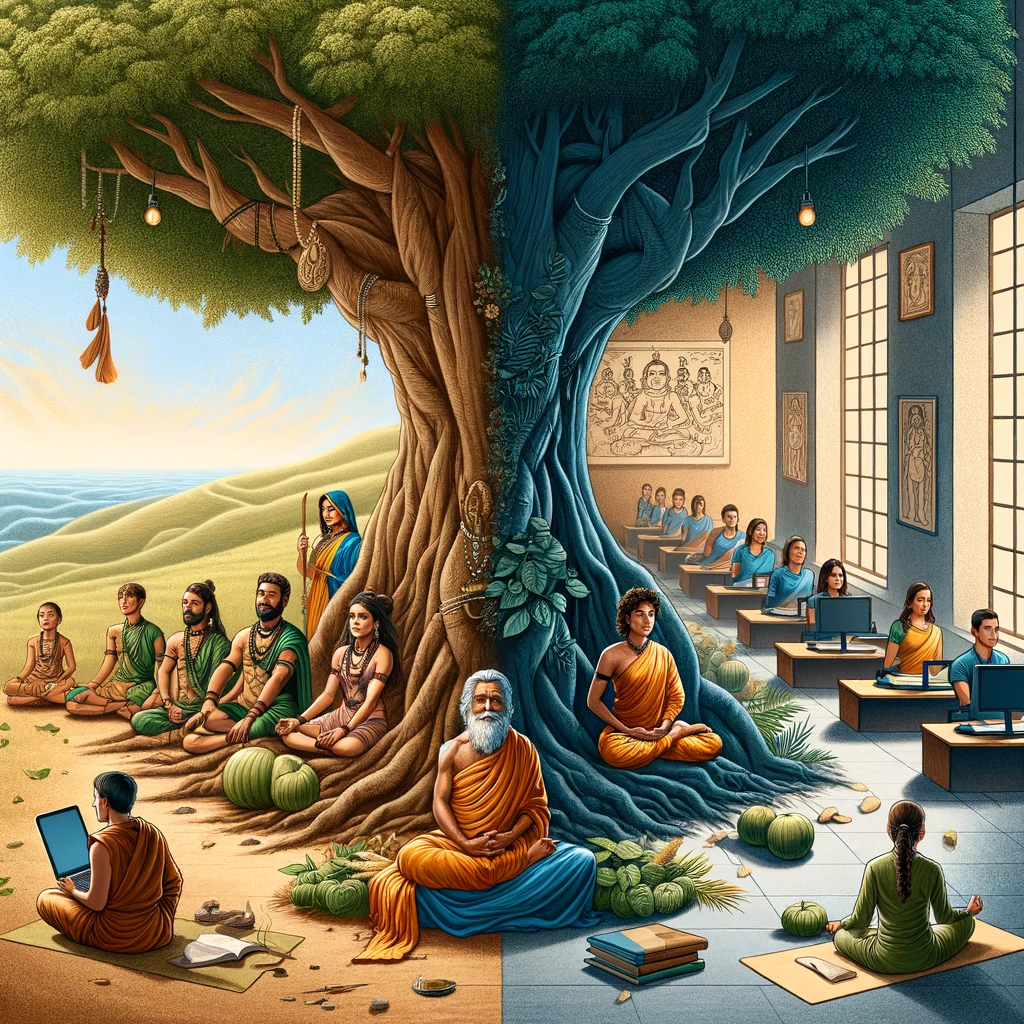
IV. Gurukul 2.0: Time Discipline in a Distracted Age
Why Time, Not Intelligence, Is the Real Constraint
Modern students are not failing due to lack of ability. They are failing due to temporal chaos. Their days are fragmented, overstimulated, and biologically incoherent. Notifications interrupt thought, late-night scrolling destroys sleep, and “flexible schedules” quietly erode rhythm.
The Gurukula solved this problem long before productivity books existed—not by cramming more hours into the day, but by aligning learning with human biology.
Time in the Gurukula was not managed.
It was respected.
The Three Kalas Revisited: A Biological Architecture for Learning
The Gurukula divided the day into qualitative phases, not merely clock hours. These Kalas were aligned with energy, attention, and nervous system states.
Kala | Traditional Meaning | 2026 Application |
Satvik | Clarity, receptivity, inwardness | Walking revision, reflection, journaling, concept integration |
Rajasic | Effort, action, outward engagement | Academics, projects, problem-solving, exams |
Tamasic | Rest, dissolution, recovery | Sleep, silence, stillness, digital detox |
This is not spiritual poetry. It is chronobiology with cultural intelligence.
Attempting heavy conceptual learning during Tamasic phases leads to fatigue. Forcing stillness during Rajasic peaks leads to restlessness. Ignoring Satvik windows results in shallow learning that never integrates.
Chankraman belongs squarely in Satvik time—when the mind is quiet enough to absorb and the body alert enough to sustain attention.
Books and Science That Quietly Agree with the Gurukula
What modern thinkers have rediscovered in isolation, the Gurukula integrated holistically.
- Cal Newport’s Deep Work argues that meaningful learning requires uninterrupted focus blocks. The Gurukula created these blocks through rhythm, not willpower.
- Circadian rhythm research confirms that attention, memory, and emotional regulation fluctuate predictably across the day. Ignoring this is educational malpractice.
- IKS concepts of Dinacharya recognized that when we eat, sleep, study, and rest matters as much as what we do.
In short, discipline is not restriction—it is cognitive compassion.
Gurukul 2.0: Using AI Without Being Used by It
Technology is not the enemy. Unregulated stimulation is.
A Gurukul 2.0 approach uses AI as a silent assistant, never as a dopamine dealer or authority figure.
Practical, ethical applications:
- AI timers to structure walking revision sessions (20–30 minutes)
- Voice-note recitation checks to verify recall accuracy during Chankraman
- Progress tracking without gamification—no streaks, no badges, no addiction loops
What is deliberately excluded:
- Infinite scroll
- Algorithmic “motivation”
- Notifications that fracture attention
AI should serve rhythm, not destroy it. The moment a tool hijacks attention, it ceases to be educational.
A Discipline That Frees, Not Constrains
Students often resist discipline because modern systems weaponize it—using fear, comparison, and punishment. The Gurukula used discipline as protection.
When time is structured around natural energy cycles:
- Focus becomes easier
- Learning becomes deeper
- Anxiety reduces without therapy
- Memory stabilizes under pressure
This is not about waking up at 4 AM or following rituals blindly.
It is about aligning learning with how humans actually function.

V. Beyond Textbooks: Trilateral Human Development
Why Single-Dimensional Education Always Breaks Humans
Modern education makes a dangerous assumption:
if the mind is trained, the human being will automatically be prepared for life.
History, psychology, and lived experience all disagree.
A person can be technically skilled yet emotionally unstable.
Highly literate yet ethically hollow.
Digitally fluent yet physically dysregulated.
The Gurukula never made this mistake. It recognized that a human being is not a brain with accessories, but a three-layered system requiring balanced development. This gave rise to a trilateral model of education—one that modern systems are only now rediscovering in fragments.
1. Apara Vidya: Worldly Skills (Necessary but Insufficient)
Apara Vidya refers to all forms of instrumental knowledge—skills that help us function, earn, and participate in society.
This includes:
- Literacy and numeracy
- Scientific and technological competence
- Professional and career-oriented skills
Modern education overwhelmingly prioritizes this domain—and then wonders why students feel empty, anxious, or morally confused.
Apara Vidya answers the question:
How do I survive and succeed in the world?
But it cannot answer:
- Why should I succeed?
- At what cost?
- Who am I becoming in the process?
When education stops here, it produces efficient operators, not wise humans.
2. Para Vidya: Self-Knowledge (The Missing Core)
Para Vidya is knowledge of the self—not as personality labels or motivational slogans, but as inner governance.
It develops:
- Emotional regulation rather than emotional repression
- Ethical clarity rather than rule-following
- Identity stability rather than external validation dependence
Practices such as silence, reflection, journaling, contemplation, and guided inquiry were not optional extras in the Gurukula. They were essential technologies for inner literacy.
This layer answers the question:
Who is the one who knows, chooses, and acts?
Without Para Vidya, intelligence becomes dangerous. Ambition becomes ruthless. Success becomes hollow.
This is why modern systems produce high performers who quietly burn out—or implode ethically when pressure peaks.
3. Kayika Vidya: Embodied Intelligence (The Forgotten Foundation)
Kayika Vidya is education of the body—not for aesthetics or athletics, but for stability, dignity, and regulation.
It includes:
- Gardening, cleaning, crafts, and manual work
- Yoga, breathwork, and conscious walking (Chankraman)
These practices teach:
- Patience without preaching
- Responsibility without lectures
- Humility without humiliation
The body learns before the intellect consents. When hands work, the ego softens. When breath steadies, emotions follow. When movement becomes rhythmic, thought becomes coherent.
Modern education outsourced this domain to “PT periods” and extracurriculars—stripping it of dignity and continuity.
The Gurukula placed it at the center.
Why This Model Works (And Why It Is Returning)
This trilateral approach is no longer “alternative.” It is quietly endorsed across disciplines:
- NEP 2020 mandates experiential, vocational, and holistic learning—not as add-ons, but as structural reforms.
- Montessori and Waldorf systems echo the same insight: cognition matures through movement, rhythm, and purposeful activity.
- Modern somatic psychology confirms that emotional regulation and learning capacity are body-dependent, not mind-only phenomena.
What the Gurukula knew intuitively, modern science now proves experimentally.
The Hard Line Education Must Cross in 2026
If education develops skills without character, it produces threats.
If it develops ambition without embodiment, it produces collapse.
If it develops knowledge without self-knowledge, it produces confusion.
Trilateral development is not idealistic—it is preventative.
And at the center of this triangle sits Chankraman:
the quiet practice that synchronizes mind, body, and values—one step at a time.

VI. Yoga as Cognitive and Moral Infrastructure
Not Fitness—Governance of the Mind
Modern education has domesticated yoga into a lifestyle accessory—stretching routines, flexibility goals, and Instagram aesthetics. In doing so, it has stripped yoga of its original and most powerful purpose: the governance of the human mind.
In the Gurukula, yoga was not an “activity.” It was infrastructure—as essential as language or arithmetic. Its role was simple and uncompromising:
If the mind is unstable, no learning is reliable.
Yoga addressed this instability systematically, through three interlocking domains.
Asana: Nervous System Regulation
Asana was never about physical prowess. It was about creating a body that can sit, stand, walk, and act without internal noise.
Regular asana practice:
- Regulates the autonomic nervous system
- Reduces chronic fight-or-flight activation
- Improves posture, breathing capacity, and circulation
A regulated body produces a receptive brain. Without this foundation, attention fractures easily and stress accumulates invisibly.
In practical terms, asana prepares the student for:
- Sustained concentration
- Calm recall under pressure
- Reduced restlessness during study and exams
Pranayama: Impulse Control and Emotional Stability
Breath is the fastest interface between body and mind. The Gurukula treated breath not as a relaxation tool, but as a training lever for impulse control.
Pranayama practices:
- Slow down reactive emotional loops
- Increase tolerance for discomfort and uncertainty
- Restore cognitive clarity during stress
This is not philosophy. Modern research confirms that controlled breathing directly influences emotional regulation and executive function.
A student who can regulate breath can:
- Pause before reacting
- Recover quickly from mistakes
- Maintain clarity in high-pressure environments
This is the difference between panic-driven performance and composed competence.
Yama–Niyama: The Ethical Spine
Cognition without ethics produces clever harm.
Discipline without values produces burnout.
The Yamas and Niyamas were the moral operating system of Gurukula education. They shaped:
- Integrity under competition
- Respect without surveillance
- Self-restraint without repression
Truthfulness, non-violence, moderation, cleanliness, and contentment were not taught as moral theory. They were lived constraints that stabilized identity and reduced internal conflict.
When values are embodied, comparison decreases. Aggression softens. Focus deepens.
High-Stress Use Cases: Where Yoga Proves Its Worth
In modern education, stress is not an exception—it is the default. Yoga becomes most valuable not in calm environments, but when pressure peaks.
Pre-Exam Anxiety
Asana and pranayama lower physiological arousal, preventing memory collapse and blank-outs.
Emotional Resilience
Students trained in self-regulation recover faster from failure and criticism.
Reducing Aggression and Comparison
Ethical grounding combined with bodily awareness reduces the compulsive need to outperform peers at the cost of self-worth.
Yoga does not make students passive.
It makes them unshakeable.
The Uncomfortable Truth for Educators
You cannot teach clarity to a dysregulated nervous system.
You cannot demand ethics from an unregulated ego.
You cannot expect resilience from a body trained only to sit still.
Yoga, in its original form, is not optional enrichment.
It is cognitive and moral infrastructure.
And when integrated with Chankraman, it creates students who can think clearly, act ethically, and endure pressure without breaking.

VII. The Relationship Framework: Education Is Human Before It Is Institutional
The Truth Modern Systems Avoid
No education system—ancient or modern—has ever succeeded at scale without first succeeding at relationships.
Curricula do not teach.
Platforms do not mentor.
Institutions do not care.
Humans do.
The Gurukula understood a principle that modern schooling has tried to engineer away:
Learning is a relational act before it is an intellectual one.
When relationship collapses, education becomes coercive. When trust exists, learning accelerates almost effortlessly.
Guru–Shishya: Education as Secure Attachment
The Guru in the Gurukula was not primarily an instructor or evaluator. The Guru was a witness—to effort, struggle, growth, and character.
- Teacher as witness, not examiner
Evaluation existed, but it was embedded in daily observation, correction, and encouragement—not episodic judgment. - Learning accelerates under trust
When a student feels seen rather than surveilled, curiosity replaces fear. Questions deepen. Risk-taking becomes safe.
Modern psychology now confirms what the Gurukula practiced intuitively: secure attachment enhances cognitive exploration. A student learns faster when the nervous system is not braced against humiliation or rejection.
Freire warned that education without relationship becomes oppression. The Gurukula ensured that education remained dialogical, humane, and reciprocal.
Why 300 Is the Upper Limit: The Mathematics of Belonging
Scale is the silent killer of education quality.
Anthropologist Robin Dunbar identified a cognitive limit—approximately 150–300 stable relationships that humans can meaningfully maintain. Beyond this, connection thins, accountability fades, and anonymity takes over.
The Gurukula respected this limit instinctively.
- Accountability emerges naturally in small, stable communities
- Belonging becomes identity, not branding
- Discipline becomes internal, not enforced
Modern mega-schools and universities often exceed this limit by orders of magnitude—and then spend enormous resources on surveillance, discipline, and motivational theater to compensate.
The cost of ignoring human scale is always paid in alienation and disengagement.
Economics with Ethics: Knowledge Is Daan, Not Commodity
Perhaps the most radical aspect of the Gurukula was its economic model.
Knowledge was not sold.
It was offered.
- Education as daan cultivated gratitude, humility, and responsibility in the learner
- Community-supported education ensured sustainability without commodification
- Teachers were supported, not pressured to perform for metrics
This model did not eliminate economics—it embedded economics within ethics.
In a modern context, this translates to:
- CSR-supported learning ecosystems
- Alumni contributions rooted in gratitude, not obligation
- Parents as partners, not customers
Once education becomes a product, students become consumers—and meaning evaporates.
A Hard Question for 2026
If a student does not feel known, they will not grow.
If a teacher is reduced to a service provider, they will disengage.
If a school treats families as customers, it will lose its soul.
Education is human before it is institutional.
The Gurukula was not perfect—but it was profoundly aligned with human psychology, social scale, and ethical economics.
Final Provocation
If a child cannot walk and think clearly for twenty uninterrupted minutes,
no syllabus revision, no AI tutor, no exam strategy will rescue them.
This is not an exaggeration. It is a diagnostic test.
A mind that collapses without a chair, a screen, or constant stimulation is not educated—it is conditioned. A nervous system that panics the moment pressure rises is not weak—it is untrained. An education that produces toppers who cannot regulate breath, posture, or impulse is not successful—it is unfinished.
The Gurukula offered a ruthless but compassionate standard:
Can you carry knowledge in your body, not just in your notebook?
Walking while learning is not symbolic. It is proof of integration.
When thought remains coherent in motion, when memory survives mild exertion, when breath stays steady under recall—learning has crossed from theory into capability.
So the instruction is embarrassingly simple, and that is why it is ignored:
Stand up. Walk. Learn. Become.
No app required.
No subscription needed.
No permission necessary.
Participate and Donate to MEDA Foundation
If you believe education must build whole humans—not burnt-out achievers, then this philosophy must move beyond articles into lived ecosystems.
MEDA Foundation is actively working to create self-sustaining, inclusive learning models—especially for neurodiverse individuals, unemployed youth, and underserved communities. These are environments where dignity precedes degrees, where embodiment precedes examination, and where people are taught to help themselves—and then help others.
Your participation, mentorship, and donations are not charity.
They are investments in human stability.
- You help create employment, not dependency
- You support autism-inclusive education grounded in dignity
- You enable learning systems that align body, mind, and purpose
If we want fewer broken adults, we must fund better childhoods and saner education.
Book References (Indicative)
- Taittiriya Upanishad — Holistic education and character formation
- Chandogya Upanishad — Sá Vidyá Yá Vimuktaye
- The Body Keeps the Score — Bessel van der Kolk
- Spark: The Revolutionary New Science of Exercise and the Brain — John Ratey
- Make It Stick — Brown, Roediger, McDaniel
- Deep Work — Cal Newport
- Range — David Epstein
- Pedagogy of the Oppressed — Paulo Freire
- NCERT & Indian Knowledge Systems (IKS) Framework Documents
- NEP 2020 Policy Papers
Education does not need more screens.
It needs more humans who can stand upright—physically, mentally, and morally.
Everything else is decoration.
