Tag: #EmbodiedCognition

  • Handwritten Mind Thinks Deeper, Learns Longer, and Ages Better

    Handwritten Mind Thinks Deeper, Learns Longer, and Ages Better

    Handwriting is not a nostalgic skill but a biologically grounded cognitive technology that shapes how human beings think, remember, regulate emotions, and construct meaning across a lifetime. By engaging widespread neural networks, slowing thought just enough to enable understanding, and anchoring ideas in embodied experience, writing by hand strengthens memory, deepens learning, supports emotional regulation, and preserves cognitive resilience from childhood through old age. In contrast, an overreliance on screens trades speed for shallowness, storage for sense-making, and convenience for long-term mental strength. A simple, daily ten-minute handwriting practice emerges as a powerful, low-cost intervention—one that restores human texture in a digital world and protects the core capacities that make learning, wisdom, and dignity possible.

    ಹಸ್ತಲಿಪಿ ಬರವಣಿಗೆ ಒಂದು ನೆನಪಿನ ಕೌಶಲ್ಯ ಮಾತ್ರವಲ್ಲ; ಅದು ಮಾನವ ಮೆದುಳಿನೊಂದಿಗೆ ಆಳವಾಗಿ ಜೋಡಿಸಲ್ಪಟ್ಟಿರುವ ಜೈವಿಕ ಜ್ಞಾನತಂತ್ರಜ್ಞಾನವಾಗಿದೆ. ಕೈಯಿಂದ ಬರೆಯುವ ಪ್ರಕ್ರಿಯೆ ಮೆದುಳಿನ ಅನೇಕ ನರವಲಯಗಳನ್ನು ಸಕ್ರಿಯಗೊಳಿಸಿ, ಚಿಂತನೆಗೆ ಅಗತ್ಯವಾದ ನಿಧಾನತೆಯನ್ನು ನೀಡುತ್ತದೆ, ಅರ್ಥಗ್ರಹಣವನ್ನು ಗಾಢಗೊಳಿಸುತ್ತದೆ, ಸ್ಮರಣಶಕ್ತಿಯನ್ನು ಬಲಪಡಿಸುತ್ತದೆ ಹಾಗೂ ಭಾವನಾತ್ಮಕ ಸಮತೋಲನ ಮತ್ತು ಜೀವನಪೂರ್ಣ ಕಲಿಕೆಯನ್ನು ಬೆಂಬಲಿಸುತ್ತದೆ. ಇದಕ್ಕೆ ವಿರುದ್ಧವಾಗಿ, ಪರದೆಗಳ ಮೇಲಿನ ಅತಿಯಾದ ಅವಲಂಬನೆ ವೇಗಕ್ಕಾಗಿ ಆಳತೆಯನ್ನು ತ್ಯಜಿಸಿ, ಅರ್ಥಕ್ಕಿಂತ ಸಂಗ್ರಹಣೆಯನ್ನು ಪ್ರಧಾನ ಮಾಡುತ್ತದೆ ಮತ್ತು ದೀರ್ಘಕಾಲೀನ ಮಾನಸಿಕ ಬಲವನ್ನು ಕುಗ್ಗಿಸುತ್ತದೆ. ಪ್ರತಿದಿನ ಕೇವಲ ಹತ್ತು ನಿಮಿಷ ಕೈಯಿಂದ ಬರೆಯುವ ಸರಳ ಅಭ್ಯಾಸವು ಕಡಿಮೆ ವೆಚ್ಚದಾದರೂ ಅತ್ಯಂತ ಪರಿಣಾಮಕಾರಿ ಮಾರ್ಗವಾಗಿ ಹೊರಹೊಮ್ಮುತ್ತದೆ—ಇದು ಡಿಜಿಟಲ್ ಯುಗದಲ್ಲಿ ಮಾನವೀಯ ಸ್ಪರ್ಶವನ್ನು ಮರಳಿ ತಂದು, ಕಲಿಕೆ, ಜ್ಞಾನ ಮತ್ತು ಗೌರವವನ್ನು ಉಳಿಸುವ ಮೂಲ ಸಾಮರ್ಥ್ಯಗಳನ್ನು ಸಂರಕ್ಷಿಸುತ್ತದೆ.

    I. Writing as a Human Survival Technology

    1. The Core Truth (Tell It Like It Is)

    Handwriting is not nostalgia, not a romantic indulgence, and certainly not a stubborn refusal to “move with the times.” It is a biological upgrade embedded into human cognition, shaped by thousands of years of co-evolution between the hand, the eye, and the thinking brain. Long before it was a cultural artifact, writing by hand was a cognitive survival tool—a way to externalize memory, stabilize knowledge, transmit wisdom, and make sense of a chaotic world.

    In contrast, our current trajectory is clear and uncomfortable. By outsourcing writing almost entirely to screens, we are trading speed for shallowness. Digital tools optimize for velocity, volume, and convenience. The human brain, however, optimizes for meaning, pattern, and integration. When speed dominates, depth is the first casualty. When convenience becomes the primary design principle, cognitive erosion quietly follows.

    Typing allows thoughts to spill out faster than they can be processed. Handwriting forces a pause—a fraction of a second where the mind must decide what is worth preserving. That pause is not inefficiency; it is cognition doing its job. It is the brain compressing reality into understanding. Remove that pause consistently, and thinking becomes flatter, more reactive, and less coherent over time.

    This is why ten minutes of handwriting daily is not a “nice habit” or a productivity hack. It is preventive mental healthcare. Just as walking protects cardiovascular health and resistance training preserves muscle mass, handwriting protects the neural systems responsible for memory, attention, emotional regulation, and meaning-making. Ignore it long enough, and decline is not dramatic—but it is predictable.

    The uncomfortable truth is this: we did not evolve to think at keyboard speed. We evolved to think at hand speed.

    2. What Is Really at Stake

    The erosion of handwriting is not about losing cursive or penmanship aesthetics. What is truly at stake is far more fundamental:

    • Memory depth
    • Conceptual clarity
    • Emotional regulation
    • Lifelong learning capacity

    These are not academic luxuries. They are the core capabilities that allow human beings to remain adaptive, resilient, and humane in complex environments.

    For children, the loss is structural. When handwriting is removed too early, children lose the neural scaffolding required for literacy itself. Writing letters by hand helps wire the brain for reading, spelling, sequencing, and mathematical reasoning. Without this embodied foundation, learning becomes brittle—dependent on recognition rather than understanding, memorization rather than mastery.

    For adults, the loss is existential. Handwriting is one of the last remaining practices that slows thought enough to allow meaning-making. Without it, adults increasingly consume information without digesting it, react without reflecting, and communicate without clarity. The result is not ignorance, but confusion—plenty of data, very little wisdom.

    For seniors, the cost is cruelly accelerated. As natural neural decline begins, handwriting serves as a maintenance protocol for cognitive resilience. Remove it, and memory fades faster, attention narrows sooner, and emotional balance becomes harder to sustain. What might have been a gradual transition becomes an unnecessary collapse.

    Across all ages, the pattern is the same: when handwriting disappears, thinking becomes thinner, memory becomes fragile, and identity becomes harder to hold together.

    This is why framing handwriting as optional enrichment is a mistake. It is not enrichment. It is infrastructure—quiet, low-cost, human infrastructure that supports the mind across an entire lifetime.

    Ignore it, and we don’t just lose a skill.
    We lose a way of thinking.

    Free Vectors | Illustration of an old woman/elderly studying hard

    II. Why This Article Matters Now

    Intended Audience

    This article is written for those who shape minds, systems, and futures—often without fully realizing the quiet forces that sustain them.

    It speaks first to parents and educators, who are under constant pressure to “modernize” learning while silently watching attention spans shrink and comprehension weaken. Many sense that something essential is being lost, yet lack a clear, evidence-based language to defend what appears old-fashioned.

    It addresses students and lifelong learners, navigating an age of infinite information but diminishing understanding. Speed has become a proxy for intelligence; output has replaced insight. This article invites learners to reclaim depth as a competitive and personal advantage.

    It is meant for knowledge workers and leaders whose effectiveness depends not on how quickly they respond, but on how well they think. In environments dominated by screens, meetings, and dashboards, handwriting offers a rare cognitive refuge—a place where clarity, strategy, and foresight can still emerge.

    It is equally relevant to seniors and caregivers, for whom cognitive maintenance is no longer abstract. As memory, attention, and emotional regulation become fragile, handwriting stands out as one of the few low-risk, low-cost, dignity-preserving practices that meaningfully support mental health.

    Finally, it is directed at NGOs, policymakers, and social entrepreneurs—those responsible for designing interventions at scale. In a world obsessed with expensive, high-tech solutions, handwriting represents an overlooked, human-centered lever capable of delivering disproportionate impact across education, rehabilitation, and inclusion.

    Purpose of the Article

    The first purpose of this article is to reframe handwriting as a cognitive amplifier, not a dying or decorative skill. Writing by hand does not compete with technology; it complements and stabilizes it. Without this distinction, digital adoption becomes reckless rather than strategic.

    Second, the article aims to provide evidence-based clarity amidst digital hype. The promise of tablets, AI, and keyboards has been loudly marketed; their cognitive trade-offs have not. This piece separates enthusiasm from evidence, trend from truth.

    Third, it offers a simple, scalable daily practice—ten minutes of handwriting—that requires no apps, subscriptions, or specialized training. In an age of complex solutions, simplicity is not a weakness; it is the point.

    Finally, the article seeks to inspire systemic adoption. Handwriting should not survive as a private hobby or nostalgic act. It belongs in:

    • classrooms as a learning accelerator,
    • homes as a stabilizing ritual,
    • rehabilitation programs as a cognitive and emotional anchor.

    This is not about individual optimization alone. It is about collective cognitive resilience.

    The Central Provocation

    If handwriting disappeared tomorrow, human thinking would indeed become faster—and shallower.

    We would process more information, but understand less. We would record more, but remember less. We would communicate more frequently, but with diminishing coherence and emotional depth. The loss would not be immediate or dramatic. It would be gradual, quiet, and largely misattributed to stress, aging, or distraction—when in fact the cognitive infrastructure had been quietly dismantled.

    The warning signs are already visible. Roughly 40% of young people now struggle with sustained handwriting, not because they lack intelligence or ability, but because the practice was removed before the brain systems supporting it were fully established. We did not replace handwriting with something better; we replaced it with something faster.

    This article challenges a deeply uncomfortable assumption of the digital age:
    that newer automatically means wiser.

    It argues instead for a more mature position—one that recognizes that human cognition has limits, needs textures, and requires friction to grow strong.

    What follows is not a rejection of technology, but a recalibration of priorities.

    Free Vectors | Old man studying hard / elderly

    III. The Neuroscience of Handwriting: Why the Brain Responds Differently

    1. The Brain Is Not a Keyboard

    The human brain did not evolve to interact with flat, uniform keys. It evolved to learn through movement, sensation, and spatial interaction. This distinction matters far more than most technology debates acknowledge.

    When a person writes by hand, the brain does not operate in isolated modules. Instead, it activates a distributed, integrated network that includes:

    • The motor cortex, which plans and executes fine-grained hand movements
    • The visual cortex, which continuously tracks letter shape, spacing, and orientation
    • Somatosensory regions, which process pressure, texture, and proprioceptive feedback
    • The hippocampus, responsible for encoding experiences into long-term memory
    • The prefrontal cortex, which governs attention, sequencing, and executive control

    This is not incidental activation. It is orchestrated engagement. Each letter written becomes a multisensory event—seen, felt, adjusted, and cognitively evaluated in real time.

    Typing, by comparison, narrows neural involvement. The same repetitive motor action produces uniform characters, regardless of intention or context. Visual variation is minimal. Tactile feedback is blunt. The brain is reduced to a transcription device, capturing information without deeply processing it.

    This difference explains why typed notes can look impressive yet leave little trace in memory, while messy handwritten notes often remain vividly recallable. One engages the whole brain; the other primarily engages the fingers.

    In short, the brain is not a keyboard—and treating it like one has consequences.

    2. Brain Wave Dynamics

    Beyond which regions are activated, handwriting also alters how the brain synchronizes itself.

    Electroencephalogram (EEG) studies conducted by researchers at institutions such as the Norwegian University of Science and Technology (NTNU) and the University of Washington reveal a consistent pattern: handwriting produces stronger, more coherent neural oscillations than typing.

    Two brain wave patterns are especially relevant:

    • Theta waves, associated with learning, novelty detection, and memory encoding
    • Alpha waves, linked to reflection, integration, and long-term memory consolidation

    During handwriting, these waves are not merely present; they are synchronized across regions, suggesting that information is being processed holistically rather than fragmented across tasks.

    Typing, on the other hand, often correlates with more scattered activity—sufficient for execution, but weak for integration. The brain is busy, but not deeply engaged.

    This distinction is critical. Learning is not just about exposure to information. It is about the brain entering a state where new material can be meaningfully absorbed, connected, and retained. Handwriting reliably induces that state. Typing does not.

    3. The Action–Perception Loop

    At the heart of handwriting’s power lies what neuroscientists call the action–perception loop.

    When writing with a pen on paper, action and perception are inseparable. The eyes follow the tip of the pen. The hand adjusts pressure, speed, and direction. The brain continuously evaluates the emerging shape and corrects it. Thought, movement, and perception occur at the same spatial point, at the same moment.

    This creates:

    • Immediate sensory feedback
    • Micro-adjustments in movement
    • Spatial anchoring of thought on the page

    Each word occupies a physical location. Each idea has a shape, a size, a position relative to others. Memory attaches not just to the concept, but to its embodied trace.

    Typing breaks this loop. The hands act in one place; the letters appear elsewhere. The movement is abstract, the feedback delayed and uniform. Thought floats, unanchored, easily overwritten.

    As a result, handwritten ideas become embodied memory—experienced, not merely recorded. Typed text, by contrast, remains largely transient, optimized for storage rather than understanding.

    The implication is clear and uncomfortable: when we remove the body from thinking, the mind remembers less.

    Handwriting works because it refuses to separate cognition from physical reality.

    Signature moves: are we losing the ability to write by hand? | Technology |  The Guardian

    IV. Memory and Recall: Why Slower Processing Wins

    1. The “Desirable Difficulty” Principle

    One of the most counterintuitive findings in cognitive science is that learning improves when it is slightly harder. Psychologists call this desirable difficulty—a level of challenge that slows the learner just enough to force engagement, without overwhelming the system.

    Handwriting naturally creates this condition.

    Because writing by hand is slower than typing, the brain cannot afford to capture everything. It must make decisions in real time. This forces three critical cognitive operations:

    • Selection – deciding what actually matters
    • Compression – reducing ideas to their essential form
    • Interpretation – translating information into one’s own mental language

    Each of these operations strengthens memory traces. The brain is not copying; it is constructing understanding.

    Typing, by contrast, encourages verbatim capture. Fingers can keep up with speech or thought faster than comprehension can. Information is recorded without being processed, creating the illusion of learning while bypassing the mechanisms that make learning durable.

    This is why typed notes often look complete and impressive, yet feel strangely empty when revisited. They are records, not representations. Handwritten notes, though incomplete and imperfect, are cognitively alive.

    2. Recall and Transfer

    The difference between handwriting and typing is not subtle, and it is not anecdotal. It has been measured repeatedly.

    In a series of influential studies by Pam Mueller and Daniel Oppenheimer (Princeton and UCLA), students who took handwritten notes consistently outperformed laptop note-takers on tests of free recall. More importantly, when asked conceptual questions—those requiring understanding, inference, and application—handwriters scored 12% to 20% higher.

    This advantage persisted even when typists were explicitly instructed not to transcribe verbatim. The medium itself shaped the thinking.

    Why does this matter? Because real-world competence depends far more on transfer than recall. The ability to apply ideas in new contexts, connect concepts across domains, and reason under uncertainty is what separates knowledge from wisdom.

    Handwriting slows the hand—but in doing so, it sharpens the mind. It creates space for thought to mature before it is recorded, increasing the likelihood that information will be retrievable and usable later.

    3. External Memory, Internal Meaning

    Handwriting also changes the role of memory itself.

    When writing on paper, the page becomes an external hippocampus—a stable, spatially organized extension of memory. The brain no longer needs to store every detail. Instead, it can focus on higher-order functions:

    • Pattern recognition
    • Insight generation
    • Conceptual synthesis

    This division of labor is crucial. Human cognition works best when memory is partially offloaded in ways that preserve meaning and structure, not just data. Paper does this elegantly. It holds ideas still long enough for the brain to walk around them, connect them, and re-enter them from different angles.

    Digital text, by contrast, is fluid, searchable, and endlessly editable—but often spatially and emotionally flat. It is excellent for storage, poor for sense-making.

    In essence, handwriting frees the brain from hoarding facts and invites it to do what it does best: think.

    Slower processing is not a flaw.
    It is the gateway to understanding.

    Newberry Library | A Show of Hands: Handwriting in the Age of Print

    V. Across the Lifespan: One Tool, Many Benefits

    Handwriting is one of the rare cognitive practices that remains developmentally relevant from early childhood to late adulthood. Its value does not diminish with age; it changes form. At every life stage, handwriting supports the brain in precisely the ways that stage demands.

    1. Childhood: Wiring the Reading Brain

    For children, handwriting is not an accessory to learning—it is part of the biological wiring process.

    When children write letters by hand, they are not merely practicing motor skills. They are building neural links between:

    • visual symbols (what a letter looks like),
    • sounds (what it represents),
    • and movements (how it is formed).

    This triad is foundational to:

    • Letter recognition
    • Phonemic awareness
    • Fine motor precision

    Neuroscience research shows that children who learn letters through handwriting activate reading-related brain regions more strongly and more consistently than those who learn through typing or tracing alone. These early sensorimotor experiences become the scaffolding on which fluent reading, spelling, and even mathematical reasoning are built.

    Children who write letters by hand do not just read earlier—they read faster and comprehend better. Remove handwriting too soon, and literacy becomes fragile, dependent on recognition rather than understanding. The result is a generation that can decode text but struggles to truly absorb it.

    This is not a failure of intelligence. It is a failure of method.

    2. Adolescents and Adults: Academic and Professional Edge

    As learners mature, handwriting shifts from a developmental necessity to a cognitive advantage.

    Meta-analyses across university populations reveal a consistent pattern:

    • Approximately 40% of students who take handwritten notes achieve A or B grades
    • Compared to roughly 30% of those who rely primarily on digital note-taking

    The difference is not explained by effort or motivation alone. It is explained by how thinking is shaped during learning.

    Handwriting enhances:

    • Focus, by reducing multitasking and cognitive noise
    • Idea synthesis, by forcing summarization and prioritization
    • Long-form thinking, the ability to hold and develop complex ideas over time

    In professional environments, this advantage becomes even more pronounced. Strategy, leadership, and problem-solving rarely emerge from speed. They emerge from structured reflection, something handwriting quietly but reliably supports.

    Long-form thinking is increasingly rare, not because people lack intelligence, but because the tools they use discourage it. Handwriting remains one of the few practices that actively protects depth in an age of distraction.

    3. Seniors: Cognitive Reserve and Dignity

    In later life, handwriting takes on a different role: cognitive maintenance and dignity preservation.

    Regular handwriting has been shown to:

    • Maintain neural connectivity
    • Slow aspects of cognitive decline
    • Preserve autobiographical memory, the sense of a coherent life narrative

    For seniors, especially those experiencing Mild Cognitive Impairment (MCI) or early-stage dementia, structured handwriting activities—such as journaling, letter writing, or calligraphy—offer measurable benefits. These include improvements in working memory, attentional control, and emotional stability.

    Importantly, handwriting-based interventions are non-invasive, low-cost, and empowering. They allow individuals to participate actively in their own cognitive care, rather than being treated as passive recipients of treatment.

    There is dignity in this. Writing affirms identity. It says: I am still here. I can still leave a trace.

    Across the lifespan, the message is consistent:
    handwriting adapts because the human brain adapts.
    One tool, many benefits—quiet, persistent, and profoundly human.

    Line art of hand writing notes in book | Premium Vector

    VI. Emotional and Psychological Benefits (Often Ignored)

    In discussions about handwriting, emotional and psychological effects are often treated as secondary—soft benefits compared to memory or academic performance. This is a mistake. In reality, emotional regulation and meaning-making are foundational to all higher cognition. Without them, memory fragments, attention collapses, and learning becomes unsustainable.

    Handwriting quietly supports these deeper systems.

    1. Writing as Emotional Regulation

    Human emotions move faster than conscious thought. When left unprocessed, they accumulate as anxiety, rumination, and cognitive overload. Handwriting interrupts this spiral.

    Research on expressive writing consistently shows that journaling reduces anxiety, dampens rumination, and helps individuals regain emotional balance. The mechanism is not catharsis alone; it is structure. Writing forces diffuse emotional states into linear form—one word after another, one line at a time.

    Handwriting, in particular, slows emotional reactivity. The physical act of forming letters introduces a natural delay between feeling and expression. This delay is not suppression; it is regulation. It gives the prefrontal cortex time to engage, reducing impulsive responses and restoring perspective.

    Over time, this practice restores narrative coherence—the ability to tell a clear story about what is happening and why it matters. People who can narrate their experiences coherently cope better with stress, adapt more effectively to change, and recover faster from setbacks.

    In simple terms: when emotions are written by hand, they become manageable.

    2. Identity and Meaning

    Beyond regulation, handwriting supports something even more fundamental: identity continuity.

    Writing helps people:

    • Re-author life stories, especially during periods of confusion or transition
    • Process trauma by giving shape to experiences that resist verbal expression
    • Anchor values, clarifying what matters amid noise and pressure

    These functions are not abstract. They are deeply practical. A person who cannot make sense of their own story struggles to make decisions, sustain motivation, or trust their judgment.

    Handwriting is particularly powerful for:

    • Neurodiverse individuals, who often benefit from slower, more embodied forms of expression
    • Adolescents, whose identities are still forming and easily destabilized by social and digital pressure
    • Seniors facing loss or transition, for whom writing becomes a way to preserve meaning, memory, and selfhood

    In these contexts, handwriting is not therapy in the clinical sense. It is something older and more human: a way of staying in relationship with oneself.

    When writing disappears, people do not just lose a skill.
    They lose a mirror.

    And without a mirror, both emotional health and moral clarity begin to fade.

    1,126 Elderly Hands Writing Stock Photos - Free & Royalty-Free Stock Photos  from Dreamstime

    VII. The 10-Minute Daily Pen: A Practical Protocol

    The power of handwriting does not lie in intensity or volume. It lies in consistency. The goal is not to write beautifully or profoundly every day, but to show up long enough for the brain to engage its full circuitry. Ten minutes is the smallest unit of time that reliably does this without triggering resistance.

    1. Why 10 Minutes Works

    Ten minutes works because it respects human psychology.

    First, it creates low resistance. Most people will avoid practices that feel demanding, open-ended, or perfection-driven. Ten minutes feels manageable. It lowers the psychological barrier to starting, which is often the hardest part.

    Second, it delivers a high neurological payoff. Within a few minutes of handwriting, sensorimotor, attentional, and memory networks are already active. By the ten-minute mark, the brain has shifted into a state conducive to learning, reflection, and emotional regulation. Longer sessions are beneficial, but unnecessary for baseline cognitive maintenance.

    Third, it is sustainable across ages and abilities. Children can participate without fatigue. Adults can fit it into crowded schedules. Seniors can engage without cognitive overload. A practice that cannot be sustained eventually becomes irrelevant, no matter how effective it is in theory.

    Ten minutes is not arbitrary. It is strategically humane.

    2. Simple Daily Formats

    The content of the writing matters far less than the act itself. Variety prevents boredom and supports different cognitive functions. Some effective formats include:

    • Morning intention list
      Writing a short list of priorities or intentions aligns attention and reduces cognitive scatter before the day begins.
    • Gratitude lines
      One or two handwritten lines of appreciation recalibrate emotional tone and counteract negativity bias.
    • Free-flow journaling
      Writing continuously without editing allows thoughts and emotions to surface and organize themselves.
    • Memory recall
      Recalling events from yesterday, childhood moments, or significant life experiences strengthens autobiographical memory and narrative coherence.
    • Storytelling (real or imagined)
      Creating stories activates imagination, empathy, and long-form thinking—capacities increasingly underused in digital environments.

    These formats can rotate. Repetition is helpful, but rigidity is not. The goal is engagement, not routine compliance.

    3. Keep It Human, Not Perfect

    Perfection is the fastest way to kill this practice.

    There should be:

    • No grammar policing
    • No aesthetic pressure
    • No comparison

    Messy handwriting is not a flaw; it is evidence of thinking in motion. Spelling errors do not weaken the effect; self-censorship does.

    The goal of the 10-minute daily pen is neural engagement, not literary excellence. It is about activating the brain’s learning, memory, and regulation systems—not producing content for judgment.

    In an age obsessed with optimization, this protocol succeeds precisely because it resists it.

    Pick up a pen.
    Write for ten minutes.
    Stop before it becomes burdensome.

    Consistency will do the rest.

    Writing builds resilience by changing your brain, helping you face everyday  challenges

    VIII. Reclaiming Human Texture in a Digital World

    The question is no longer whether digital tools are useful. That debate is settled. The real question is whether, in our enthusiasm for efficiency, we have forgotten the conditions under which human beings think well.

    Handwriting forces us to confront that question honestly.

    1. Technology Is a Tool, Not a Replacement

    Screens are exceptional at what they are designed to do. They optimize:

    • speed,
    • scale,
    • storage,
    • and transmission.

    They are unmatched for efficiency. But efficiency is not wisdom.

    Pens, on the other hand, cultivate something quieter and harder to measure:

    • reflection,
    • coherence,
    • judgment,
    • and meaning.

    Technology accelerates output. Handwriting deepens input.

    The mistake of the digital age is not adoption—it is substitution. We did not add screens to human practices; we replaced human practices with screens. In doing so, we assumed that cognition would remain unchanged. It has not.

    The correct relationship is sequential, not competitive:

    • Think by hand first
    • Execute digitally later

    This order preserves depth while still benefiting from technological reach. Reverse it, and thinking becomes reactive, fragmented, and increasingly outsourced.

    We do not need less technology.
    We need better boundaries.

    2. The Real Choice

    When stripped of hype and habit, the choice becomes stark and unavoidable.

    Do we want:

    • Faster inputs, or deeper understanding?
    • Infinite storage, or meaningful memory?
    • Convenience today, or cognitive strength tomorrow?

    These are not abstract trade-offs. They show up in classrooms where students skim but cannot explain. In workplaces where information flows freely but insight is scarce. In lives where people are constantly busy yet increasingly unsure of what matters.

    Reclaiming handwriting is not an act of resistance. It is an act of rebalancing.

    Human intelligence evolved with friction, rhythm, and embodiment. Remove those elements entirely, and efficiency rises—but wisdom erodes.

    The pen restores texture.
    Texture restores meaning.

    And meaning, in the end, is what allows human beings—not machines—to remain fully awake in a digital world.


    Final Invitation

    Participate and Donate to MEDA Foundation

    If this article has made one thing clear, it is this: the most powerful cognitive interventions are not always complex, expensive, or high-tech. Often, they are simple, human, and quietly transformative.

    MEDA Foundation works precisely in this space.

    Across communities and age groups, MEDA Foundation actively strives to:

    • Strengthen cognitive independence from childhood through old age
    • Support neurodiverse individuals, including those with autism and learning challenges, with dignity and practicality
    • Promote low-cost, high-impact practices—such as handwriting, journaling, and embodied learning—within education, rehabilitation, and community programs

    This work is not theoretical. It is grounded, scalable, and urgently needed in a world where cognitive fragility is rising faster than we care to admit.

    You can be part of this effort:

    • 👉 Participate as a volunteer, educator, researcher, mentor, or program designer
    • 👉 Donate to help scale handwriting-based cognitive empowerment initiatives across schools, learning centers, and rehabilitation ecosystems

    Your support helps preserve something essential: the human capacity to think clearly, remember deeply, and live with agency.

    (Because sometimes the most effective solutions are not futuristic—they are profoundly human.)

    Book References (Anchor Texts)

    For readers who wish to explore the research and ideas underlying this work, the following books provide strong intellectual foundations:

    • The Shallows — Nicholas Carr
    • Moonwalking with Einstein — Joshua Foer
    • Make It Stick — Brown, Roediger, McDaniel
    • The Writing Brain — Virginia Berninger
    • Spark — John J. Ratey
    • How We Learn — Benedict Carey
    • The Extended Mind — Annie Murphy Paul

    These works collectively reinforce a central truth: how we learn, write, and remember shapes who we become.

    Pick up a pen.
    Give your brain ten honest minutes.

    And if you believe in human dignity, learning equity, and cognitive independence,
    support MEDA Foundation—where simple practices are transforming real lives.


  • The Forgotten Gurukula Lesson for 2026

    The Forgotten Gurukula Lesson for 2026

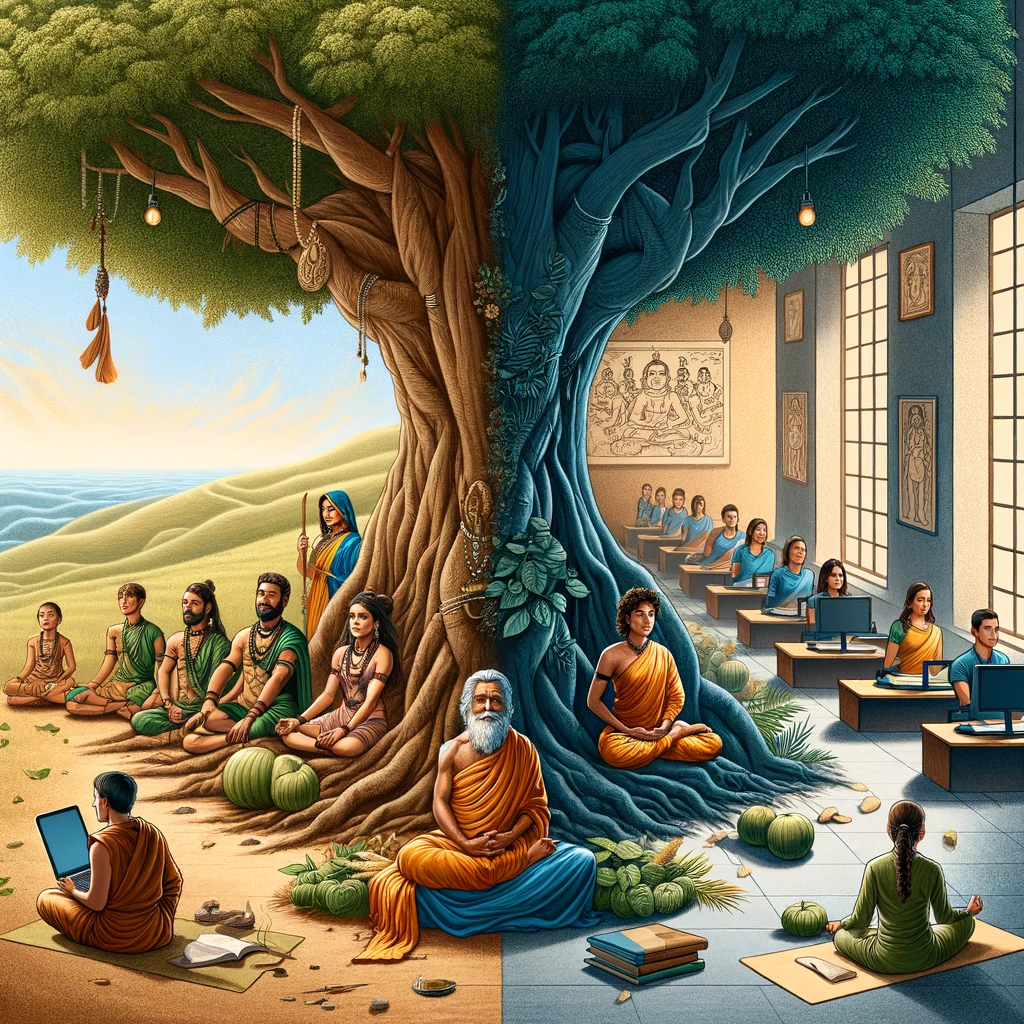
    Education in 2026 stands at a breaking point where cognitive overload, emotional fragility, and ethical drift have replaced clarity, resilience, and character. True learning is revealed not through accumulation of information but through liberation of the mind, body, and values—an insight long understood by the Gurukula system and now validated by neuroscience. Practices such as Chankraman—learning through disciplined walking—restore attention, memory, and emotional regulation by aligning learning with human biology, while time discipline, yoga, and trilateral development integrate worldly skills, self-knowledge, and embodied intelligence. When education is rooted in relationships, ethical economics, and human-scale communities, it produces calm minds under pressure, self-directed learners, and service-oriented citizens rather than anxious job seekers. The ultimate measure of education is simple and uncompromising: the ability to think clearly in motion, act ethically under stress, and contribute responsibly to the well-being of society.

    2026ರ ಶಿಕ್ಷಣ ವ್ಯವಸ್ಥೆ ಗಂಭೀರ ಸಂಕಟದ ಹಂತದಲ್ಲಿದೆ; ಇಲ್ಲಿ ಜ್ಞಾನಾಭಿವೃದ್ಧಿಯ ಬದಲು ಅತಿಯಾದ ಮಾಹಿತಿ ಭಾರ, ಭಾವನಾತ್ಮಕ ಅಸ್ಥಿರತೆ ಮತ್ತು ನೈತಿಕ ದಿಕ್ಕು ತಪ್ಪುವುದು ಹೆಚ್ಚಾಗಿದೆ. ನಿಜವಾದ ಕಲಿಕೆ ಎಂದರೆ ಮಾಹಿತಿಯ ಸಂಗ್ರಹವಲ್ಲ, ಮನಸ್ಸು–ದೇಹ–ಮೌಲ್ಯಗಳ ಮುಕ್ತತೆ ಎಂಬುದನ್ನು ಗುರುಕುಲ ಪದ್ಧತಿ ಹಿಂದೆಯೇ ಅರಿತಿದ್ದು, ಇಂದಿನ ನರವಿಜ್ಞಾನವೂ ಇದನ್ನು ದೃಢಪಡಿಸುತ್ತದೆ. ಚಂಕ್ರಮಣ ಎಂಬಂತೆ ನಡೆಯುತ್ತಾ ಕಲಿಯುವ ಅಭ್ಯಾಸಗಳು ಕಲಿಕೆಯನ್ನು ಮಾನವ ಜೈವಿಕತೆಯೊಂದಿಗೆ ಹೊಂದಾಣಿಕೆ ಮಾಡಿ ಗಮನಶಕ್ತಿ, ಸ್ಮರಣೆ ಮತ್ತು ಭಾವನ ನಿಯಂತ್ರಣವನ್ನು ಪುನಃ ಸ್ಥಾಪಿಸುತ್ತವೆ; ಅದೇ ಸಮಯದಲ್ಲಿ ಕಾಲಶಿಸ್ತು, ಯೋಗ ಮತ್ತು ತ್ರೈಮುಖ ಅಭಿವೃದ್ಧಿ ಲೋಕಜ್ಞಾನ, ಆತ್ಮಜ್ಞಾನ ಮತ್ತು ದೇಹಜ ಬುದ್ಧಿಮತ್ತೆಯನ್ನು ಏಕೀಕರಿಸುತ್ತವೆ. ಶಿಕ್ಷಣವು ಸಂಬಂಧಗಳು, ನೈತಿಕ ಆರ್ಥಿಕತೆ ಮತ್ತು ಮಾನವೀಯ ಪ್ರಮಾಣದ ಸಮುದಾಯಗಳಲ್ಲಿ ನೆಲೆಯೂರಿದಾಗ, ಅದು ಆತಂಕಪಡುವ ಉದ್ಯೋಗಾರ್ಥಿಗಳ ಬದಲು ಒತ್ತಡದ ನಡುವೆಯೂ ಶಾಂತ ಮನಸ್ಸುಳ್ಳ, ಸ್ವಯಂಪ್ರೇರಿತ ಕಲಿಯುವ ಮತ್ತು ಸಮಾಜಸೇವೆಗೆ ಬದ್ಧ ನಾಗರಿಕರನ್ನು ರೂಪಿಸುತ್ತದೆ. ಶಿಕ್ಷಣದ ಅಂತಿಮ ಮಾನದಂಡ ಸರಳವೂ ಕಟ್ಟುನಿಟ್ಟಾದದ್ದೂ ಆಗಿದೆ: ಚಲನೆಯಲ್ಲಿಯೇ ಸ್ಪಷ್ಟವಾಗಿ ಯೋಚಿಸುವುದು, ಒತ್ತಡದಲ್ಲಿಯೇ ನೈತಿಕವಾಗಿ ಕಾರ್ಯನಿರ್ವಹಿಸುವುದು ಮತ್ತು ಸಮಾಜದ ಕಲ್ಯಾಣಕ್ಕೆ ಹೊಣೆಗಾರಿಕೆಯಿಂದ ಕೊಡುಗೆ ನೀಡುವುದು.

    The ONLY Gurukula Lesson You Need in 2026: Why Movement, Meaning, and Mentorship Will Decide the Future of Education

    I. Introduction: Intended Audience, Purpose, and the 2026 Crisis

    Why This One Lesson Changes Everything

    Education in 2026 will not collapse due to lack of information. It will collapse under the weight of exhausted minds, dysregulated emotions, and ethically unanchored ambition.
    Syllabi are expanding, AI tutors are improving, and access to content is unprecedented—yet students are more anxious, distracted, and mentally fatigued than any generation before them. This is not a content problem. It is a human capacity problem.

    The forgotten Gurukula lesson of Chankraman—learning through disciplined walking—appears almost trivial at first glance. Walk and learn? In an age of AI copilots and adaptive testing? Yet this single practice quietly corrects multiple failures of modern education at once. It restores attention in a distracted age, embodiment in a sedentary system, memory in an anxious mind, ethics in a competitive culture, and humility in a performance-obsessed world.

    If modern education continues to treat students as disembodied brains strapped to chairs, force-feeding them information while ignoring posture, breath, rhythm, and meaning, no reform will succeed. Not NEP 2020. Not AI-powered classrooms. Not revised assessment rubrics. You cannot upgrade software on a system whose hardware is overheating and misaligned.

    The future belongs to embodied learners, mentored humans, and values-driven citizens—not exam-performing machines.
    And the Gurukula understood this long before neuroscience caught up.

    Intended Audience

    This article speaks to those who are already sensing that something is deeply wrong—but may not yet have the language or framework to articulate it clearly:

    • CBSE & ICSE students (Classes 8–12) who feel mentally heavy, restless, anxious, and unable to concentrate despite “studying all the time.”
    • Parents overwhelmed by exam anxiety, torn between supporting their children and pushing them harder out of fear.
    • Teachers, school leaders, and education reformers who know that pedagogy has become mechanical, transactional, and emotionally bankrupt.
    • Policy thinkers aligned with NEP 2020 and the Indian Knowledge System (IKS) seeking practical, implementable bridges between ancient wisdom and modern constraints.
    • Social entrepreneurs and NGOs in education who want scalable, low-cost, human-centered interventions that actually work on the ground.

    This is not an abstract philosophy piece. It is for people who must act inside broken systems without breaking the child.

    Purpose of the Article

    The purpose of this article is precise and unapologetic:

    To demonstrate that one neglected Gurukula practice—learning by walking—addresses the modern education crisis more effectively than most policy reforms, and to offer a practical, science-backed, culturally rooted blueprint that can be applied immediately in 2026 classrooms, homes, hostels, and self-study routines.

    This is not nostalgia.
    This is not spiritual romanticism.
    This is not anti-technology rhetoric.

    It is a systems correction—using the body to stabilize the mind so that learning can once again become humane, effective, and liberating.

    The 2026 Education Crisis: What We Are Refusing to Name

    Modern education is producing measurable outcomes—but unmeasurable damage.

    • Cognitive overload without comprehension
      Students consume vast quantities of information but retain little wisdom. Memory is shallow, fragmented, and panic-prone.
    • Digital addiction masquerading as “smart learning”
      Screens promise efficiency but deliver overstimulation, dopamine dysregulation, and reduced attention spans.
    • Rising anxiety, ADHD-like symptoms, and burnout
      What is often diagnosed as pathology is frequently a predictable response to unnatural learning environments.
    • Education reduced to credential manufacturing
      Degrees have replaced discernment. Marks have replaced meaning. Speed has replaced depth.

    The system is not broken—it is working exactly as designed, and that is the problem.

    The Ancient Remedy We Abandoned Too Quickly

    The Gurukula system never separated learning, living, and becoming.
    Education was not preparation for life—it was life.

    Its goal was not literacy alone, but liberation (vimukti):

    • Liberation from confusion
    • Liberation from fear
    • Liberation from dependency
    • Liberation from unexamined ambition

    Movement, discipline, rhythm, service, silence, and mentorship were not “extras.” They were the infrastructure of learning.

    Chankraman sits at the heart of this worldview—not as exercise, but as a cognitive, ethical, and spiritual alignment practice.

    Gurukula in the Age of AI: Why Rooted Education Matters More Than Ever

    II. Sá Vidyá Yá Vimuktaye: Redefining Education Itself

    From Accumulation to Liberation

    At its deepest level, Indian thought makes a radical claim that modern education has quietly abandoned:
    education is not meant to make you knowledgeable—it is meant to make you free.

    The phrase Sá Vidyá Yá Vimuktaye does not describe education as accumulation, certification, or employability. It defines education as liberation from confusion, fear, and dependency. A truly educated person is not the one who knows the most, but the one who needs the least external validation to think, decide, and act wisely.

    Modern schooling, by contrast, has slid into what can only be described as information obesity. Students are force-fed content far beyond their capacity to digest it. Notes pile up. Tabs remain open. Videos autoplay. Yet clarity decreases. Confidence erodes. Independent thinking weakens.

    We have confused knowing more with being better equipped to live.
    The result is a generation that is academically busy, emotionally brittle, and existentially unsure.

    Liberative education asks a harder question:

    Can the student stand steady under pressure, think clearly in uncertainty, and act ethically without supervision?

    If the answer is no, the education has failed—regardless of marks.

    Relevant Textual Roots: How the Gurukula Structured Knowing

    The Gurukula system did not rush learning. It layered it deliberately through a three-stage cognitive and experiential process:

    1. Shravana – Receiving Knowledge

    This was not passive listening. It was attentive reception in a calm, regulated state—often accompanied by rhythmic recitation and movement. The nervous system was settled before the intellect was engaged.

    2. Manana – Reflecting and Questioning

    Students were encouraged to walk, discuss, repeat, and test ideas internally. Understanding was not assumed just because something was heard. Confusion was treated as a legitimate phase, not a weakness.

    3. Nididhyasana – Internalization and Living the Knowledge

    True learning occurred only when knowledge shaped behavior, values, and identity. If it did not change how one lived, it was considered incomplete.

    This mirrors what modern cognitive science now confirms: learning that does not move through reflection and embodiment remains fragile and easily collapses under stress.

    The Bhagavad Gita reinforces this orientation with surgical clarity:
    Yogah Karmasu Kaushalam—Yoga is skill in action.

    Education, therefore, is not about withdrawal from life into theory. It is about acting with clarity, steadiness, and ethical intelligence in the middle of complexity. Knowledge that cannot survive action is ornamental. Knowledge that guides action is liberating.

    The Modern Parallel: Science Catches Up with Shastra

    What ancient systems articulated intuitively, neuroscience now documents empirically.

    • Stressed minds cannot integrate knowledge.
      Chronic anxiety, fear of failure, and time pressure activate survival circuits in the brain, impairing memory consolidation and higher-order thinking.
    • Learning requires safety, rhythm, and embodiment.
      When the body is regulated—through movement, breath, and predictable rhythms—the brain becomes receptive. Memory deepens. Insight emerges.

    In other words, education fails not because students are incapable, but because learning environments are biologically hostile.

    The Gurukula did not “motivate” students with rewards and punishments. It designed conditions where learning could naturally take root—through movement, mentorship, repetition, and meaning.

    India's Gurukul Education System: A Forgotten Legacy with Modern Relevance

    III. The Core Practice: Chankraman (Learning by Walking)

    What It Is: A Practice So Simple We Dismissed It

    Chankraman is the disciplined practice of memorization, recitation, and reflection while walking slowly and rhythmically. Not pacing in agitation. Not multitasking. But deliberate, conscious movement aligned with thought.

    This method was not an anomaly—it was standard operating procedure across multiple wisdom traditions:

    • Vedic education, where students memorized thousands of verses through walking recitation
    • Buddhist monasteries, where kinhin (walking meditation) balanced seated practice
    • Gurukulas, where pathways, courtyards, and forest trails were learning spaces, not recreational afterthoughts

    Learning happened in motion, in rhythm, and in relationship with breath. The body was not treated as a transport vehicle for the brain—it was an active partner in cognition.

    Contrast this with the modern classroom: rigid chairs, bent spines, compressed diaphragms, frozen limbs—and we wonder why attention collapses after 20 minutes.

    Why It Works: Where Science Finally Meets Shastra

    What ancient educators designed through observation and lived experience is now supported by contemporary neuroscience and psychology.

    1. Increased Cerebral Blood Flow

    Walking increases oxygen and nutrient delivery to the brain. This improves alertness without overstimulation—clarity without anxiety. John Ratey’s work demonstrates that even mild movement significantly enhances learning readiness.

    2. Bilateral Brain Activation

    Walking is a cross-lateral activity. Each step subtly engages both hemispheres of the brain, creating neural coherence. This improves recall, pattern recognition, and integration—critical for subjects involving sequences, concepts, and relationships.

    3. Reduced Amygdala Hijack

    Movement regulates the nervous system. As Bessel van der Kolk documents, the body must feel safe before the mind can think clearly. Walking reduces threat signals, lowering panic and performance anxiety—especially vital during revision and exam preparation.

    4. Stronger Hippocampal Encoding

    The hippocampus—central to memory and learning—responds positively to movement. Information learned while walking is encoded more robustly, making recall under pressure far more reliable.

    This is the essence of embodied cognition:

    We do not learn with the brain alone. We learn with the whole organism.

    The Gurukula understood this. Neuroscience merely translated it into modern language.

    Why Sitting Is the New Smoking (For Students)

    The comparison is not rhetorical. Prolonged sitting is now recognized as biologically disruptive—and for students, cognitively destructive.

    • Postural fatigue leads to mental fog
      Collapsed posture restricts breathing, reduces oxygenation, and dulls alertness. The mind interprets physical stagnation as fatigue.
    • Static learning creates false confidence
      Silent reading while seated often produces an illusion of understanding. Recognition is mistaken for recall. Until the student stands, moves, and retrieves the information actively, learning remains untested and fragile.
    • Panic during exams is the price of unintegrated memory
      Knowledge learned in a stressed, motionless state often fails under pressure. The mind goes blank not because the student did not study—but because the learning was never embodied.

    Chankraman exposes weak learning early and strengthens it naturally. When a student can walk, speak, recall, and think simultaneously, the knowledge is no longer theoretical—it is owned.

    A Hard Truth for 2026

    If a student cannot recall a concept while walking calmly, they do not truly know it.

    And if an education system cannot allow students to stand, move, and breathe while learning, it is not preparing them for life—it is training them for compliance.

    Chankraman is not a nostalgic ritual.
    It is cognitive engineering through movement.

    Ancient Gurukul Influence on Modern Education

    IV. Gurukul 2.0: Time Discipline in a Distracted Age

    Why Time, Not Intelligence, Is the Real Constraint

    Modern students are not failing due to lack of ability. They are failing due to temporal chaos. Their days are fragmented, overstimulated, and biologically incoherent. Notifications interrupt thought, late-night scrolling destroys sleep, and “flexible schedules” quietly erode rhythm.

    The Gurukula solved this problem long before productivity books existed—not by cramming more hours into the day, but by aligning learning with human biology.

    Time in the Gurukula was not managed.
    It was respected.

    The Three Kalas Revisited: A Biological Architecture for Learning

    The Gurukula divided the day into qualitative phases, not merely clock hours. These Kalas were aligned with energy, attention, and nervous system states.

    Kala

    Traditional Meaning

    2026 Application

    Satvik

    Clarity, receptivity, inwardness

    Walking revision, reflection, journaling, concept integration

    Rajasic

    Effort, action, outward engagement

    Academics, projects, problem-solving, exams

    Tamasic

    Rest, dissolution, recovery

    Sleep, silence, stillness, digital detox

    This is not spiritual poetry. It is chronobiology with cultural intelligence.

    Attempting heavy conceptual learning during Tamasic phases leads to fatigue. Forcing stillness during Rajasic peaks leads to restlessness. Ignoring Satvik windows results in shallow learning that never integrates.

    Chankraman belongs squarely in Satvik time—when the mind is quiet enough to absorb and the body alert enough to sustain attention.

    Books and Science That Quietly Agree with the Gurukula

    What modern thinkers have rediscovered in isolation, the Gurukula integrated holistically.

    • Cal Newport’s Deep Work argues that meaningful learning requires uninterrupted focus blocks. The Gurukula created these blocks through rhythm, not willpower.
    • Circadian rhythm research confirms that attention, memory, and emotional regulation fluctuate predictably across the day. Ignoring this is educational malpractice.
    • IKS concepts of Dinacharya recognized that when we eat, sleep, study, and rest matters as much as what we do.

    In short, discipline is not restriction—it is cognitive compassion.

    Gurukul 2.0: Using AI Without Being Used by It

    Technology is not the enemy. Unregulated stimulation is.

    A Gurukul 2.0 approach uses AI as a silent assistant, never as a dopamine dealer or authority figure.

    Practical, ethical applications:

    • AI timers to structure walking revision sessions (20–30 minutes)
    • Voice-note recitation checks to verify recall accuracy during Chankraman
    • Progress tracking without gamification—no streaks, no badges, no addiction loops

    What is deliberately excluded:

    • Infinite scroll
    • Algorithmic “motivation”
    • Notifications that fracture attention

    AI should serve rhythm, not destroy it. The moment a tool hijacks attention, it ceases to be educational.

    A Discipline That Frees, Not Constrains

    Students often resist discipline because modern systems weaponize it—using fear, comparison, and punishment. The Gurukula used discipline as protection.

    When time is structured around natural energy cycles:

    • Focus becomes easier
    • Learning becomes deeper
    • Anxiety reduces without therapy
    • Memory stabilizes under pressure

    This is not about waking up at 4 AM or following rituals blindly.
    It is about aligning learning with how humans actually function.

    Education Was Supposed to Give Us a Spine, But Are We Even Using It? In  ancient India, the Gurukul system was designed to shape human beings, not  just students. It taught us

    V. Beyond Textbooks: Trilateral Human Development

    Why Single-Dimensional Education Always Breaks Humans

    Modern education makes a dangerous assumption:
    if the mind is trained, the human being will automatically be prepared for life.

    History, psychology, and lived experience all disagree.

    A person can be technically skilled yet emotionally unstable.
    Highly literate yet ethically hollow.
    Digitally fluent yet physically dysregulated.

    The Gurukula never made this mistake. It recognized that a human being is not a brain with accessories, but a three-layered system requiring balanced development. This gave rise to a trilateral model of education—one that modern systems are only now rediscovering in fragments.

    1. Apara Vidya: Worldly Skills (Necessary but Insufficient)

    Apara Vidya refers to all forms of instrumental knowledge—skills that help us function, earn, and participate in society.

    This includes:

    • Literacy and numeracy
    • Scientific and technological competence
    • Professional and career-oriented skills

    Modern education overwhelmingly prioritizes this domain—and then wonders why students feel empty, anxious, or morally confused.

    Apara Vidya answers the question:

    How do I survive and succeed in the world?

    But it cannot answer:

    • Why should I succeed?
    • At what cost?
    • Who am I becoming in the process?

    When education stops here, it produces efficient operators, not wise humans.

    2. Para Vidya: Self-Knowledge (The Missing Core)

    Para Vidya is knowledge of the self—not as personality labels or motivational slogans, but as inner governance.

    It develops:

    • Emotional regulation rather than emotional repression
    • Ethical clarity rather than rule-following
    • Identity stability rather than external validation dependence

    Practices such as silence, reflection, journaling, contemplation, and guided inquiry were not optional extras in the Gurukula. They were essential technologies for inner literacy.

    This layer answers the question:

    Who is the one who knows, chooses, and acts?

    Without Para Vidya, intelligence becomes dangerous. Ambition becomes ruthless. Success becomes hollow.

    This is why modern systems produce high performers who quietly burn out—or implode ethically when pressure peaks.

    3. Kayika Vidya: Embodied Intelligence (The Forgotten Foundation)

    Kayika Vidya is education of the body—not for aesthetics or athletics, but for stability, dignity, and regulation.

    It includes:

    • Gardening, cleaning, crafts, and manual work
    • Yoga, breathwork, and conscious walking (Chankraman)

    These practices teach:

    • Patience without preaching
    • Responsibility without lectures
    • Humility without humiliation

    The body learns before the intellect consents. When hands work, the ego softens. When breath steadies, emotions follow. When movement becomes rhythmic, thought becomes coherent.

    Modern education outsourced this domain to “PT periods” and extracurriculars—stripping it of dignity and continuity.

    The Gurukula placed it at the center.

    Why This Model Works (And Why It Is Returning)

    This trilateral approach is no longer “alternative.” It is quietly endorsed across disciplines:

    • NEP 2020 mandates experiential, vocational, and holistic learning—not as add-ons, but as structural reforms.
    • Montessori and Waldorf systems echo the same insight: cognition matures through movement, rhythm, and purposeful activity.
    • Modern somatic psychology confirms that emotional regulation and learning capacity are body-dependent, not mind-only phenomena.

    What the Gurukula knew intuitively, modern science now proves experimentally.

    The Hard Line Education Must Cross in 2026

    If education develops skills without character, it produces threats.
    If it develops ambition without embodiment, it produces collapse.
    If it develops knowledge without self-knowledge, it produces confusion.

    Trilateral development is not idealistic—it is preventative.

    And at the center of this triangle sits Chankraman:
    the quiet practice that synchronizes mind, body, and values—one step at a time.

    Gurukul : ancient education system of India

    VI. Yoga as Cognitive and Moral Infrastructure

    Not Fitness—Governance of the Mind

    Modern education has domesticated yoga into a lifestyle accessory—stretching routines, flexibility goals, and Instagram aesthetics. In doing so, it has stripped yoga of its original and most powerful purpose: the governance of the human mind.

    In the Gurukula, yoga was not an “activity.” It was infrastructure—as essential as language or arithmetic. Its role was simple and uncompromising:

    If the mind is unstable, no learning is reliable.

    Yoga addressed this instability systematically, through three interlocking domains.

    Asana: Nervous System Regulation

    Asana was never about physical prowess. It was about creating a body that can sit, stand, walk, and act without internal noise.

    Regular asana practice:

    • Regulates the autonomic nervous system
    • Reduces chronic fight-or-flight activation
    • Improves posture, breathing capacity, and circulation

    A regulated body produces a receptive brain. Without this foundation, attention fractures easily and stress accumulates invisibly.

    In practical terms, asana prepares the student for:

    • Sustained concentration
    • Calm recall under pressure
    • Reduced restlessness during study and exams

    Pranayama: Impulse Control and Emotional Stability

    Breath is the fastest interface between body and mind. The Gurukula treated breath not as a relaxation tool, but as a training lever for impulse control.

    Pranayama practices:

    • Slow down reactive emotional loops
    • Increase tolerance for discomfort and uncertainty
    • Restore cognitive clarity during stress

    This is not philosophy. Modern research confirms that controlled breathing directly influences emotional regulation and executive function.

    A student who can regulate breath can:

    • Pause before reacting
    • Recover quickly from mistakes
    • Maintain clarity in high-pressure environments

    This is the difference between panic-driven performance and composed competence.

    Yama–Niyama: The Ethical Spine

    Cognition without ethics produces clever harm.
    Discipline without values produces burnout.

    The Yamas and Niyamas were the moral operating system of Gurukula education. They shaped:

    • Integrity under competition
    • Respect without surveillance
    • Self-restraint without repression

    Truthfulness, non-violence, moderation, cleanliness, and contentment were not taught as moral theory. They were lived constraints that stabilized identity and reduced internal conflict.

    When values are embodied, comparison decreases. Aggression softens. Focus deepens.

    High-Stress Use Cases: Where Yoga Proves Its Worth

    In modern education, stress is not an exception—it is the default. Yoga becomes most valuable not in calm environments, but when pressure peaks.

    Pre-Exam Anxiety

    Asana and pranayama lower physiological arousal, preventing memory collapse and blank-outs.

    Emotional Resilience

    Students trained in self-regulation recover faster from failure and criticism.

    Reducing Aggression and Comparison

    Ethical grounding combined with bodily awareness reduces the compulsive need to outperform peers at the cost of self-worth.

    Yoga does not make students passive.
    It makes them unshakeable.

    The Uncomfortable Truth for Educators

    You cannot teach clarity to a dysregulated nervous system.
    You cannot demand ethics from an unregulated ego.
    You cannot expect resilience from a body trained only to sit still.

    Yoga, in its original form, is not optional enrichment.
    It is cognitive and moral infrastructure.

    And when integrated with Chankraman, it creates students who can think clearly, act ethically, and endure pressure without breaking.

    Facebook

    VII. The Relationship Framework: Education Is Human Before It Is Institutional

    The Truth Modern Systems Avoid

    No education system—ancient or modern—has ever succeeded at scale without first succeeding at relationships.

    Curricula do not teach.
    Platforms do not mentor.
    Institutions do not care.

    Humans do.

    The Gurukula understood a principle that modern schooling has tried to engineer away:

    Learning is a relational act before it is an intellectual one.

    When relationship collapses, education becomes coercive. When trust exists, learning accelerates almost effortlessly.

    Guru–Shishya: Education as Secure Attachment

    The Guru in the Gurukula was not primarily an instructor or evaluator. The Guru was a witness—to effort, struggle, growth, and character.

    • Teacher as witness, not examiner
      Evaluation existed, but it was embedded in daily observation, correction, and encouragement—not episodic judgment.
    • Learning accelerates under trust
      When a student feels seen rather than surveilled, curiosity replaces fear. Questions deepen. Risk-taking becomes safe.

    Modern psychology now confirms what the Gurukula practiced intuitively: secure attachment enhances cognitive exploration. A student learns faster when the nervous system is not braced against humiliation or rejection.

    Freire warned that education without relationship becomes oppression. The Gurukula ensured that education remained dialogical, humane, and reciprocal.

    Why 300 Is the Upper Limit: The Mathematics of Belonging

    Scale is the silent killer of education quality.

    Anthropologist Robin Dunbar identified a cognitive limit—approximately 150–300 stable relationships that humans can meaningfully maintain. Beyond this, connection thins, accountability fades, and anonymity takes over.

    The Gurukula respected this limit instinctively.

    • Accountability emerges naturally in small, stable communities
    • Belonging becomes identity, not branding
    • Discipline becomes internal, not enforced

    Modern mega-schools and universities often exceed this limit by orders of magnitude—and then spend enormous resources on surveillance, discipline, and motivational theater to compensate.

    The cost of ignoring human scale is always paid in alienation and disengagement.

    Economics with Ethics: Knowledge Is Daan, Not Commodity

    Perhaps the most radical aspect of the Gurukula was its economic model.

    Knowledge was not sold.
    It was offered.

    • Education as daan cultivated gratitude, humility, and responsibility in the learner
    • Community-supported education ensured sustainability without commodification
    • Teachers were supported, not pressured to perform for metrics

    This model did not eliminate economics—it embedded economics within ethics.

    In a modern context, this translates to:

    • CSR-supported learning ecosystems
    • Alumni contributions rooted in gratitude, not obligation
    • Parents as partners, not customers

    Once education becomes a product, students become consumers—and meaning evaporates.

    A Hard Question for 2026

    If a student does not feel known, they will not grow.
    If a teacher is reduced to a service provider, they will disengage.
    If a school treats families as customers, it will lose its soul.

    Education is human before it is institutional.

    The Gurukula was not perfect—but it was profoundly aligned with human psychology, social scale, and ethical economics.

    Final Provocation

    If a child cannot walk and think clearly for twenty uninterrupted minutes,
    no syllabus revision, no AI tutor, no exam strategy will rescue them.

    This is not an exaggeration. It is a diagnostic test.

    A mind that collapses without a chair, a screen, or constant stimulation is not educated—it is conditioned. A nervous system that panics the moment pressure rises is not weak—it is untrained. An education that produces toppers who cannot regulate breath, posture, or impulse is not successful—it is unfinished.

    The Gurukula offered a ruthless but compassionate standard:

    Can you carry knowledge in your body, not just in your notebook?

    Walking while learning is not symbolic. It is proof of integration.
    When thought remains coherent in motion, when memory survives mild exertion, when breath stays steady under recall—learning has crossed from theory into capability.

    So the instruction is embarrassingly simple, and that is why it is ignored:

    Stand up. Walk. Learn. Become.

    No app required.
    No subscription needed.
    No permission necessary.

    Participate and Donate to MEDA Foundation

    If you believe education must build whole humans—not burnt-out achievers, then this philosophy must move beyond articles into lived ecosystems.

    MEDA Foundation is actively working to create self-sustaining, inclusive learning models—especially for neurodiverse individuals, unemployed youth, and underserved communities. These are environments where dignity precedes degrees, where embodiment precedes examination, and where people are taught to help themselves—and then help others.

    Your participation, mentorship, and donations are not charity.
    They are investments in human stability.

    • You help create employment, not dependency
    • You support autism-inclusive education grounded in dignity
    • You enable learning systems that align body, mind, and purpose

    If we want fewer broken adults, we must fund better childhoods and saner education.

    Book References (Indicative)

    • Taittiriya Upanishad — Holistic education and character formation
    • Chandogya UpanishadSá Vidyá Yá Vimuktaye
    • The Body Keeps the Score — Bessel van der Kolk
    • Spark: The Revolutionary New Science of Exercise and the Brain — John Ratey
    • Make It Stick — Brown, Roediger, McDaniel
    • Deep Work — Cal Newport
    • Range — David Epstein
    • Pedagogy of the Oppressed — Paulo Freire
    • NCERT & Indian Knowledge Systems (IKS) Framework Documents
    • NEP 2020 Policy Papers

    Education does not need more screens.
    It needs more humans who can stand upright—physically, mentally, and morally.

    Everything else is decoration.