

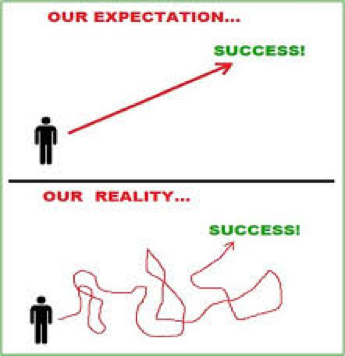
Linear progress feels orderly and reassuring, but in volatile systems it becomes dangerously fragile. Durable performance no longer comes from perfect forecasts, rigid plans, or polished certainty; it comes from shortening feedback loops, treating plans as hypotheses, designing modular structures, rewarding intelligent pivots, and building leadership maturity that tolerates ambiguity without ego defensiveness. In stable environments, optimization compounds advantage — but in unstable ones, responsiveness compounds survival. The real competitive edge is not who predicts best, but who recalibrates fastest, reallocates capital sooner, and converts uncertainty into structured adaptability.
ರೇಖೀಯ ಪ್ರಗತಿ ಕ್ರಮಬದ್ಧವಾಗಿಯೂ ಭರವಸೆಯುತವಾಗಿಯೂ ಕಾಣಿಸಬಹುದು, ಆದರೆ ಅಸ್ಥಿರ ವ್ಯವಸ್ಥೆಗಳಲ್ಲಿ ಅದು ಅಪಾಯಕಾರಿಯಾಗಿ ದುರ್ಬಲವಾಗುತ್ತದೆ. ದೀರ್ಘಕಾಲೀನ ಸಾಧನೆ ಪರಿಪೂರ್ಣ ಮುನ್ಸೂಚನೆಗಳಿಂದಲೂ, ಕಠಿಣ ಯೋಜನೆಗಳಿಂದಲೂ, ಮೆರುಗುಳ್ಳ ಖಚಿತತೆಯಿಂದಲೂ ಬರದು; ಅದು ಪ್ರತಿಕ್ರಿಯಾ ಚಕ್ರಗಳನ್ನು ಕಗ್ಗತ್ತಲಗೊಳಿಸುವುದರಿಂದ, ಯೋಜನೆಗಳನ್ನು ಪರಿಕಲ್ಪನೆಗಳಾಗಿ ಪರಿಗಣಿಸುವುದರಿಂದ, ಘಟಕಾಧಾರಿತ ರಚನೆಗಳನ್ನು ವಿನ್ಯಾಸಗೊಳಿಸುವುದರಿಂದ, ಬುದ್ಧಿವಂತ ದಿಕ್ಕುಬದಲಾವಣೆಗಳನ್ನು ಬಹುಮಾನಿಸುವುದರಿಂದ ಮತ್ತು ಅಸ್ಪಷ್ಟತೆಯನ್ನು ಅಹಂಕಾರರಹಿತವಾಗಿ ಸಹಿಸುವ ನಾಯಕತ್ವ ಪರಿಪಕ್ವತೆಯನ್ನು ನಿರ್ಮಿಸುವುದರಿಂದ ಬರುತ್ತದೆ. ಸ್ಥಿರ ಪರಿಸರಗಳಲ್ಲಿ ಸುಧಾರಣೆ ಸ್ಪರ್ಧಾತ್ಮಕ ಲಾಭವನ್ನು ಹೆಚ್ಚಿಸುತ್ತದೆ — ಆದರೆ ಅಸ್ಥಿರ ಪರಿಸರಗಳಲ್ಲಿ ತ್ವರಿತ ಪ್ರತಿಕ್ರಿಯಾಶೀಲತೆ ಉಳಿವಿನ ಶಕ್ತಿಯನ್ನು ಹೆಚ್ಚಿಸುತ್ತದೆ. ನಿಜವಾದ ಸ್ಪರ್ಧಾತ್ಮಕ ಮುಂಚೂಣಿಯು ಯಾರು ಉತ್ತಮವಾಗಿ ಮುನ್ಸೂಚಿಸುತ್ತಾರೆ ಎಂಬುದಲ್ಲ; ಯಾರು ವೇಗವಾಗಿ ಮರುಸಂಯೋಜಿಸುತ್ತಾರೆ, ಸಂಪನ್ಮೂಲಗಳನ್ನು ಬೇಗ ಮರುಹಂಚಿಕೆ ಮಾಡುತ್ತಾರೆ ಮತ್ತು ಅನಿಶ್ಚಿತತೆಯನ್ನು ಸಂರಚಿತ ಹೊಂದಾಣಿಕೆಗೆ ಪರಿವರ್ತಿಸುತ್ತಾರೆ ಎಂಬುದೇ ಅದಾಗಿದೆ.
The Illusion of Control: Why Linear Progress Often Leads to Strategic Failure
Introduction: The Strategic Illusion
Linear progress is not progress — it is a psychological comfort mechanism. In volatile, complex environments, rigid adherence to sequential milestones creates an illusion of control while increasing fragility. Strategic failure does not arise from lack of planning; it arises from over-commitment to plans designed for stable conditions.
The competitive advantage in 2026 and beyond lies in adaptive capacity, optionality, and nonlinear responsiveness — not in flawless checklist execution.
Intended Audience and Purpose
This article is written for senior leaders, founders, board members, policy strategists, investors, and institutional decision-makers operating in unpredictable environments shaped by technological acceleration, geopolitical uncertainty, AI disruption, and network-driven markets.
Its purpose is threefold:
- To dismantle the assumption that linear progress equals strategic advancement.
- To expose the structural risks embedded in milestone-driven management systems.
- To provide a pragmatic, evidence-based framework for thriving in complex adaptive environments where cause and effect are nonlinear.
This is not an argument against planning. It is an argument against mistaking planning discipline for strategic intelligence.
Opening Provocation
A company can hit every KPI and still collapse. Why? Because it optimized the wrong assumptions.
History has shown this repeatedly. Organizations that execute flawlessly against outdated models do not fail because they lack discipline — they fail because they discipline themselves into irrelevance.
The core tension is unavoidable:
- Planning provides psychological safety.
- Reality evolves independently of your roadmap.
Planning gives leaders clarity, confidence, and communicable direction. It reduces ambiguity. It aligns teams. It creates accountability.
But markets are not obliged to respect your PowerPoint.
The Structural Origin of the Problem
Modern strategic planning frameworks were largely shaped during industrial expansion in the 20th century — an era defined by relatively stable demand curves, slower technological cycles, and high capital barriers to entry. In that environment:
- Forecasting had reasonable reliability.
- Competitive landscapes shifted gradually.
- Scale advantages endured longer.
- Operational efficiency was a durable moat.
Linear cause-and-effect thinking worked because environments were comparatively linear.
Five-year plans, waterfall development models, sequential stage-gate systems — these approaches assumed that:
- The future could be forecast with tolerable error margins.
- Execution quality was the primary variable.
- Environmental shifts would be incremental, not exponential.
Those assumptions no longer hold.
The Digital-Era Discontinuity
Today’s competitive environment is shaped by:
- Platform ecosystems
- Network effects
- AI acceleration
- Real-time information diffusion
- Compressed innovation cycles
- Asymmetric disruption from small entrants
In such systems, small triggers produce disproportionate outcomes. Feedback loops amplify minor shifts. Competitors emerge from adjacent industries without warning.
A meticulously constructed plan can become obsolete within quarters — not years.
Yet organizations continue to reward plan adherence more than signal detection.
The Psychological Trap
Linear roadmaps offer emotional stability. They provide the narrative that leaders are “in control.” Milestones signal progress. Dashboards create visibility. Quarterly targets create momentum.
But when milestone completion becomes the goal, learning stops.
Execution begins to serve the plan rather than the environment.
This is the strategic illusion:
The appearance of order is mistaken for resilience.
And fragility quietly compounds underneath.
The Hidden Cost of Over-Commitment
Over-commitment to sequential milestones creates three forms of risk:
- Cognitive Rigidity – Teams defend assumptions instead of testing them.
- Capital Lock-In – Resources are tied to predefined initiatives long after signals suggest change.
- Political Inertia – Leaders fear revising plans because deviation is interpreted as failure.
The paradox is stark:
The more precisely a plan is executed, the harder it becomes to abandon it.
This is not a failure of intelligence. It is a structural bias built into how we design accountability systems.
The New Strategic Imperative
In nonlinear environments, control does not come from prediction accuracy.
It comes from adaptation speed.
Competitive advantage now belongs to entities that:
- Shorten feedback loops
- Preserve optionality
- Design modular strategies
- Reward intelligent pivots
- Treat assumptions as provisional
The leaders who will dominate 2026 and beyond will not be those who perfect linear execution.
They will be those who build systems capable of absorbing uncertainty without collapsing into chaos.
The remainder of this article will explore how to make that transition — practically, structurally, and psychologically.

III. Why the Human Brain Prefers Straight Lines
If linear strategy persists despite repeated market disruptions, it is not because leaders are naive. It is because linear thinking aligns with deep cognitive architecture. To build adaptive organizations, we must first understand the psychological machinery that makes straight lines so seductive.
- Cognitive Bias Toward Sequential Order
Humans are neurologically optimized for pattern recognition and causal inference. Sequential order reduces cognitive load. When events follow a predictable chain, the brain conserves energy and increases perceived certainty.
We are wired to prefer:
- Predictable sequences – Step A leads to Step B leads to Step C.
- Clear causality – Action produces proportionate outcome.
- Completion satisfaction – Tasks closed, milestones achieved, loops finished.
Linear plans reduce uncertainty anxiety because they simulate a stable environment. When leaders create roadmaps, timelines, and cascading deliverables, they are not merely organizing work — they are regulating collective anxiety.
Predictability produces calm.
Calm produces confidence.
Confidence is easily mistaken for control.
But cognitive ease does not equal strategic validity.
Sequential order works exceptionally well in environments where cause and effect are stable. Manufacturing assembly lines are predictable. Regulatory compliance procedures are predictable. Accounting cycles are predictable.
Markets, however, are not assembly lines.
When volatility increases, sequential logic begins to fracture. Yet the brain continues to crave it. This creates a structural mismatch between how we think and how systems behave.
- The Dopamine of Completion
Completion triggers neurochemical reward pathways. The act of checking a box, advancing a progress bar, or achieving a quarterly milestone activates the brain’s reinforcement circuitry. That sensation feels like progress — even when strategic position has not improved.
This creates a dangerous managerial distortion.
Checklists and dashboards can signal forward motion even when:
- Learning has stalled – Assumptions remain untested.
- Market relevance is declining – Customers have shifted behavior.
- Assumptions remain unchallenged – Early hypotheses harden into doctrine.
In many organizations, reporting systems reward execution velocity rather than adaptive intelligence. Teams become experts at completing deliverables, not at invalidating flawed premises.
The danger is subtle:
Activity substitutes for advancement.
A team can increase output while decreasing relevance.
The more sophisticated the measurement system, the stronger the illusion can become. Progress indicators create psychological closure — and closure reduces curiosity. Once something feels complete, the mind stops questioning it.
But in dynamic markets, questioning is survival.
- Narrative Fallacy in Strategic Planning
Humans are storytelling organisms. We construct coherent narratives to explain complexity. Ambiguity is uncomfortable; messy systems create cognitive strain. A clean, linear strategy provides narrative relief.
We prefer stories where:
- The future unfolds predictably.
- Strategy leads logically to success.
- Execution errors explain failure — not flawed assumptions.
This is the narrative fallacy in strategic planning: we impose coherence on environments that are inherently nonlinear.
In reality, markets behave more like ecosystems than assembly lines.
Ecosystems do not evolve sequentially. They evolve through interaction, adaptation, competition, and feedback. Small inputs can trigger cascading consequences. Stability can reverse rapidly.
To understand this, it is useful to briefly introduce principles from complexity theory:
Nonlinear causation
In complex systems, outcomes are not proportional to inputs. A minor technological shift can redefine entire industries. A single regulatory change can reshape competitive landscapes. Effects are often exponential rather than incremental.
Feedback loops
Actions influence environments, which in turn influence future actions. Positive feedback amplifies change; negative feedback dampens it. These loops create unpredictable trajectories.
Emergence
System-level patterns arise that cannot be predicted by analyzing individual components. Network effects, viral adoption, or sudden market tipping points emerge from interactions — not from linear planning.
Traditional strategic models assumed linear causality: forecast demand, allocate resources, execute steps, measure outcomes.
Complex systems do not respect linear forecasts. They evolve through interaction, adaptation, and emergent dynamics.
The cognitive problem is not that leaders lack intelligence. It is that our brains are optimized for order, while modern markets operate through dynamic instability.
The strategic implication is profound:
If your strategy feels perfectly coherent, it may be dangerously incomplete.
True strategic sophistication begins when leaders recognize that discomfort, ambiguity, and iterative learning are not signs of weakness — they are signals that the organization is engaging with reality rather than a comforting narrative.
The next step is understanding how rigid compliance with linear systems institutionalizes these cognitive biases — and why that compliance becomes expensive in volatile environments.

The Straight Line Trap in Modern Business Culture
If cognitive bias explains why individuals prefer linearity, institutional design explains why organizations enforce it. Modern business culture does not merely tolerate straight-line thinking — it systematizes and rewards it.
The result is a structural trap: companies become highly efficient at executing yesterday’s logic while losing sensitivity to today’s signals.
- KPI Worship and Activity Theater
Metrics are necessary. Measurement drives accountability. However, when measurement becomes detached from strategic intent, it creates what can be called activity theater — the performance of productivity without corresponding strategic movement.
Many organizations measure:
- Output instead of impact – Units produced, campaigns launched, features shipped.
- Compliance instead of adaptability – Whether teams followed the process rather than whether the process remains valid.
- Timeline adherence instead of insight generation – Whether deadlines were met, not whether assumptions were tested and refined.
The distortion is subtle. When compensation, promotion, and recognition are tied to KPI attainment, managers optimize for what is measured — even if what is measured is misaligned with market reality.
A dashboard can glow green while the competitive position quietly erodes.
For example, teams may deliver on-time product iterations while failing to notice that customer behavior has shifted platforms entirely. Sales targets may be met through aggressive discounting, masking structural demand decline. Operational efficiency may improve even as strategic relevance deteriorates.
This is the paradox of performance metrics:
The clearer the internal scorecard, the easier it becomes to ignore external complexity.
The antidote is not abandoning metrics. It is elevating metrics that capture learning velocity, adaptability, and market resonance — not just production volume.
- The “Plan as Contract” Mistake
In many organizations, strategic plans gradually transform from navigational tools into political instruments.
They become:
- Politically protected documents – Approved by boards, investors, and senior executives.
- Symbols of leadership credibility – A leader’s authority becomes attached to the plan’s success.
- Untouchable artifacts – Revision is interpreted as incompetence rather than responsiveness.
Once institutionalized, a plan is no longer a hypothesis — it becomes a promise.
This creates a dangerous dynamic. If revising the plan is perceived as weakness, leaders delay course correction. Teams suppress contradictory data. Middle management filters uncomfortable signals upward to avoid destabilizing commitments.
The organization begins defending the roadmap instead of interrogating it.
Strategic discipline is misinterpreted as adherence rather than alignment. But in volatile systems, rigidity masquerading as discipline becomes fragility.
True credibility does not come from never adjusting the plan. It comes from adjusting it intelligently, transparently, and decisively.
- The Sunk Cost Escalation Spiral
The sunk cost fallacy is one of the most powerful distortions in strategic decision-making. Once time, capital, and reputational capital are invested in a particular direction, psychological resistance to change intensifies.
After significant investment:
- Teams double down – Additional resources are deployed to “make it work.”
- Signals are ignored – Contradictory data is rationalized or dismissed.
- Adaptation is delayed – Course correction is postponed until losses compound.
What begins as disciplined persistence becomes defensive entrenchment.
Escalation of commitment is often framed as resilience. Leaders speak of grit, staying the course, honoring commitments. But persistence is only virtuous when the underlying thesis remains valid.
In dynamic markets, delayed adaptation compounds risk. The longer capital remains locked in misaligned initiatives, the greater the opportunity cost. Competitors experimenting more flexibly accumulate learning while rigid organizations accumulate exposure.
This is how discipline converts into rigidity:
- Planning becomes protection.
- Protection becomes denial.
- Denial becomes decline.
The straight line trap is therefore not an operational flaw. It is a cultural architecture problem. Organizations build systems that reward certainty over curiosity, consistency over calibration, and loyalty to plans over loyalty to reality.
To escape this trap, leaders must redesign incentives, reporting structures, and communication norms so that adaptation is not seen as deviation — but as competence.
The next section will examine how systemic volatility magnifies these cultural vulnerabilities and why nonlinear environments punish rigidity at accelerating speed.

Historical and Contemporary Case Patterns
Patterns matter more than anecdotes. When we step back from individual stories and analyze structural similarities across industries, a recurring theme emerges:
Organizations rarely collapse because they lack intelligence.
They collapse because they apply yesterday’s logic with increasing precision in a world that has already shifted.
- The Icarus Pattern
In The Icarus Paradox, strategy scholar Danny Miller argued that companies often fail not due to weakness, but due to exaggerated strengths.
Success reinforces behavior. Reinforced behavior becomes identity. Identity becomes rigidity.
Organizations fail because their strengths harden into blind spots.
A company known for operational efficiency becomes obsessed with cost control — even when innovation is required.
A company celebrated for product excellence becomes inward-looking — even when distribution models are shifting.
A company dominant in scale becomes complacent — even when agility becomes decisive.
This is the Icarus dynamic:
The very wings that enable flight eventually melt under environmental change.
The straight-line plan becomes an extension of prior success. It optimizes known capabilities rather than questioning their relevance. Over time, strategic coherence increases — but environmental alignment decreases.
- Kodak: Optimizing the Past
Kodak is frequently cited in business analysis not because it lacked innovation, but because it misaligned innovation with business model incentives.
Kodak engineers developed one of the earliest digital cameras in 1975. The company understood the technology. It possessed technical foresight.
Yet Kodak’s economic engine depended on film sales — a high-margin consumable model. Digital photography threatened that revenue stream. The organization faced a structural conflict: protect the existing model or accelerate the disruptive one.
It chose preservation.
Leadership optimized for short-term stability, protecting the chemical film business while digital ecosystems matured elsewhere. The plan remained logical within the old paradigm.
Success followed the plan.
Failure followed the environment.
The issue was not ignorance of digital potential. It was the inability to abandon a profitable linear model before the environment forced the shift.
- Blockbuster vs. Platform Shift
Blockbuster operated through physical retail expansion, late-fee economics, and geographic dominance. Its strategy was consistent with its era: increase store footprint, standardize operations, optimize inventory turnover.
But distribution logic was changing.
Netflix initially disrupted via mail-order DVDs, then redefined the market through streaming and eventually original content production. The shift was not merely technological; it was architectural. Distribution moved from physical to digital, from scarcity to on-demand access.
Blockbuster’s metrics continued to validate its retail expansion model. Stores were profitable. Processes were refined. KPIs were met.
However, the environment no longer rewarded physical proximity — it rewarded digital access and subscription economics.
Blockbuster followed its roadmap with operational excellence.
Netflix followed environmental signals with adaptive experimentation.
The lesson is not that retail expansion was foolish. It was rational within a stable distribution environment. It became irrational once platform economics took hold.
- The Strategy Paradox
In The Strategy Paradox, Michael E. Raynor articulated a central tension: the strategies that offer the greatest potential returns often carry the highest uncertainty because they depend on future conditions that cannot be predicted with precision.
Commitment creates risk.
To achieve scale, organizations must commit resources. But the more specific the commitment, the more exposed the organization becomes to environmental variance.
The paradox is unavoidable:
- Without commitment, there is no advantage.
- With commitment, there is vulnerability.
Traditional linear planning attempts to reduce this risk through forecasting precision. But forecasting in nonlinear systems has inherent limits.
Therefore, the solution is not better prediction alone. It is structured optionality — maintaining pathways that can be expanded or contracted as signals evolve.
The Shared Pattern
Across these cases, the surface details differ. Industries differ. Technologies differ. Time periods differ.
But the structural pattern remains consistent:
- Success reinforced a specific model.
- The model became embedded in metrics, incentives, and identity.
- Environmental conditions shifted nonlinearly.
- The organization continued executing its established plan.
- Collapse followed misalignment, not incompetence.
Success followed the plan.
Failure followed the environment.
The strategic error was not ambition. It was rigidity disguised as discipline.
These cases illustrate that the straight line trap is not theoretical. It is observable, repeatable, and costly. The critical question is not whether disruption will occur — but whether institutional design allows adaptation before misalignment becomes fatal.
The next section will examine how systemic volatility amplifies this dynamic and why nonlinear competitive systems punish rigidity with increasing speed.

The Reality: Nonlinear Competitive Systems
If the previous sections exposed cognitive and institutional rigidity, this section addresses the environmental shift that makes such rigidity increasingly dangerous.
We are no longer operating in predominantly linear competitive landscapes. We are operating in nonlinear systems — environments where interactions matter more than isolated actions, and where minor changes can trigger cascading consequences.
Understanding this shift is not academic. It is existential.
- Markets as Complex Adaptive Systems
Modern markets function less like predictable machines and more like complex adaptive systems — dynamic networks of interacting agents whose collective behavior produces emergent outcomes.
Several defining characteristics illustrate this reality:
- Network Effects
In network-driven markets, value increases as participation increases. Platforms become stronger as they grow, creating feedback loops that amplify early advantages.
Consider Meta Platforms or Uber. Their competitive strength does not come solely from product quality, but from network density. Once scale reaches a threshold, market dominance accelerates nonlinearly.
Small early adoption advantages can snowball into overwhelming market control. Conversely, slight declines in user engagement can trigger rapid erosion.
Linear forecasting fails in such environments because growth and decline are not proportional to effort.
- Platform Dominance
Platform economics alter competitive structure. Traditional firms compete product-to-product. Platforms compete ecosystem-to-ecosystem.
Amazon does not simply sell goods. It orchestrates sellers, logistics providers, cloud services, data flows, and consumer attention into an integrated ecosystem. Strategic leverage comes from system integration, not incremental improvements.
In such systems, competition shifts rapidly. Adjacent players can enter through ecosystem leverage rather than traditional barriers.
A five-step roadmap designed around incremental product improvement may be irrelevant when the battlefield has moved to ecosystem orchestration.
- AI-Driven Acceleration
Artificial intelligence compounds nonlinearity by compressing innovation cycles and amplifying information processing asymmetries.
Consider OpenAI or NVIDIA. AI capabilities scale through data accumulation and computational infrastructure, creating rapid capability leaps rather than gradual improvements.
When capability curves steepen, strategic windows shrink.
Organizations that plan in annual cycles may find their competitive assumptions outdated within quarters. AI does not simply improve efficiency — it changes the slope of technological evolution.
- Information Asymmetry and Speed
Information now travels instantly, globally, and often algorithmically amplified. Consumer sentiment can pivot overnight. Regulatory shifts can cascade through markets in days. Viral trends can reshape demand patterns within weeks.
Small triggers create disproportionate outcomes.
A product flaw becomes a reputational crisis.
A policy tweak becomes an industry disruption.
A startup with minimal capital scales through digital leverage.
Nonlinearity means that traditional proportional reasoning — “we invested 10%, so we should grow 10%” — no longer applies.
The environment is dynamic, interactive, and reflexive.
- VUCA Is No Longer Temporary
The acronym VUCA — Volatility, Uncertainty, Complexity, Ambiguity — was once used to describe exceptional conditions. Today, it describes baseline conditions.
Volatility is not a phase.
Uncertainty is not an anomaly.
Complexity is not episodic.
Ambiguity is not temporary.
Geopolitical fragmentation, technological acceleration, supply chain reconfiguration, regulatory flux, and AI transformation are structural forces. They are embedded in the operating environment.
Treating volatility as cyclical encourages leaders to wait for stability to return. But stability, in many sectors, is no longer the dominant state.
The implication is clear:
Planning models built on predictability assumptions will consistently underperform.
Organizations must design for persistent turbulence, not intermittent disruption.
- Five-Year Plans vs. Five-Week Feedback Cycles
In industrial contexts, five-year strategic plans made sense. Capital investments were large and slow-moving. Competitive structures were stable. Product life cycles were extended.
In nonlinear systems, the relevant variable is not planning horizon — it is feedback velocity.
The faster the environment evolves, the shorter learning loops must become.
If customer behavior shifts monthly, strategic reviews cannot be annual.
If AI capabilities evolve quarterly, product roadmaps cannot be static.
If capital markets react instantly, capital allocation cannot be rigid.
This does not mean abandoning long-term vision. It means separating:
- Long-term direction
from - Short-term execution flexibility.
A durable strategic direction provides orientation.
Short learning loops provide adaptation.
Organizations that reduce feedback cycles gain informational advantage. They detect environmental shifts earlier. They reallocate capital faster. They invalidate assumptions before losses compound.
In nonlinear systems, adaptability is not a soft capability — it is a core economic asset.
The organizations that thrive will not necessarily be the ones with the best initial strategy. They will be the ones that update strategy fastest without collapsing into chaos.
The next section will explore how leaders can redesign strategic architecture to move from rigid milestone management to adaptive experimentation without sacrificing coherence or accountability.

VII. The Cost of Rigid Strategic Architecture
If nonlinear markets are the new reality, then rigid strategic architecture becomes not merely inefficient — it becomes dangerous.
The danger is rarely dramatic at first. It appears as slight delays, filtered information, cautious decision-making, and polished reports that conceal uncomfortable truths. Over time, these delays compound into systemic fragility.
Rigid architecture does not collapse suddenly. It decays quietly.
- Structural Inertia
Structural inertia is the organizational equivalent of mass. The larger and more layered an institution becomes, the harder it is to change direction.
Bureaucracy slows signal processing.
Information must travel through reporting layers. Interpretations are refined to protect reputations. Data is contextualized to align with prior commitments. By the time signals reach decision-makers, they are often diluted.
Three mechanisms drive this inertia:
- Layered Decision Chains
Each additional approval stage increases latency. In fast-moving markets, latency equals disadvantage. - Functional Silos
Departments optimize locally while failing to see systemic shifts. Marketing sees sentiment. Operations sees cost. Finance sees margin. Few see the integrated pattern. - Standardized Process Routines
Procedures designed for efficiency resist deviation. When unexpected signals appear, the default response is to force them into existing frameworks rather than reconfigure the framework.
Structural inertia does not mean organizations are slow because they lack intelligence. They are slow because they are optimized for consistency.
Consistency is valuable in stable systems.
It is hazardous in dynamic ones.
- Incentive Misalignment
Even when leaders intellectually understand the need for adaptation, incentive structures often undermine it.
Middle management is typically rewarded for:
- Process adherence – Following established workflows.
- Risk avoidance – Minimizing visible mistakes.
- Reporting clarity – Producing clean, predictable updates.
They are rarely rewarded for:
- Challenging strategic assumptions.
- Recommending capital reallocation.
- Terminating underperforming initiatives early.
- Escalating uncomfortable truths quickly.
This creates a silent distortion. Intelligent pivoting introduces uncertainty. Uncertainty complicates reporting. Complicated reporting increases perceived risk. Perceived risk threatens career progression.
Therefore, managers optimize for stability over responsiveness.
The system does not explicitly forbid adaptation. It implicitly penalizes it.
Over time, this produces:
- Conservatism in decision-making.
- Delayed escalation of weak signals.
- Defensive justification of existing plans.
Adaptation requires courage. Incentives often reward caution.
Until incentive structures align with learning and recalibration, strategic flexibility remains rhetorical rather than operational.
- Psychological Safety vs. Strategic Safety
Psychological safety within teams is essential for innovation and candor. However, organizations often conflate internal comfort with external security.
Internal comfort often replaces external responsiveness.
A culture may feel harmonious, stable, and aligned — while the external environment is shifting rapidly. Meetings are orderly. Reports are polished. Consensus is high.
But consensus around outdated assumptions is not safety. It is synchronized vulnerability.
Strategic safety is not the absence of internal tension.
It is the presence of external alignment.
An organization may avoid internal conflict by suppressing dissenting market signals. It may avoid uncomfortable discussions about declining relevance. It may avoid revisiting high-profile investments.
In doing so, it protects internal equilibrium — while eroding strategic position.
True resilience requires a paradoxical balance:
- Psychological safety to surface uncomfortable truths.
- Strategic discomfort to question entrenched assumptions.
Leaders must create environments where revising direction is viewed as competence, not instability.
Rigid architecture prioritizes calm continuity.
Adaptive architecture prioritizes calibrated responsiveness.
The cost of rigidity is not immediate collapse. It is gradual desynchronization from reality.
The next step is understanding how to redesign strategic systems so that adaptability becomes embedded — not episodic — and how leaders can operationalize nonlinear responsiveness without dissolving organizational coherence.

VIII. Reframing Control: From Prediction to Navigation
The central misconception of traditional strategy is this: control comes from accurate prediction.
In nonlinear systems, that assumption collapses.
True control is not forecasting accuracy.
True control is responsiveness velocity.
When environments evolve faster than models can predict, the strategic advantage shifts from prediction precision to adaptation speed. Leaders must therefore reframe control not as certainty about the future, but as the capability to navigate uncertainty without destabilizing the organization.
This requires a shift:
From
• Deterministic planning
To
• Adaptive navigation
Deterministic planning assumes the future can be forecast, decomposed, and executed step-by-step. Adaptive navigation assumes the future must be explored, interpreted, and continuously recalibrated.
Navigation does not eliminate direction. It changes how direction is pursued.
- Plans Are Hypotheses
Traditional strategic plans are treated as commitments. Once approved, they become reference points against which performance is judged.
Adaptive strategy treats plans as hypotheses.
A hypothesis is not a promise. It is a structured assumption awaiting validation.
For example:
- “This product feature will increase retention by 15%.”
- “This geographic expansion will reduce acquisition costs.”
- “This partnership will accelerate distribution.”
Each of these is an assumption about cause and effect. In nonlinear environments, assumptions require testing — not protection.
Reframing plans as hypotheses accomplishes three things:
- It reduces ego attachment to initial projections.
- It legitimizes revision based on evidence.
- It encourages structured experimentation rather than blind execution.
The discipline remains — but it shifts from adherence discipline to validation discipline.
The critical question changes from:
“Are we on track?”
To:
“Is our thesis still valid?”
- Milestones Are Experiments
In deterministic models, milestones mark completion of predefined tasks.
In adaptive models, milestones mark the completion of learning cycles.
Instead of asking whether a deliverable was produced, leaders ask:
- What did we learn?
- Which assumptions were confirmed?
- Which assumptions were invalidated?
- How does this change capital allocation?
Milestones become experiments embedded within a broader directional intent.
This subtle shift changes organizational behavior dramatically:
- Teams seek signal, not just completion.
- Reporting includes uncertainty, not just progress.
- Early failure becomes informative rather than reputationally threatening.
Completion without insight becomes insufficient.
Insight without execution becomes incomplete.
Adaptive organizations integrate both.
The goal is not endless experimentation. It is intelligent iteration.
- Feedback Is the Primary Asset
In industrial logic, capital and scale were primary strategic assets. In nonlinear environments, feedback quality and speed become equally — if not more — decisive.
Feedback includes:
- Customer behavior changes
- Competitive moves
- Regulatory shifts
- Technological capability leaps
- Internal performance signals
The faster feedback loops operate, the faster strategy evolves.
Organizations must therefore design:
- Short reporting cycles
- Cross-functional information flow
- Rapid decision pathways
- Mechanisms to sunset failing initiatives quickly
Feedback should not merely be collected. It must be integrated into decision-making in real time.
The difference between fragile and resilient organizations is not intelligence. It is feedback responsiveness.
From Control to Competence
Prediction-based control seeks certainty before action.
Navigation-based control acts under uncertainty with structured adaptability.
This reframing does not reduce accountability. It strengthens it.
Leaders are no longer accountable for being right about the future.
They are accountable for detecting misalignment early and correcting course decisively.
The shift from deterministic planning to adaptive navigation requires cultural courage. It demands transparency about uncertainty and tolerance for recalibration.
But in nonlinear systems, this is not optional sophistication. It is survival discipline.
The next section will translate these conceptual shifts into practical frameworks for embedding adaptability into strategic architecture without sacrificing clarity or coherence.
The Strategic Adaptation Framework
If reframing control is conceptual, this section is operational.
Adaptive navigation cannot remain philosophical. It must be engineered into processes, capital allocation, reporting structures, and cultural norms. The following four pillars form a practical framework for embedding resilience without descending into chaos.
- Outcome-Based Experimentation
Execution discipline must evolve from task completion to outcome validation.
Traditional management tracks whether deliverables were produced on time and within budget. Adaptive strategy tracks whether those deliverables changed reality.
Organizations must measure:
- Market validation – Did customers adopt, engage, pay, or switch behavior?
- Behavioral change – Did the initiative alter user habits, retention, or conversion patterns?
- Learning speed – How quickly were assumptions tested and refined?
This shifts the focus from output metrics (features shipped, campaigns launched, meetings conducted) to impact metrics (retention increase, churn reduction, cost efficiency, engagement lift).
Key implementation principles:
- Attach a measurable behavioral hypothesis to every initiative.
- Define clear “kill criteria” before launch.
- Conduct post-milestone assumption reviews.
- Sunset initiatives that fail validation early — without stigma.
Completion is no longer success.
Validated learning is success.
Organizations that institutionalize rapid validation cycles reduce capital waste and improve strategic alignment over time.
- Real Options Thinking
Traditional planning often commits heavily to a single roadmap, assuming that concentrated focus maximizes return.
In volatile environments, concentrated commitment increases fragility.
Real options thinking introduces structured flexibility. Instead of placing a single large bet, leaders maintain multiple viable pathways with staged investments.
This approach involves:
- Making small exploratory investments in emerging opportunities.
- Preserving the right — but not the obligation — to scale promising initiatives.
- Deliberately designing exit pathways for underperforming strategies.
Real options do not imply indecision. They imply intelligent exposure management.
Capital allocation shifts from “all-in commitment” to “progressive conviction.”
Investment increases as evidence strengthens.
This reduces downside risk while preserving upside potential.
Strategic optionality becomes a designed asset — not an accidental byproduct.
- Ambidexterity
Efficiency and innovation are often positioned as opposites. In reality, both are necessary.
The concept of the Ambidextrous organization describes institutions that simultaneously excel at:
- Exploitation – Optimizing existing operations, improving efficiency, refining core offerings.
- Exploration – Experimenting with new technologies, markets, and business models.
Overemphasis on exploitation creates stagnation.
Overemphasis on exploration creates instability.
Ambidextrous design separates these functions structurally or temporally while aligning them strategically.
Practical implementation includes:
- Dedicated innovation teams insulated from quarterly performance pressure.
- Clear capital allocation ratios between core optimization and exploratory bets.
- Executive-level oversight ensuring exploratory insights influence core strategy.
This balance prevents the Icarus effect — where efficiency hardens into rigidity — while avoiding reckless experimentation detached from operational discipline.
Ambidexterity is not a compromise. It is structural dual capability.
- Modular Architecture
Rigid systems fail catastrophically. Modular systems degrade gracefully.
Modular architecture applies to:
- Product design
- Organizational structure
- Technology infrastructure
- Strategic initiatives
A modular system:
- Can reconfigure when market conditions shift.
- Absorbs shocks without systemic collapse.
- Replaces failing components without dismantling the entire structure.
In technology, this might mean microservices rather than monolithic systems.
In organization design, it may mean semi-autonomous units rather than centralized bottlenecks.
In strategy, it means independent initiatives rather than interdependent, all-or-nothing programs.
Modularity increases adaptability by limiting contagion risk.
When one component underperforms, it can be adjusted without destabilizing the entire enterprise.
Integrating the Framework
These four pillars reinforce one another:
- Outcome-based experimentation generates validated insight.
- Real options preserve flexibility while insight accumulates.
- Ambidexterity balances present performance with future positioning.
- Modular architecture ensures structural resilience.
Together, they transform adaptability from an abstract aspiration into engineered capability.
Strategic adaptation is not improvisation.
It is disciplined flexibility.
Organizations that institutionalize these principles do not abandon direction. They strengthen it — by ensuring that direction remains aligned with reality as reality evolves.
The next section will address how to communicate this adaptive model to stakeholders who still expect linear narratives — and how leaders can maintain credibility while embracing controlled dynamism.
Communicating Nonlinear Strategy to Linear Stakeholders
Adaptive strategy fails not because it lacks logic — but because it is poorly communicated.
Boards, investors, regulators, and senior stakeholders often demand clarity in familiar formats:
- Predictable timelines
- Fixed deliverables
- Stable forecasts
These expectations are not irrational. Capital allocation requires visibility. Governance requires accountability. Institutions require coherence.
The challenge, therefore, is not to abandon structure — but to redesign how structure is expressed.
“Controlled chaos” must be translated into structured adaptability.
The goal is to preserve confidence while acknowledging uncertainty.
- Replace Single-Point Forecasts with Scenario Modeling
Traditional reporting offers one number:
- One revenue projection
- One growth rate
- One cost estimate
This creates false precision.
Adaptive strategy introduces scenario ranges instead of singular predictions. Leaders present:
- Base case
- Accelerated adoption case
- Constrained market case
Each scenario includes clear assumptions and trigger conditions.
The message shifts from:
“This will happen.”
To:
“These are the plausible pathways, and here is how we will respond under each.”
Scenario modeling accomplishes three objectives:
- It demonstrates preparedness rather than overconfidence.
- It acknowledges uncertainty without signaling incompetence.
- It builds stakeholder trust by clarifying contingency logic.
Investors and boards are rarely uncomfortable with uncertainty itself. They are uncomfortable with unmanaged uncertainty.
Scenario transparency reframes adaptability as foresight.
- Present Decision Rules, Not Rigid Forecasts
Instead of promising fixed outcomes, adaptive leaders present decision architectures.
For example:
- “If customer acquisition cost exceeds X for two consecutive quarters, we reallocate capital.”
- “If adoption exceeds Y threshold, we accelerate investment.”
- “If regulatory shifts occur in Z direction, we pivot geography.”
These are decision rules.
Decision rules provide structure without requiring rigid prediction. They clarify how leadership will act under changing conditions.
This accomplishes two critical goals:
- It reassures stakeholders that leadership is disciplined.
- It preserves flexibility to adjust execution without appearing inconsistent.
Rigid forecasts demand defensive explanations when conditions shift. Decision rules normalize recalibration.
The narrative becomes:
“We are executing according to defined adaptive logic.”
Rather than:
“Our forecast was wrong.”
This subtle distinction preserves credibility.
- Report Learning Velocity Alongside Financial Metrics
Financial performance remains essential. However, in nonlinear environments, lagging financial indicators alone are insufficient.
Adaptive organizations supplement traditional metrics with learning indicators such as:
- Assumption validation rate
- Time-to-pivot
- Experiment cycle duration
- Customer behavior shifts
- Adoption acceleration curves
This reframes progress.
Instead of reporting only revenue growth, leaders report:
- What was tested
- What was invalidated
- What was refined
- How quickly insights were integrated
Learning velocity becomes a strategic asset.
Stakeholders begin to understand that responsiveness is measurable — not abstract.
Over time, this shifts evaluation criteria from static execution toward dynamic intelligence.
- Separate Long-Term Direction from Short-Term Flexibility
Linear stakeholders often equate adaptability with lack of commitment.
To avoid this misunderstanding, leaders must clearly distinguish between:
- Enduring strategic direction – The long-term thesis about value creation.
- Adaptive execution pathways – The evolving methods used to pursue that thesis.
For example:
“We are committed to dominating digital distribution.”
But not:
“We are committed to achieving this through a single predefined channel.”
This separation preserves strategic coherence while allowing tactical flexibility.
The organization remains anchored — but not frozen.
- Reframe Adaptation as Risk Management
Perhaps the most powerful communication shift is reframing adaptability not as experimentation — but as disciplined risk mitigation.
Rigid plans expose capital to concentrated risk.
Adaptive structures distribute risk across iterative cycles.
When stakeholders see adaptability as downside protection rather than strategic drift, resistance diminishes.
The narrative becomes:
“We reduce exposure by learning early.”
“We preserve capital by pivoting quickly.”
“We maintain upside while limiting irreversible commitments.”
This language resonates in boardrooms.
From Chaos to Structured Adaptability
Adaptive strategy can appear chaotic if poorly articulated. But properly framed, it demonstrates higher-order discipline.
Linear strategy offers emotional certainty.
Adaptive strategy offers structural resilience.
The role of leadership is to convert uncertainty into informed preparedness — and to communicate that preparedness with clarity, transparency, and consistency.
Credibility in nonlinear environments does not come from being unwavering.
It comes from being coherently responsive.
The next section will consolidate these principles into a practical implementation model leaders can use to embed adaptive capacity across their organizations without sacrificing accountability or direction.

Practical Implementation Model
Adaptive strategy succeeds only when it is operationalized. Conceptual agreement without structural redesign produces cosmetic agility — not real adaptability.
This section converts philosophy into management mechanics.
The objective is clear:
Build measurable adaptive capacity without sacrificing accountability, performance, or strategic coherence.
- Shorten Planning Horizons
Long-range planning is not eliminated — it is reframed.
Replace rigid 3–5 year execution commitments with:
- 12–18 month rolling strategic windows
- Quarterly recalibration cycles
- Defined re-evaluation checkpoints
Long-term vision remains stable.
Execution roadmaps become modular and revisable.
Practical actions:
- Implement rolling forecasts rather than annual static budgets.
- Conduct quarterly strategy stress-tests against market signals.
- Separate capital commitment phases from exploratory validation phases.
Shorter planning horizons reduce forecast fragility and increase responsiveness velocity.
- Increase Feedback Density
Adaptive systems depend on signal richness.
Most organizations suffer not from lack of data — but from slow signal interpretation.
Increase feedback density by:
- Embedding real-time customer analytics dashboards.
- Holding structured assumption-review sessions after every milestone.
- Reducing reporting lag between operational data and executive decision forums.
- Encouraging upward signal flow from frontline teams.
Feedback must be continuous, not ceremonial.
The goal is to shorten the loop between action → signal → interpretation → adjustment.
Speed of interpretation becomes a competitive advantage.
- Reward Pivot Intelligence
Organizations often punish deviation from plan — even when deviation reflects superior judgment.
This creates strategic rigidity.
Adaptive cultures must explicitly reward:
- Early identification of flawed assumptions.
- Responsible termination of underperforming initiatives.
- Cross-functional escalation of weak signals.
- Intelligent reallocation of capital based on emerging evidence.
Performance systems should measure decision quality, not just outcome conformity.
Pivot intelligence is the ability to change direction without losing coherence.
Without incentive redesign, adaptability remains rhetorical.
- Sunset Obsolete Initiatives Quickly
Strategic decay is natural. Prolonged attachment is optional.
Initiatives should have:
- Predefined evaluation checkpoints
- Clear kill criteria
- Explicit ownership of shutdown decisions
Sunsetting must be normalized — not stigmatized.
Every quarter, leadership should review:
- Which initiatives no longer align with validated assumptions?
- Which projects are consuming capital without learning return?
- Which legacy structures constrain flexibility?
Graceful termination protects capital, morale, and focus.
Delay compounds waste.
- Measure an Internal Adaptability Index
What gets measured improves.
Organizations should institutionalize an internal adaptability index — a quantified signal of responsiveness health.
This moves adaptability from abstract aspiration to trackable capability.
Introducing the Adaptive Capacity Score
The Adaptive Capacity Score is a composite internal metric designed to evaluate how effectively the organization senses, learns, and responds.
Core components include:
- Time to Pivot
- Average duration between signal detection and decision implementation.
- Measures responsiveness velocity.
- Shorter cycles indicate higher adaptive maturity.
- Rate of Assumption Testing
- Number of core strategic assumptions explicitly tested per quarter.
- Percentage of initiatives launched with defined validation hypotheses.
- Ratio of validated vs. invalidated assumptions.
This measures intellectual discipline.
- Cross-Functional Signal Flow
- Frequency of interdepartmental data exchange.
- Time required for frontline insights to reach executive forums.
- Degree of integration between operational, financial, and customer data streams.
This measures systemic coherence.
Optional Advanced Metrics
For more mature organizations, additional variables may include:
- Experiment cycle duration
- Capital reallocation speed
- Initiative survival rate after first validation gate
- Revenue percentage from products introduced within last 24 months
These indicators collectively reflect adaptive metabolism.
Implementation Sequence
- Diagnose current adaptability baseline.
- Pilot Adaptive Capacity Score in one division.
- Integrate score into executive dashboards.
- Tie leadership evaluation partially to adaptability performance.
- Refine annually.
Adaptability must become a leadership KPI — not a cultural slogan.
Strategic Outcome
When implemented correctly:
- Planning becomes dynamic but disciplined.
- Forecasts become ranges but credible.
- Strategy becomes directional but flexible.
- Culture becomes accountable but responsive.
The organization transitions from prediction-dependent to navigation-capable.
Adaptive capacity is not chaos.
It is engineered responsiveness.
The next section can synthesize the full framework into a cohesive leadership doctrine — transforming adaptive navigation from a set of tools into a strategic philosophy embedded at every level of the enterprise.

XII. The Leadership Psychology Shift Required
Adaptive strategy does not fail at the spreadsheet level.
It fails at the psychological level.
The most difficult transformation is not structural — it is internal.
Leaders must evolve from certainty providers to sense-makers.
From authority anchors to adaptive stabilizers.
From being right to being responsive.
Without this psychological shift, every adaptive framework collapses back into rigid control.
- Tolerating Ambiguity
Linear leadership rewards clarity and decisiveness.
Nonlinear environments require comfort with partial information.
Ambiguity tolerance means:
- Making decisions without complete datasets.
- Accepting that second-order effects are unknowable.
- Allowing strategies to remain provisional.
This does not mean indecision. It means probabilistic thinking.
High-adaptability leaders think in likelihoods, not absolutes. They ask:
- “What is the confidence interval?”
- “What assumptions underpin this?”
- “What would invalidate this belief?”
The psychological muscle here is cognitive flexibility.
Without it, leaders overcommit prematurely — not because data demands it, but because ego demands closure.
- Accepting Temporary Disorder
Adaptive navigation introduces transitional instability.
When pivots occur:
- Teams may feel uncertain.
- Metrics may fluctuate.
- Narratives may evolve mid-cycle.
This can create the appearance of inconsistency.
Leaders must recognize that temporary disorder is often a sign of recalibration — not failure.
The danger is reacting emotionally to short-term volatility and reverting to rigid command structures.
Resilient leaders normalize controlled disruption:
- “This fluctuation reflects learning.”
- “This pivot reflects discipline.”
- “This adjustment reflects responsiveness.”
The ability to remain composed during recalibration signals maturity to the organization.
Emotional steadiness becomes strategic capital.
- Embracing Imperfect Narratives
Stakeholders prefer coherent stories.
Adaptive strategy produces evolving ones.
Leaders must communicate narratives that are directional but open-ended. This requires:
- Transparency about uncertainty.
- Clarity about decision rules.
- Consistency in purpose even as tactics evolve.
The narrative becomes:
“Our destination remains constant. Our route adapts.”
This reframing protects credibility.
Imperfect narratives are not weak leadership. They are honest leadership in complex systems.
- Ego Detachment: The Hardest Shift
The most profound barrier to adaptive capacity is ego attachment to being correct.
Traditional authority reinforces identity through certainty:
- “My forecast was accurate.”
- “My strategy prevailed.”
- “My model predicted this.”
In nonlinear environments, correctness decays quickly.
Responsive leaders detach identity from prediction accuracy.
They measure themselves not by:
- Whether their initial thesis survived unchanged,
But by:
- How quickly they updated when evidence shifted.
Being wrong early is cheaper than being wrong stubbornly.
Ego detachment requires intellectual humility — the willingness to invalidate one’s own assumptions publicly.
This does not weaken authority.
It strengthens trust.
When leaders say:
“We were wrong. We learned. We are adjusting.”
They model adaptive intelligence.
Organizations replicate what leaders reward emotionally.
If leaders defend being right, teams hide data.
If leaders reward responsiveness, teams surface truth.
- From Certainty Provider to Navigation Architect
In stable eras, leadership equated to prediction.
In volatile eras, leadership equates to navigation.
Navigation requires:
- Continuous signal interpretation
- Course correction
- Resource reallocation
- Emotional containment
The leader becomes less of a prophet and more of a systems integrator.
This is a fundamental identity shift.
The Psychological Equation
Adaptive Capacity = Structural Design × Leadership Maturity
Without psychological evolution:
- Feedback loops are ignored.
- Kill criteria are bypassed.
- Forecasts are defended long after invalidation.
With psychological evolution:
- Learning accelerates.
- Capital efficiency improves.
- Organizational trust deepens.
The technical tools of adaptive strategy are teachable.
The psychological discipline is cultivated.
And it is here — in ego detachment, ambiguity tolerance, and emotional steadiness — that adaptive leadership either succeeds or fails.
XIII. Final Synthesis
Linear progress feels efficient, logical, and reassuring.
But in volatile systems, it is structurally fragile.
Nonlinear navigation feels messy, iterative, and at times uncomfortable.
But it is structurally resilient.
This is the central paradox of modern strategy.
In predictable environments, straight lines win.
In unstable environments, flexibility wins.
And the defining competitive variable is no longer planning accuracy.
It is adaptation speed.
The Illusion of Linear Superiority
Linear systems thrive under stable conditions:
- Stable demand
- Stable regulation
- Stable technology cycles
- Stable competitive landscapes
In such environments:
- Long-range forecasting compounds advantage.
- Efficiency dominates experimentation.
- Optimization yields superior returns.
But volatility breaks the compounding logic of linearity.
When inputs fluctuate unpredictably:
- Forecast error multiplies.
- Fixed commitments amplify risk.
- Inflexible structures magnify losses.
The very discipline that once produced strength becomes rigidity.
Linear excellence is context-dependent.
Resilience is context-independent.
The Structural Advantage of Nonlinear Navigation
Nonlinear navigation does not assume stability.
It assumes:
- Assumptions will decay.
- Signals will contradict forecasts.
- Systems will behave unpredictably.
Instead of resisting this reality, it designs for it.
Adaptive systems:
- Shorten feedback loops.
- Preserve optionality.
- Encourage rapid recalibration.
- Separate direction from execution rigidity.
This creates antifragility — systems that improve through volatility rather than collapse under it.
The advantage shifts from:
“Who predicted correctly?”
To:
“Who adjusted fastest?”
Comfort vs. Durability
Linear planning provides psychological comfort:
- Clear roadmaps
- Fixed milestones
- Stable projections
Adaptive navigation provides operational durability:
- Modular execution
- Decision-rule frameworks
- Continuous learning integration
Comfort feels stable.
Durability actually is.
Leadership must choose which form of security to prioritize.
The Competitive Equation of the Future
In predictable environments, precision wins.
In dynamic environments, responsiveness wins.
Markets increasingly exhibit:
- Technological acceleration
- Regulatory shifts
- Consumer behavior volatility
- Geopolitical instability
Under these conditions:
The future will not reward those who plan best.
It will reward those who adapt fastest.
Adaptation speed compounds.
Organizations that recalibrate quickly:
- Waste less capital.
- Capture emerging opportunities sooner.
- Retain strategic coherence under stress.
- Outlearn slower competitors.
Learning velocity becomes strategic leverage.
The Leadership Mandate
The ultimate shift is philosophical:
Strategy is no longer a fixed map.
It is a navigation system.
Control is not prediction accuracy.
It is response precision.
Strength is not rigidity.
It is structural elasticity.
The organizations that endure will not be those that resisted uncertainty.
They will be those that engineered for it.
And the leaders who prevail will not be remembered for flawless forecasts.
They will be remembered for disciplined adaptability.
This concludes the doctrine:
From deterministic planning
To adaptive navigation.
From forecast confidence
To feedback intelligence.
From linear comfort
To nonlinear resilience.


