Tag: #Cosmology

  • Timeless Truths: How Hindu Scriptures Foreshadow Modern Scientific Discoveries

    Timeless Truths: How Hindu Scriptures Foreshadow Modern Scientific Discoveries

    Ancient Hindu scriptures, rich with philosophical and scientific insights, offer a framework that aligns remarkably well with modern discoveries in fields such as astronomy, quantum physics, consciousness studies, and technology. Concepts like the cyclical nature of the universe, the illusory nature of reality (Maya), and the interconnectedness of all things resonate with contemporary theories in cosmology and quantum mechanics. The scriptures also delve into advanced ideas on consciousness, the mind-body connection, and holistic healing, which are increasingly recognized in modern medicine. Additionally, speculative concepts such as Vimana Shastra hint at advanced technologies that mirror current aerospace and energy research. Exploring these ancient texts reveals a profound wisdom that not only anticipates modern science but also offers potential pathways for future breakthroughs in human augmentation, environmental sustainability, and technological advancements.
    Timeless Truths: How Hindu Scriptures Foreshadow Modern Scientific Discoveries
    Ancient Wisdom, Modern Science: Exploring the Parallels Between Hindu Scriptures and Modern Discoveries

    Introduction

    Context and Purpose

    In the ever-evolving landscape of scientific discovery, the intersection of ancient wisdom and modern science has captured the imagination of scholars, thinkers, and practitioners across the globe. Hindu scriptures, some of the oldest surviving texts in human history, offer a treasure trove of philosophical, cosmological, and scientific insights. These texts—written thousands of years ago—articulate profound ideas that often parallel or predate modern scientific theories. From the cyclic nature of the universe to intricate understandings of consciousness and the quantum realm, these scriptures resonate with the very principles that science continues to explore and validate today.

    This article delves deep into these connections, examining how Hindu texts such as the Vedas, Upanishads, and Puranas align with contemporary advancements in fields like astronomy, quantum mechanics, metaphysics, and even futuristic technologies. By doing so, it aims to highlight the relevance of ancient Indian knowledge systems in shaping modern scientific thought, offering an integrated perspective that bridges past and present. Additionally, it explores speculative areas where ancient wisdom could inspire groundbreaking discoveries in the future.

    Target Audience

    This article is crafted for a diverse audience:

    • Intellectuals: Those with a keen interest in comparative studies and interdisciplinary exploration.
    • Spiritual Seekers: Individuals eager to understand how spiritual traditions align with or enhance scientific understanding.
    • Students of Ancient Cultures: Learners fascinated by the depth and breadth of ancient Indian civilization.
    • Innovators and Researchers: Scientists, technologists, and thought leaders looking for inspiration from historical frameworks for contemporary challenges.

    By appealing to this broad spectrum, the article aims to foster a shared appreciation for the wisdom of ancient texts and their potential to guide humanity in addressing the complex questions of our time.

    Purpose

    The purpose of this article is threefold:

    1. Comparison: To present a detailed comparison between ancient Hindu wisdom and contemporary scientific principles, showcasing how ideas articulated millennia ago align with recent discoveries.
    2. Exploration: To identify parallels and differences between ancient metaphysical insights and empirical findings, providing a balanced view of their interplay.
    3. Inspiration: To encourage further exploration into Hindu scriptures as a source of innovative ideas, potentially paving the way for future scientific breakthroughs in areas such as cosmology, energy, consciousness studies, and technology.

    By grounding this exploration in both documented evidence and interpretive insights, the article seeks to encourage dialogue, inspire curiosity, and promote a deeper understanding of the universal quest for knowledge that transcends time and culture.

    Ancient Indian Knowledge

    Cultural and Philosophical Context of Hindu Scriptures

    1. Introduction to Hindu Scriptures

    Hindu scriptures represent one of humanity’s earliest and most comprehensive repositories of spiritual and scientific knowledge. They encompass a diverse array of texts, each with unique contributions to understanding the universe, consciousness, and the human experience.

    • The Vedas:
      The four Vedas—Rigveda, Yajurveda, Samaveda, and Atharvaveda—are foundational texts that encapsulate a holistic view of cosmic knowledge.
      • Rigveda: Often considered the oldest text, it contains hymns that explore the origins of the universe, the nature of gods, and the laws governing existence.
        • Example: The Nasadiya Sukta (Rigveda 10.129) delves into cosmological questions, pondering creation and the existence of a primordial entity.
      • Yajurveda: Focuses on rituals and ceremonies, symbolizing the interconnectedness of spiritual practice and cosmic order.
      • Samaveda: A collection of chants and melodies that emphasizes the vibrational aspects of the cosmos.
      • Atharvaveda: Contains hymns on healing, health, and earthly sciences, offering insights into medicine and well-being.
    • Upanishads:
      Philosophical treatises that explore the nature of reality, self, and universal consciousness. They shift from ritualistic practices to introspective inquiry.
      • Key Concepts:
        • Atman (the individual soul) and Brahman (the ultimate reality) are one, emphasizing unity in diversity.
        • “Tat Tvam Asi” (Chandogya Upanishad 6.8.7) – “You are That,” symbolizing the unity of the individual and the cosmos.
    • Puranas:
      Rich in cosmological, genealogical, and theological narratives, the Puranas weave intricate stories about the universe’s origins and its cycles.
      • Bhagavata Purana: Offers detailed accounts of creation, dissolution (Pralaya), and the role of divine forces.
      • Vishnu Purana: Discusses cosmological concepts, including the cyclic nature of time (Yugas).
    • Mahabharata & Ramayana:
      These epics combine spiritual and practical wisdom with philosophical depth.
      • Mahabharata: Explores dharma (duty), karma (action), and moksha (liberation) through narratives such as the Bhagavad Gita.
      • Ramayana: Chronicles the life of Lord Rama, embodying ideals of virtue, sacrifice, and justice.
    • Yoga Sutras:
      Composed by Patanjali, the Yoga Sutras outline a structured path to self-realization.
      • Emphasizes Ashtanga Yoga (Eightfold Path), including ethics, meditation, and self-discipline.
      • Insight into mind-body connections resonates with modern psychology and neuroscience.
    1. The Role of Thinkers and Innovators in Ancient India

    India’s ancient knowledge tradition is marked by the contributions of exceptional thinkers whose discoveries laid the groundwork for modern science.

    • Aryabhata (476 CE):
      • Introduced the concept of zero as a numeral and formulated astronomical models that accounted for the Earth’s rotation.
      • Aryabhatiya, his seminal work, accurately calculated the Earth’s circumference.
    • Brahmagupta (598–668 CE):
      • Expanded on zero’s properties and developed methods in algebra and geometry.
      • Proposed theories on gravity centuries before Newton.
    • Sushruta (circa 600 BCE):
      • Authored the Sushruta Samhita, one of the earliest texts on surgery and medicine.
      • Techniques like cataract surgery and plastic surgery are documented in his works.
    • Bhaskaracharya (1114 CE):
      • Advanced concepts in calculus and planetary motion, including accurate calculations of eclipses.

    These luminaries not only advanced knowledge but also demonstrated how spiritual understanding and empirical inquiry could coexist harmoniously.

    1. Philosophical Foundations

    Underlying Hindu scriptures is a cohesive philosophical framework that connects the spiritual and material realms.

    • The Concept of an Interconnected Universe:
      • Hindu philosophy posits that all existence is a manifestation of a single, unified consciousness.
      • Mandukya Upanishad: Describes reality as a continuum of states, from the waking world to deeper states of consciousness.
      • Advaita Vedanta: The non-dualistic school of thought asserts the indivisibility of the self and the universe.
    • Cyclical Time and the Universe:
      • Time is seen as cyclical rather than linear, represented by the Yuga cycles (Satya, Treta, Dvapara, and Kali).
      • This view parallels modern cosmology’s theories of oscillating universes.
      • Quote: “The universe breathes in and out, expanding and contracting infinitely.” (Bhagavata Purana)
    • Fluidity of Matter and Energy:
      • Hindu texts suggest that matter and energy are interchangeable, akin to modern physics.
      • Prakriti (nature) and Purusha (consciousness) interact dynamically to shape reality.
      • The Rigveda describes energy as the fundamental principle of creation: “From a single vibration arose all forms.”
    • Universal Laws and Reason:
      • Hindu scriptures emphasize the Rta (cosmic order) that governs the universe.
      • Rationality and spiritual insight are viewed as complementary tools to discern these laws.
      • Bhagavad Gita 16.24: “Understand what is prescribed by reason, and act accordingly.”

    By establishing a profound cultural and philosophical context, Hindu scriptures demonstrate their enduring relevance and their ability to bridge ancient wisdom with contemporary inquiry. This interconnected worldview challenges us to think beyond rigid dichotomies and seek harmony between science and spirituality.

    Age of Universe decoded | HINDUISM AND SANATAN DHARMA

    Astronomy and Cosmology: Ancient Insights and Modern Discoveries

    1. The Cyclical Universe: Big Bang and the Expanding Universe

    The Hindu cosmological framework is deeply rooted in the idea of a cyclic universe, where creation, preservation, and destruction repeat endlessly.

    • Hindu Concept:
      • The Vedas describe Yugas (epochs) that form a continuous cycle, emphasizing the recurring nature of time and the universe.
      • Creation arises from the cosmic womb (Hiranyagarbha), evolves, and eventually collapses into dissolution (Mahapralaya).
      • Rigveda 10.129 (Nasadiya Sukta):
        “In the beginning, there was neither existence nor non-existence. Darkness was hidden in darkness. The universe was created, destroyed, and recreated, moving in endless cycles.”
    • Modern Science:
      • The Big Bang Theory postulates that the universe originated from a singularity, expanded over billions of years, and continues to expand.
      • Modern cosmology also explores the possibility of an oscillating universe, involving cycles of expansion and contraction.
      • Evidence from cosmic background radiation supports the expansion phase, aligning with the Hindu concept of recurring cosmic events.
    • Comparison:
      • Hindu scriptures view time and creation as circular, while early Western thought often conceptualized time linearly.
      • The alignment between the cyclical universe in Hindu texts and modern cosmological theories underscores their shared understanding of an ever-evolving cosmos.
    1. Heliocentrism in the Surya Siddhanta

    Centuries before the scientific revolution, Hindu texts like the Surya Siddhanta articulated the heliocentric model of the solar system.

    • Ancient Insights:
      • The Surya Siddhanta explicitly states that the Sun is the center of the solar system, with Earth and other planets revolving around it.
      • It provides accurate calculations of planetary orbits, sizes, and distances—remarkable achievements for its time.
      • Key Quote: “The Earth revolves around the Sun in a circular orbit, upheld by the forces that connect them.”
    • Modern Science:
      • Copernicus introduced heliocentrism to the West in the 16th century, which was later validated by Galileo and Newton.
      • Newton’s laws of motion and gravity explained the forces governing planetary orbits, aligning with descriptions in the Surya Siddhanta.
    • Comparison:
      • The Surya Siddhanta anticipated heliocentrism by thousands of years, showcasing the advanced observational and mathematical knowledge of ancient Indian astronomers.
    1. Black Holes and Cosmic Cycles

    The enigmatic nature of black holes and the dissolution of matter echo themes present in Hindu cosmology.

    • Hindu Scriptures:
      • The concept of Mahapralaya (universal dissolution) describes the universe collapsing into a state of primal darkness, resembling a black hole.
      • Bhagavata Purana 3.11:
        “The universe, along with all its elements, enters into a state of primal darkness, like a black hole, where time and space cease to exist.”
    • Modern Theory:
      • Black holes, regions where gravity is so intense that not even light can escape, are central to modern astrophysics.
      • Singularities within black holes represent the collapse of matter and energy into an incomprehensibly dense state, akin to descriptions in Hindu texts.
      • Current theories, such as Hawking radiation, also suggest cyclical events where matter escapes and recycles.
    • Comparison:
      • Hindu cosmology’s descriptions of dissolution and rebirth align with the principles governing black holes and the eventual collapse and regeneration of cosmic matter.
    1. Antariksha (Space) and the Concept of Gravity

    Hindu scriptures reflect a sophisticated understanding of space (Antariksha) and forces that maintain cosmic order.

    • Hindu Texts:
      • The Vedas describe Antariksha as the vast expanse that holds all celestial bodies in their respective places.
      • The binding force (Prithvi Sammanam) mentioned in the texts resembles gravity.
      • Rigveda: “The Earth is held in balance, upheld by forces unseen, maintaining order in space.”
    • Modern Science:
      • Newton’s Law of Universal Gravitation mathematically defines the attractive force between celestial bodies.
      • Einstein’s theory of general relativity further refines this by describing gravity as the curvature of spacetime caused by massive objects.
    • Comparison:
      • Ancient texts poetically express ideas about forces maintaining cosmic stability, which modern science quantifies through gravitational theories.
      • The intuitive understanding of interconnectedness in the cosmos bridges ancient spiritual insights with scientific rigor.

    Hindu scriptures offer profound insights into astronomy and cosmology that parallel, and in some cases anticipate, modern scientific discoveries. Whether through the cyclic nature of the universe, the heliocentric model, or the mysterious dissolution of cosmic entities, these ancient texts demonstrate an intuitive grasp of universal principles. By examining these parallels, we can appreciate the enduring relevance of Hindu cosmology in illuminating the mysteries of the cosmos.

    The Story of Lord Brahma and the Creation of the Universe - divinetales.in

    Metaphysics and Consciousness: Connecting Hindu Philosophy with Quantum Physics

    This section explores the striking parallels between the metaphysical concepts outlined in Hindu philosophy and contemporary theories in quantum physics.

    1. Consciousness as the Fundamental Reality
    • Hindu Insights:
      • The Upanishads emphasize consciousness as the ultimate, eternal reality that underlies the material world.
      • Mandukya Upanishad: “Consciousness is the fundamental truth of the universe, indivisible and eternal, the source of all that exists.”
      • The concept of Brahman as the universal consciousness aligns with this principle, portraying it as infinite and formless, encompassing all existence.
    • Modern Insights:
      • In quantum mechanics, consciousness is increasingly viewed as non-local and integral to the collapse of the wave function, where the observer influences the outcome of quantum phenomena.
      • The hard problem of consciousness, as discussed by philosophers like David Chalmers, mirrors ancient questions about the relationship between consciousness and the material universe.
      • Studies in quantum cognition suggest that human thought and perception may function according to quantum principles, resonating with the Hindu perspective of consciousness as transcendent.
    • Comparison:
      • Hindu texts assert that the universe is a manifestation of consciousness, while modern quantum theories grapple with the role of the observer in shaping physical reality.
    1. Maya and the Illusory Nature of Reality
    • Hindu Concept:
      • The Maya doctrine in Hinduism describes the world as an illusion, a veil that obscures the ultimate truth of existence.
      • Bhagavad Gita 9.7: “What you perceive as real is merely an illusion created by the mind. This veil of Maya hides the eternal truth.”
      • Maya does not imply that the physical world is unreal but rather that our perception of it is incomplete and distorted.
    • Modern Theory:
      • Quantum physics reveals that the nature of particles is probabilistic until measured, and matter exists as a wave of possibilities rather than a fixed entity.
      • Simulation theory, popularized by thinkers like Nick Bostrom, suggests that reality could be a construct, mirroring the Hindu idea of Maya.
      • Quantum decoherence explains how the apparent “solid” reality emerges from the quantum world, echoing the interplay of illusion and truth described in Hindu philosophy.
    • Comparison:
      • Both frameworks challenge the idea of a purely material reality, emphasizing that what we perceive as real may be an illusion or a construct of consciousness.
    1. Atman and Quantum Non-Locality
    • Hindu Texts:
      • The concept of Atman (the soul) in Hinduism is described as eternal, formless, and indivisible, identical with Brahman (universal consciousness).
      • Bhagavad Gita 2.22: “Just as a person discards old garments and dons new ones, the soul similarly abandons old bodies and assumes new ones.”
      • This view highlights the interconnectedness of all life and the transcendence of Atman beyond physical constraints.
    • Modern Insights:
      • Quantum non-locality demonstrates that particles can instantaneously influence each other regardless of distance, suggesting a fundamental interconnectedness of the universe.
      • Entanglement theories propose that separation in space and time is an illusion, aligning with the Hindu idea of Atman as boundless and omnipresent.
      • The quantum field theory’s view of the universe as an interconnected energy field resonates with the idea of Brahman as the universal substrate.
    • Comparison:
      • Hindu philosophy articulates the eternal, interconnected nature of existence through Atman and Brahman, while quantum physics uncovers similar principles through the study of non-locality and entanglement.

    The parallels between Hindu metaphysics and quantum physics provide a rich framework for exploring consciousness and the nature of reality. Concepts like Maya, Atman, and Brahman resonate deeply with modern scientific ideas of non-locality, the observer effect, and the illusory nature of material reality. These intersections suggest that ancient philosophical insights may offer profound guidance for understanding the mysteries of consciousness and existence in the scientific age.

    Hinduism and the Universe

    Ancient Technology: Vimana Shastra and Advanced Engineering

    This section delves into the fascinating descriptions of advanced technology in Hindu scriptures, particularly focusing on Vimana Shastra, a text that outlines sophisticated flying machines and other engineering marvels.

    1. Vimana Shastra: Aircraft and Space Travel
    • Hindu Scriptures:
      • The Vimana Shastra (attributed to Maharishi Bharadwaj) describes flying machines (Vimanas) capable of traversing both terrestrial and celestial domains. These ancient aircraft are said to possess remarkable capabilities, including vertical takeoff, stealth, and high-speed interstellar travel.
      • The text provides detailed schematics of different types of Vimanas, such as Shakuna Vimana (bird-like craft) and Rukma Vimana (golden aerial chariot).
    • Key Quote:
      • “Vimanas are capable of flying at great altitudes and can travel across vast distances in the sky and space. They are equipped with mechanisms to hide from enemy sight and protect themselves from hostile attacks.”
    • Modern Parallels:
      • Modern aerospace technology has achieved feats like drones, hypersonic jets, and spacecraft, echoing the descriptions of ancient Vimanas.
      • Theories of anti-gravity propulsion systems and ion thrusters resemble the principles described in the Vimana Shastra.
      • NASA and other space agencies are exploring concepts like warp drives and sustainable space travel, which align with the idea of interstellar travel in ancient texts.
    • Challenges and Skepticism:
      • While the descriptions in Vimana Shastra are intriguing, critics argue that the text lacks empirical evidence and could be symbolic rather than literal.
      • Ongoing research into ancient manuscripts aims to differentiate mythological exaggerations from potential engineering insights.
    1. Materials Science and Energy Sources
    • Ancient Texts:
      • The Vimana Shastra mentions advanced materials and energy sources used in the construction and operation of Vimanas. These include:
        • Mercury Engines: Descriptions of engines that utilize liquid mercury as a propulsion medium, generating powerful thrust and enabling high-speed travel.
        • Alloys and Materials: References to materials like Rasa Lohas (metals treated with chemicals to enhance strength and durability) and lightweight structures for aviation.
    • Key Quote:
      • “Mercury, when heated and manipulated properly, creates energy capable of propelling the Vimana into the skies and beyond.”
    • Speculative Technologies:
      • Researchers speculate that ancient texts may hint at early conceptualizations of technologies like:
        • Sustainable Energy: Harnessing clean, renewable energy sources.
        • Lightweight Alloys: Developing materials with high strength-to-weight ratios for aerospace engineering.
        • Propulsion Systems: Using ionized gases or liquid metals for thrust, potentially leading to breakthroughs in anti-gravity propulsion.
    • Modern Investigations:
      • Studies in materials science are exploring ways to develop superconductors and ultra-light materials that mirror the properties described in ancient texts.
      • Theories surrounding mercury propulsion systems remain speculative but align with the modern pursuit of non-traditional energy sources.

    The descriptions of Vimanas and their associated technologies in Hindu scriptures present a tantalizing vision of ancient engineering ingenuity. While modern science is yet to substantiate these claims fully, the parallels between ancient concepts and emerging technologies suggest that ancient texts like the Vimana Shastra could inspire future advancements in aerospace engineering, energy sustainability, and materials science. The exploration of these ideas challenges us to view ancient wisdom not merely as mythology but as a potential reservoir of untapped scientific knowledge.

    Words of Wisdom Quotes From Hindu Scriptures

    Ayurvedic Medicine and Holistic Healing: Ancient Practices and Modern Science

    This section examines the profound wisdom of Ayurvedic medicine and holistic healing as described in ancient Hindu texts. It also draws connections to modern scientific understandings of health, genetics, and the mind-body connection.

    1. Mind-Body Connection in Ayurveda
    • Ancient Insights:
      • Ayurveda, often called the “science of life,” is a comprehensive system of medicine that emphasizes the harmonious integration of mind, body, and spirit for optimal health.
      • Charaka Samhita, one of the foundational texts of Ayurveda, underscores this connection:
        • Key Quote: “The body is a temple of the soul; mind and body must work in harmony to attain health.”
      • Central to Ayurveda is the idea of the tridosha (three bio-energies: Vata, Pitta, and Kapha) that govern physical and mental states. Imbalances in these energies are considered the root cause of disease.
    • Modern Parallels:
      • Modern medicine increasingly recognizes the importance of mental health in maintaining physical well-being, supported by studies in psychoneuroimmunology (PNI).
      • Practices like mindfulness, yoga, and meditation—rooted in Ayurvedic principles—are now widely recommended for managing stress and improving overall health.
      • The emerging field of integrative medicine mirrors Ayurveda’s holistic approach by combining traditional practices with modern scientific methods.
    • Comparison:
      • Ayurveda’s emphasis on prevention, personalized care, and the interplay between mental and physical health aligns with contemporary trends in holistic and preventive medicine.
    1. Genetics and Reincarnation
    • Hindu Philosophy:
      • The doctrine of karma and reincarnation in Hinduism suggests that a person’s actions in past lives influence their current life circumstances and tendencies.
      • This philosophy extends beyond physical heredity, proposing a spiritual dimension to inherited traits.
      • Key Quote: The Bhagavad Gita states, “The soul carries the impressions of past deeds, shaping the destiny of the current life.”
    • Modern Science:
      • Advances in genetics reveal how traits and predispositions are passed down through DNA.
      • The field of epigenetics shows that environmental factors and lifestyle choices can alter gene expression and potentially influence subsequent generations.
    • Speculative Connections:
      • Reincarnation and karma might metaphorically align with epigenetic inheritance, where the life experiences of one generation (e.g., stress, trauma, or health choices) affect the genetic expression in future generations.
      • Modern studies on cellular memory and genetic mutations open intriguing possibilities about non-linear heredity, resonating with the idea of karmic impressions transcending physical boundaries.
    • Comparison:
      • While Hindu philosophy extends inheritance to a metaphysical level, modern science offers mechanisms like epigenetics to explore the intergenerational transmission of traits and behaviors.

    Ayurveda’s holistic framework and Hindu philosophy’s nuanced understanding of genetics provide a fascinating lens through which to view modern scientific advancements. The profound emphasis on the mind-body connection and intergenerational influences reflects the timeless relevance of ancient wisdom. As modern science continues to uncover the complexities of human health and heredity, it converges with the insights of Ayurveda, inviting a deeper exploration of how ancient practices can complement and enhance contemporary medicine.

    Understanding Hindu Scriptures: A Simple Guide to Vedas, Upanishads, and  More | NaamJapa.com

    Unexplored Realms of Ancient Knowledge: Speculations for the Future

    This section explores enigmatic concepts from ancient Hindu texts that remain largely unexplored in modern science. These ideas, while speculative, offer intriguing possibilities for future advancements, particularly in technology, genetics, and human augmentation.

    1. Maya Darpan (Mirror of Illusion)
    • Description:
      • The concept of Maya Darpan, or the “Mirror of Illusion,” is often referenced in Hindu philosophy as an allegorical or mystical tool that reveals the true illusory nature of reality (Maya).
      • It is described as a device or medium that strips away perceptual distortions, allowing one to see the ultimate truth beyond the physical world.
    • Speculative Modern Parallels:
      • Virtual Reality (VR) and Augmented Reality (AR): The Maya Darpan could align with advancements in immersive technologies like VR and AR, which blur the lines between perceived and actual reality.
      • Simulation Theory: The idea that our universe might be a simulated reality mirrors the concept of Maya and could one day find a tangible technological or philosophical equivalent in projects exploring the nature of existence.
      • Psychological Tools: Future technologies could develop interfaces that analyze and display the subjective and distorted nature of individual perception, akin to revealing the illusory layer of one’s mental reality.
    • Speculative Questions:
      • Could a modern Maya Darpan be a tool to train individuals in distinguishing objective reality from subjective experience, aiding in mental health and consciousness studies?
    1. Potential Breakthroughs Inspired by Ancient Texts
    2. Genetic Engineering and Human Augmentation
    • Ancient Insights:
      • Hindu scriptures mention Siddhis (spiritual powers) attained through yoga and meditation, including physical invulnerability, clairvoyance, and teleportation.
      • These descriptions hint at an advanced understanding of the human body’s latent potential.
    • Modern Parallels:
      • Genetic Engineering: Advancements in CRISPR and gene-editing technologies align with the possibility of activating dormant capabilities within human DNA.
      • Human Augmentation: Neurotechnology and bioengineering may one day enhance cognitive and physical abilities, drawing parallels to descriptions of Siddhis.
    • Speculative Questions:
      • Can ancient practices like meditation and breath control (Pranayama) provide biological insights that complement bioengineering and neural research?
    1. Climate Control and Ecological Harmony
    • Ancient Insights:
      • Texts like the Atharvaveda describe rituals and practices aimed at maintaining ecological balance, invoking rains, and ensuring fertility of the land.
      • These practices could suggest a deeper understanding of climate systems and their manipulation.
    • Modern Parallels:
      • Advances in geoengineering, such as cloud seeding and carbon capture, resonate with ancient practices aimed at controlling and balancing natural phenomena.
      • Sustainable agricultural practices described in the scriptures provide a foundation for modern permaculture and regenerative farming.
    • Speculative Questions:
      • Could ancient methods of invoking ecological balance inspire more ethical and sustainable approaches to climate control?

    The realms of Maya Darpan and unexplored ancient knowledge provide fertile ground for scientific exploration and innovation. By integrating the speculative ideas from Hindu texts with cutting-edge technologies like VR, genetic engineering, and climate science, humanity can aspire to unlock new dimensions of understanding and capability. These ancient insights challenge us to look beyond conventional boundaries, potentially bridging the gap between ancient wisdom and future discoveries.
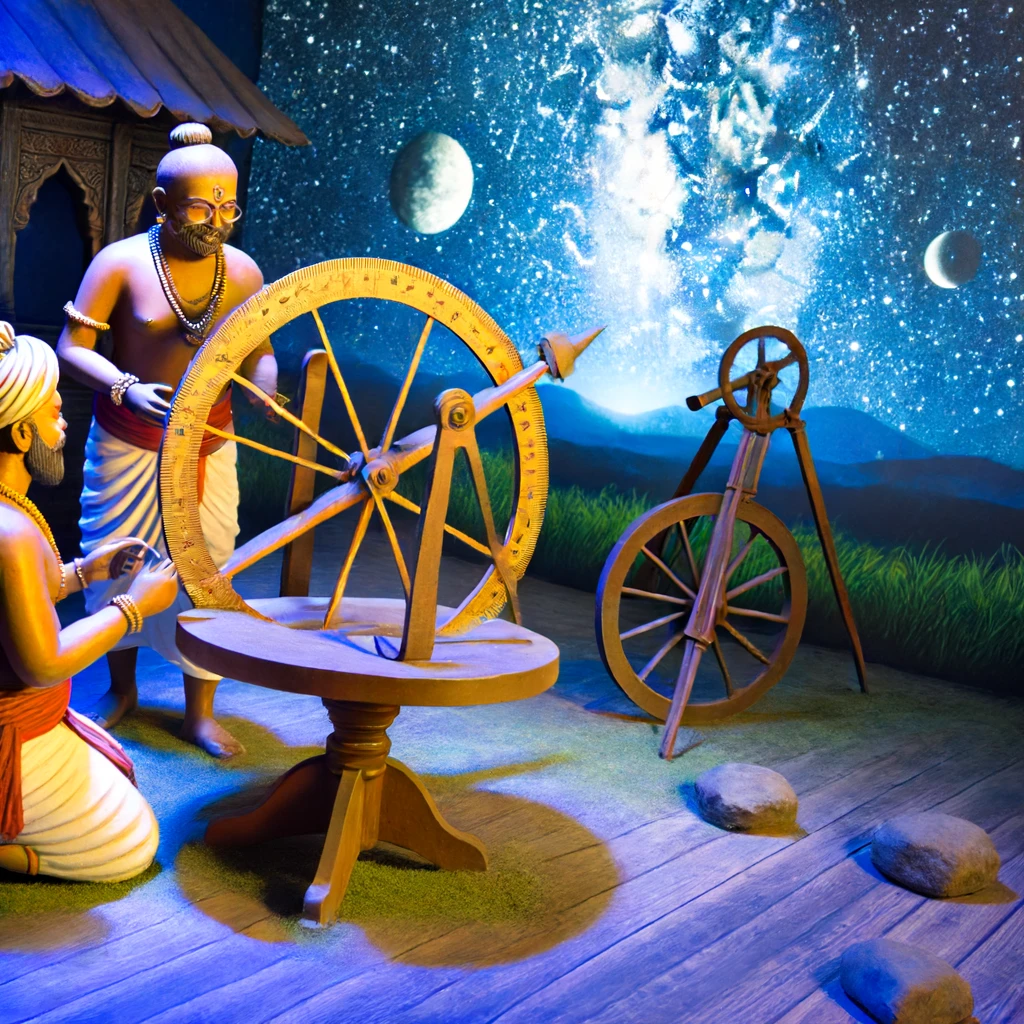
    Science Hub of Ancient Times: Reviving Ancient Vedic Wisdom - Genuine Hindu  Info Source

    Conclusion

    Summary of Insights

    The journey through the intersections of ancient Hindu scriptures and modern science reveals the remarkable foresight embedded in these texts. Hindu philosophy offers profound perspectives on:

    • Astronomy and Cosmology: The cyclical nature of the universe, heliocentrism, and cosmic phenomena like black holes.
    • Metaphysics and Quantum Physics: Concepts of consciousness, Maya (illusion), and the interconnectedness of reality.
    • Technology and Engineering: Speculative accounts of advanced technologies like Vimanas and their modern parallels in aerospace and material science.
    • Medicine and Holistic Healing: The mind-body connection and the roots of holistic health in Ayurveda.
    • Unexplored Realms: Ideas such as Maya Darpan and ancient approaches to human augmentation and climate control offer speculative but compelling avenues for future exploration.

    These insights underline how Hindu texts serve not only as spiritual guides but also as conceptual frameworks for scientific inquiry, challenging us to bridge the gap between ancient wisdom and cutting-edge innovation.

    Call to Action
    • Explore and Reflect: Readers are encouraged to delve into Hindu scriptures for inspiration, gaining insights into both spiritual and scientific dimensions of life.
    • Foster Integration: Scholars, researchers, and technologists should investigate how ancient knowledge can inform and complement modern science.
    • Spread Awareness: Promote dialogue on the relevance of ancient philosophies in addressing contemporary challenges, from technology to environmental sustainability.
    1. Participate and Donate to MEDA Foundation

    Join the mission of the MEDA Foundation, dedicated to:

    • Empowering individuals with autism and creating employment opportunities for all.
    • Building self-sustaining ecosystems that promote dignity, inclusivity, and self-reliance.
      Your support helps us continue fostering a better world where ancient wisdom meets modern progress. Visit www.MEDA.Foundation to learn more and contribute to this meaningful cause.
    Book References
    1. The Upanishads – Eknath Easwaran.
    2. The Bhagavad Gita – Swami Sivananda.
    3. The Rigveda: A New Translation – Stephanie W. Jamison and Joel P. Brereton.
    4. Yoga Sutras of Patanjali – Swami Satchidananda.
    5. Ancient Indian Science: Some Reflections – V. S. Ramachandran.
    6. Quantum Reality and Ancient Wisdom – Amit Goswami.


  • The Holographic Universe Theory – A New Perspective on Reality

    The Holographic Universe Theory – A New Perspective on Reality

    The holographic universe theory challenges the very fabric of our understanding, proposing that the three-dimensional reality we perceive is a projection from a lower-dimensional surface where all information is encoded. Rooted in groundbreaking scientific foundations like black hole thermodynamics and the AdS/CFT correspondence, the theory offers insights into unifying quantum mechanics and general relativity while redefining space and time as emergent properties rather than fundamental elements. With implications for quantum gravity, philosophy, and even the potential for simulated realities, it invites us to rethink existence itself. Though speculative and difficult to test, it resonates with both modern physics and ancient philosophies, opening doors to profound exploration and revolutionary ideas about the cosmos and our place within it.
    The Nature of Reality: Exploring the Holographic Universe Theory | by  KingWolf | Medium
    The Holographic Universe Theory – A New Perspective on Reality

    Introduction

    What if everything we know about the universe—our three-dimensional reality, time, and space—was a mere illusion, a projection from a simpler, hidden layer of existence?
    This provocative question challenges the very foundation of how we perceive the cosmos. It invites us to look beyond the tangible and familiar, into the depths of modern theoretical physics and philosophy, where the boundaries of knowledge are being redefined.

    The holographic universe theory suggests that our universe, as expansive and intricate as it seems, might be fundamentally different from how we experience it. Much like a hologram—a three-dimensional image projected from a two-dimensional surface—the universe we inhabit could be the result of information encoded on a lower-dimensional boundary. This concept, born out of groundbreaking research in quantum mechanics, black hole physics, and string theory, doesn’t just stretch the imagination; it reframes our understanding of existence itself.

    The purpose of this article is to demystify the holographic universe theory, offering insights into its origins, scientific foundations, and implications. From its potential to unify the laws of physics to the philosophical questions it raises about the nature of reality, this theory is as transformative as it is mind-bending. It challenges the long-held view of space and time as intrinsic aspects of our universe, instead proposing that they may be emergent properties—a kind of cosmic mirage.

    This discussion is aimed at anyone curious about the frontiers of science and philosophy—readers intrigued by the mysteries of the universe and the pursuit of knowledge that goes beyond the observable. Whether you’re a seasoned science enthusiast or a layperson with a fascination for the unknown, this exploration of the holographic universe theory promises to broaden your perspective.

    Why should you care?
    Because understanding this theory is not just an intellectual exercise—it’s a journey that could redefine how we perceive our place in the cosmos. If the holographic principle holds true, it could revolutionize fields as diverse as quantum computing, cosmology, and even consciousness studies. More importantly, it forces us to question the nature of reality itself: Are we truly experiencing the universe as it is, or merely the shadow of something deeper and more profound?

    In this article, we’ll unpack this fascinating idea step by step, beginning with its conceptual origins and moving through the scientific evidence, potential implications, and criticisms. Along the way, we’ll connect the abstract to the practical, showing how a seemingly esoteric theory could one day influence technology, philosophy, and our understanding of existence.

    Prepare to dive into a world where boundaries blur, where dimensions dissolve, and where the universe you thought you knew might not be what it seems.

    holographic universe | playing with memories

    Understanding the Holographic Universe

    The holographic universe theory offers a paradigm-shifting perspective on the nature of reality, suggesting that our three-dimensional world might not be as straightforward as it seems. To truly grasp its implications, we must first understand its foundational principles and the analogies that make it relatable.

    1. The Holographic Principle

    The holographic principle is a bold and elegant concept that redefines how we think about space, time, and reality.

    • Definition: At its core, the holographic principle posits that all the information contained within a three-dimensional region of space can be encoded on its two-dimensional boundary. In simpler terms, the seemingly 3D universe we experience might actually be a projection of information from a lower-dimensional surface.
    • Origins: The principle emerged in the 1990s, pioneered by physicists Gerard ‘t Hooft and Leonard Susskind. Its inspiration traces back to studies of black hole thermodynamics, particularly Bekenstein-Hawking entropy. This research revealed that the amount of information, or entropy, a black hole can hold is proportional to the surface area of its event horizon, not its volume. This finding defied traditional expectations, suggesting that surface boundaries might hold the key to understanding complex systems.
    • Key Idea: The principle challenges traditional notions of space and time by suggesting that the universe’s true nature might be simpler and more fundamental than what we perceive. If all the information about a space can be encoded on its boundary, it upends the classical idea that a volume of space contains all its own information.

    This principle has deep implications for physics, offering a potential pathway to reconcile quantum mechanics and general relativity—the two pillars of modern physics that often seem incompatible.

    1. The Universe as a Hologram

    Building on the holographic principle, the concept of the universe as a hologram takes this abstraction further, proposing that the 3D universe we inhabit is essentially a “projection” from a 2D reality.

    • Explanation: Just as a hologram uses light interference patterns on a 2D surface to create a 3D image, the universe may operate similarly. The apparent three-dimensionality of our world could emerge from encoded data on a lower-dimensional plane, akin to how depth and volume appear in a holographic image but are not truly present.
    • Real-World Analogy: To imagine this concept, think of a 3D movie projected onto a flat screen. The characters and landscapes seem to leap out of the screen, creating an immersive three-dimensional experience. However, at its core, the movie exists as patterns of light on a two-dimensional surface. Similarly, the universe we experience might be a sophisticated “projection” of data encoded on a cosmic boundary.
    • Implications: If true, this theory suggests that the fabric of reality as we perceive it—length, width, height, and even time—may be emergent properties, not fundamental aspects of the universe.

    By offering this framework, the holographic universe theory bridges the gap between abstract theoretical physics and a more intuitive understanding of reality. It forces us to reconsider the dimensions we navigate daily and explore the possibility that the universe’s complexity arises from a far simpler underlying structure.

    This perspective not only challenges existing models of the cosmos but also opens the door to transformative ideas about the relationship between the observer (us) and the observed (the universe). It is a step toward understanding how the universe encodes information and presents it in ways we experience as reality.

    How holographic technology might be the key to understanding our minds and  the universe

    Key Scientific Foundations

    The holographic universe theory isn’t just a speculative idea—it is deeply rooted in modern physics and supported by compelling scientific concepts. Two major pillars underlie its framework: Black Hole Thermodynamics and the AdS/CFT Correspondence. These foundational principles provide theoretical and mathematical backing for the idea that our universe might be a hologram.

    1. Black Hole Thermodynamics

    One of the most significant breakthroughs leading to the holographic principle comes from the study of black holes—enigmatic objects that challenge our understanding of space, time, and gravity.

    • Bekenstein-Hawking Entropy:
      In the 1970s, physicists Jacob Bekenstein and Stephen Hawking discovered a profound relationship between black holes and thermodynamics. They showed that the entropy of a black hole—a measure of the information it contains—is proportional to the surface area of its event horizon (the boundary beyond which nothing can escape), not its volume.
      • Why It Matters: In classical physics, one would expect entropy to scale with the volume of an object, as that is where its contents are located. However, this observation defied conventional wisdom and suggested that all the information about the black hole is encoded on its two-dimensional boundary, not in its three-dimensional interior.
    • Implication for the Universe:
      If this principle holds true for black holes, could it also apply to the universe as a whole? Physicists like Gerard ‘t Hooft and Leonard Susskind proposed that the same idea could be extended to all of spacetime. This means that the universe we perceive—vast, three-dimensional, and seemingly infinite—might be fundamentally encoded on a two-dimensional surface, such as the cosmological horizon.

    This idea was the first step toward the holographic principle, suggesting that our three-dimensional experience of reality might emerge from simpler, lower-dimensional data.

    1. AdS/CFT Correspondence

    The AdS/CFT correspondence is a groundbreaking concept that provides mathematical evidence for the holographic principle. Proposed by physicist Juan Maldacena in 1997, it bridges the gap between string theory and quantum field theory, offering a concrete model of how higher-dimensional spaces might correspond to lower-dimensional boundaries.

    • Simplified Explanation:
      The correspondence asserts that a string theory operating in a five-dimensional space with a specific geometry called Anti-de Sitter space (AdS) is equivalent to a conformal field theory (CFT) in four dimensions—its boundary.
      • Anti-de Sitter Space (AdS): A theoretical curved space often used in string theory, where the curvature allows for a natural boundary.
      • Conformal Field Theory (CFT): A quantum field theory that describes particles and forces in lower-dimensional space.

    What this means is that physics in a higher-dimensional space can be fully described by the physics on its lower-dimensional boundary. Essentially, everything happening in the “bulk” of the higher-dimensional space has an equivalent description on the “edge.”

    • Real-World Connection:
      While AdS space does not describe our universe directly (our universe is believed to be flat or slightly curved in a different way), the mathematical insights from AdS/CFT correspondence reinforce the feasibility of the holographic principle. The correspondence shows how the geometry and physics of a higher-dimensional space can emerge from data encoded in a lower-dimensional framework.
    • Modern Research:
      AdS/CFT has become a cornerstone of theoretical physics, with researchers using it to study quantum gravity, black holes, and other phenomena that are challenging to understand through traditional means. It serves as a testing ground for ideas about how information might be encoded and preserved in a holographic universe.

    Conclusion of Foundations

    Together, black hole thermodynamics and the AdS/CFT correspondence provide compelling evidence for the holographic nature of the universe. While these ideas are primarily theoretical, they offer profound insights into the interplay between dimensions and the nature of reality. They suggest that our intuitive understanding of space, time, and volume may be an emergent illusion, encoded on the cosmic boundary—a revolutionary notion that reshapes both physics and philosophy.

    Black Holes Prove We Live in a Holographic Universe | What Is Holographic  Duality?

    Implications of the Holographic Universe Theory

    The holographic universe theory, while rooted in cutting-edge physics, extends far beyond theoretical science. Its implications touch on fundamental questions about the nature of reality, the unification of physics, and even the potential for revolutionary technological advancements. This section explores how the theory could reshape our understanding of the cosmos and influence both science and philosophy.

    1. Quantum Gravity and Unification

    One of the most tantalizing promises of the holographic universe theory lies in its potential to address a problem that has eluded physicists for decades: unifying quantum mechanics and general relativity.

    • Potential Impact:
      • Quantum Mechanics governs the behavior of particles on the smallest scales, while General Relativity explains the force of gravity and the dynamics of large-scale structures like stars, galaxies, and black holes.
      • Despite their individual successes, these two frameworks are fundamentally incompatible, leaving physicists searching for a theory of quantum gravity—a model that merges them into a single, coherent description of reality.
      • The holographic principle provides a possible pathway for this unification by suggesting that spacetime itself may emerge from a more fundamental level of reality governed by quantum rules.
    • Breakthrough in Physics:
      • The mathematical framework supporting the holographic principle, particularly through the AdS/CFT correspondence, has already shown promise in providing insights into quantum gravity.
      • By reinterpreting spacetime as an emergent phenomenon, the theory could resolve longstanding paradoxes, such as the black hole information paradox, which challenges our understanding of how information behaves under extreme gravitational conditions.

    If fully realized, the holographic theory could represent one of the most significant breakthroughs in modern physics, offering a unified framework for understanding the universe at all scales.

    1. Revolutionizing Our Perception of Space and Time

    The holographic universe theory not only challenges our scientific models but also redefines the very fabric of our reality—space and time.

    • Space and Time as Illusions:
      • If our three-dimensional world is a projection, then space and time, as we perceive them, may not be fundamental elements of reality but rather emergent properties.
      • This means that distance, duration, and even the distinction between past, present, and future might be constructs of our perception, arising from the underlying information encoded on a two-dimensional surface.
    • Philosophical Implications:
      • This shift raises profound questions about existence itself:
        • What is the nature of reality if our perceptions are projections?
        • Is consciousness, which interprets these projections, more fundamental than spacetime?
      • Such ideas echo ancient philosophical inquiries, bridging the gap between science and metaphysics, and offering new ways to contemplate humanity’s role in the cosmos.

    These implications stretch the boundaries of both physics and philosophy, encouraging a reevaluation of how we define and interact with the universe.

    1. Technological and Philosophical Impact

    Beyond its theoretical and philosophical insights, the holographic universe theory holds potential for transformative practical applications and provocative questions about the nature of existence.

    • Practical Applications:
      • Though speculative, the principles underlying the holographic theory could influence the development of quantum computing, which relies on the manipulation of quantum information.
      • Advances in understanding information encoding and retrieval on lower-dimensional surfaces might revolutionize technologies in data storage, simulation modeling, and telecommunications.
      • A deeper grasp of how reality emerges from fundamental information could also enhance virtual and augmented reality technologies, making them more immersive and sophisticated.
    • Broader Implications:
      • The theory brings us closer to confronting provocative questions such as:
        • Is the universe a simulation? If space and time are emergent properties, could they be the result of a program or algorithm operating at a deeper level of existence?
        • What is the source of the encoded information? If the universe is a hologram, understanding its origin may open the door to concepts we can scarcely imagine, such as connections to multiverse theories or entirely new dimensions of reality.

    These possibilities not only challenge our scientific understanding but also force us to reconsider the limits of human knowledge and the potential for transformative discoveries.

    Conclusion of Implications

    The implications of the holographic universe theory extend far beyond its origins in theoretical physics, influencing how we think about the cosmos, our technology, and even ourselves. By offering a unified framework for physics, redefining the nature of space and time, and sparking new avenues for technological innovation, it has the potential to transform both science and society.

    At its core, the holographic principle invites us to ask the biggest questions: What is reality? How do we perceive it? And what lies beyond our current understanding? Whether or not the theory ultimately proves to be true, its exploration pushes the boundaries of human thought and inspires new ways of engaging with the mysteries of existence.

    Sean G. on LinkedIn: Encoded Cosmos: Is Our Reality Just a Cosmic Hologram  Decoded by DNA? 💾🩸…

    Counterarguments and Criticisms

    While the holographic universe theory is a captivating and revolutionary concept, it is not without its detractors. Scientists and philosophers alike have raised significant counterarguments and criticisms, focusing on alternative explanations for cosmic phenomena, challenges to its validity, and the practical difficulties in testing its claims.

    1. Alternative Theories

    Several competing ideas challenge the dominance of the holographic universe theory by offering alternative explanations for the nature of reality.

    • Multiverse Theory:
      • This theory posits that our universe is merely one of an infinite number of universes in a vast multiverse.
      • Comparison: While the holographic principle suggests that our universe is a projection from a lower-dimensional boundary, the multiverse theory envisions a broader context in which universes exist independently, governed by different physical laws or constants.
      • Criticism: Advocates of the multiverse theory argue that the holographic principle might not adequately explain phenomena that could arise from interactions between multiple universes, such as variations in physical constants or quantum anomalies.
    • Traditional Models of Space-Time:
      • Critics argue that classical physics, as described by Einstein’s general relativity, provides a robust and sufficient framework for understanding most cosmic phenomena.
      • Perspective: These models, while incomplete at quantum scales, have been rigorously tested and validated through decades of astronomical and experimental observations.
      • Criticism: Detractors contend that introducing a radically new concept like the holographic principle may not be necessary when existing models are effective for explaining the majority of observable phenomena.

    While the holographic principle offers a bold new perspective, some argue it might be better suited as a complementary rather than a replacement framework for understanding reality.

    1. Challenges to the Holographic Principle

    Even within the scientific community, the holographic principle faces significant challenges, both theoretical and practical.

    • Lack of Empirical Evidence:
      • The theory remains largely speculative, grounded in mathematical models rather than direct experimental evidence.
      • Unlike phenomena such as gravitational waves or the Higgs boson, which were predicted and subsequently confirmed through observation, the holographic principle lacks clear, testable predictions that can be verified using current technology.
      • Criticism: Skeptics argue that without empirical evidence, the holographic universe theory risks being relegated to the realm of abstract speculation, disconnected from the physical universe it seeks to describe.
    • Difficulty of Testing:
      • Proving the holographic principle would require access to the boundary of the universe, where the encoded information is theorized to reside.
      • Technological Constraints: Our current observational tools, including telescopes and particle accelerators, are incapable of probing such scales. Additionally, the boundary of the universe may be fundamentally inaccessible, further complicating efforts to validate the theory.
      • Criticism: This practical limitation raises doubts about whether the holographic universe theory can ever move beyond the realm of theoretical physics to become an experimentally verified model of reality.

    Conclusion of Counterarguments

    The holographic universe theory presents an alluring vision of reality that challenges our traditional understanding of space, time, and the cosmos. However, it is not without its detractors, who question its necessity, feasibility, and empirical basis.

    Alternative theories, such as the multiverse hypothesis and classical models of space-time, offer competing explanations, while the absence of experimental evidence and the difficulty of testing the theory pose significant obstacles.

    Nevertheless, the strength of the holographic principle lies in its ability to provoke critical discussion and inspire new avenues of research. Whether or not it ultimately holds the key to understanding the universe, the pursuit of its implications continues to push the boundaries of human knowledge and imagination.

    What If the Universe Was Just an Illusion? - video Dailymotion

    Conclusion

    The holographic universe theory offers a bold, transformative view of reality, combining cutting-edge science with profound philosophical questions. Its implications resonate far beyond theoretical physics, challenging our understanding of the cosmos and inspiring new ways of thinking about existence.

    Summary of Key Points

    • Radical Rethinking of Reality:
      The holographic universe theory suggests that our three-dimensional world might be a projection of information encoded on a two-dimensional surface, fundamentally altering how we perceive space, time, and existence.
    • Scientific Foundations:
      Groundbreaking concepts like black hole thermodynamics and the AdS/CFT correspondence provide a solid mathematical and theoretical basis for this idea. These principles challenge traditional models of space-time and hint at a unified framework for quantum gravity.
    • Implications and Opportunities:
      The theory offers potential breakthroughs in physics, proposing answers to longstanding questions about the unification of general relativity and quantum mechanics. At the same time, it opens philosophical debates about whether space and time are fundamental or emergent properties.

    Future Exploration and Philosophical Questions

    • Expanding Scientific Horizons:
      • The holographic principle invites physicists to explore new pathways toward understanding quantum gravity and the nature of spacetime.
      • It encourages interdisciplinary collaboration, linking theoretical physics with fields like computational science, philosophy, and even neuroscience.
    • Philosophical Implications:
      • What does it mean if the universe is a projection? Are we simply interpreting encoded data, or is consciousness an integral part of the process?
      • Could this theory lead us closer to understanding if the universe itself is a kind of simulation, as some have speculated?

    By challenging conventional paradigms, the holographic universe theory encourages us to reevaluate our place in the cosmos and the nature of our existence.

    Call to Action

    • Engage with the Discussion:
      Whether you’re a curious reader, a student, or a professional, delve into the concepts of the holographic universe theory. Read works by physicists like Leonard Susskind, explore resources on quantum mechanics, and participate in forums that discuss theoretical physics and cosmology.
    • Support Intellectual Exploration:
      At MEDA Foundation, we believe in fostering curiosity, supporting scientific inquiry, and building self-sustaining ecosystems that empower communities. Your contributions can help fund initiatives that explore the boundaries of human knowledge, while also addressing pressing societal challenges.

    Participate and Donate: Join us in shaping a future driven by understanding, compassion, and innovation. Together, we can create a world where intellectual and emotional growth go hand in hand.

    Final Thought

    The holographic universe theory, while speculative, represents the incredible human drive to seek answers to the deepest questions of existence. Whether or not it proves true, its exploration inspires us to imagine new possibilities, question our assumptions, and strive for a more profound understanding of the universe and our place within it.

    To learn more and contribute to groundbreaking initiatives, consider supporting MEDA Foundation today. Together, we can help people help themselves and unravel the mysteries of our universe.

    Astronomy-Time in BhagvatGita- Part 2 | HINDUISM AND SANATAN DHARMA

    Sanātana Dharma and ancient knowledge

    Sanātana Dharma (often referred to as the “eternal way” or “eternal truth”) is a profound and expansive spiritual framework encompassing metaphysical principles that resonate with modern theories like the holographic universe. While ancient Indian texts do not directly propose scientific models, their philosophical and cosmological insights often parallel ideas in theoretical physics. Here’s how Sanātana Dharma addresses concepts akin to the holographic universe:

    1. The Concept of Maya (Illusion)
    • Definition: Maya is the philosophical idea that the universe as we perceive it is not the ultimate reality but a projection of a deeper, unchanging truth (Brahman).
    • Connection to Holography:
      • Just as the holographic principle suggests our 3D reality is a projection of a 2D encoded surface, Maya posits that the sensory world is a projection of the underlying cosmic reality.
      • The idea of “illusion” in Maya aligns with the emergent nature of space and time as proposed in modern physics.
    1. Akasha (Cosmic Ether or Space)
    • Definition: Akasha in Vedic philosophy is the substratum of all existence, the medium through which information and energy manifest.
    • Connection to Information Encoding:
      • The notion of Akasha resembles the “boundary surface” or informational field in the holographic universe.
      • The idea that the cosmos contains encoded vibrations (sound and energy) resonates with the modern understanding of information being fundamental to reality.
    1. Advaita Vedanta (Non-Dualism)
    • Core Principle: Advaita Vedanta teaches that the individual self (Atman) and the ultimate reality (Brahman) are one and the same.
    • Parallel to Holography:
      • The holographic universe suggests that every part of the universe contains information about the whole (non-locality). Similarly, Advaita states that the microcosm (individual) reflects the macrocosm (universe).
      • This perspective aligns with how a hologram, even when divided, contains the entire image within each fragment.
    1. Vedic Cosmology and Cyclic Nature of Time
    • Concept of Time and Space:
      • Time (Kala) and space are considered relative and cyclical in Vedic cosmology, not linear or absolute.
      • This notion of time being emergent or non-fundamental aligns with the implications of the holographic principle, where space and time are not primary entities but derived constructs.
    • Multiverses in Hindu Thought:
      • Ancient texts like the Vishnu Purana and Bhagavata Purana describe innumerable universes (Brahmandas), hinting at a multiverse-like framework.
      • These universes are cyclically created and dissolved, echoing the theoretical multiverse and the concept of projections from a deeper reality.
    1. Role of Consciousness (Chit)
    • Definition: Consciousness is central to Vedic thought, viewed as the foundation of reality itself.
    • Connection to the Observer Effect:
      • The role of the observer in quantum mechanics mirrors the importance of consciousness in manifesting reality, as described in Sanātana Dharma.
      • Just as the holographic principle suggests a relationship between encoded information and emergent reality, Hindu philosophy emphasizes the role of consciousness in interpreting and co-creating the sensory world.
    1. The Concept of Lila (Cosmic Play)
    • Definition: The universe is seen as a divine play (Lila) enacted by the supreme consciousness for the joy of creation.
    • Connection to Simulation Theories:
      • If the universe is a hologram or simulation, the idea of Lila provides a philosophical lens through which to view this “projection” as a purposeful creation rather than a random occurrence.
    1. Sacred Geometry and the Structure of Reality
    • Yantras and Mandalas:
      • These symbolic diagrams, used in meditation and rituals, represent the microcosm and macrocosm as interconnected.
      • The geometrical precision and layered meanings of yantras reflect the idea of encoded information creating observable reality, similar to the holographic principle.
    1. The Role of Knowledge (Jnana)
    • Pursuit of Truth:
      • Sanātana Dharma emphasizes Jnana (knowledge) as the path to understanding the ultimate reality. The holographic universe theory can be seen as a modern scientific approach to this ancient quest for truth.
      • The Upanishads repeatedly ask, “What is real?” and guide seekers toward the realization that the sensory world is a shadow of deeper truths.

    Sanātana Dharma, through its principles of Maya, Akasha, Advaita, and Lila, provides a framework that resonates deeply with the holographic universe theory. While expressed through spiritual and philosophical language, the parallels between these ancient ideas and modern scientific theories suggest a timeless pursuit of understanding the nature of reality.

    By bridging science and spirituality, both perspectives invite us to rethink our assumptions about space, time, and existence, fostering a deeper connection to the mysteries of the cosmos.