Tag: #BehavioralChange

  • Waiting for the 100th Monkey Is Why Change Fails

    Waiting for the 100th Monkey Is Why Change Fails

    The 100th Monkey Theory is a concept suggesting that once a critical number of individuals in a population adopt a new behavior or idea, it can spontaneously spread to the rest of the population, even across separated groups, as if the knowledge transcends direct communication. Originating from observations of Japanese macaques learning to wash sweet potatoes, proponents of the theory argue that cultural or behavioral shifts can reach a tipping point, leading to rapid, collective transformation. While widely cited in popular culture to illustrate social contagion and consciousness-driven change, scientific scrutiny questions the literal interpretation, emphasizing instead its metaphorical power to highlight the potential of small actions to create large-scale social impact.

    100ನೇ ಮಾಂಕಿಯ ತತ್ವವು ಒಂದು ಜನಸಂಖ್ಯೆಯಲ್ಲಿನ ನಿರ್ದಿಷ್ಟ ಸಂಖ್ಯೆಯ ವ್ಯಕ್ತಿಗಳು ಹೊಸ ನಡೆ ಅಥವಾ ಕಲಿಕೆಯನ್ನು ಅಳವಡಿಸಿಕೊಂಡ ನಂತರ, ಅದು ನೇರ ಸಂವಹನವಿಲ್ಲದಿದ್ದರೂ ಇತರ ಎಲ್ಲಾ ಸದಸ್ಯರಿಗೆ ಸ್ವಯಂಚಾಲಿತವಾಗಿ ಹರಡಬಹುದು ಎಂದು ಸೂಚಿಸುತ್ತದೆ. ಈ ತತ್ವವು ಜಪಾನಿನ ಮಾಕಾಕ್ ಕಾಳು ಮೃಗಗಳು ಸಿಹಿ ಆಲೂಗಡ್ಡೆ ತೊಳೆಯುವ ತರಗತಿಯನ್ನು ಕಲಿತಿದ್ದಂತೆ ನಿರೀಕ್ಷಣೆಯಿಂದ ಹುಟ್ಟಿಕೊಂಡಿದ್ದು, ಅದರ ಅಭಿಪ್ರಾಯದಲ್ಲಿ ಸಾಂಸ್ಕೃತಿಕ ಅಥವಾ ನಡವಳಿ ಬದಲಾವಣೆಗಳು ತಟಸ್ಥ ಪಾಯಿಂಟ್ ಅನ್ನು ತಲುಪಿದಾಗ, ವೇಗವಾಗಿ ಮತ್ತು ಸಾಮೂಹಿಕವಾಗಿ ಬದಲಾವಣೆ ಆಗಬಹುದು. ಜನಸಾಮಾನ್ಯ ಸಂಸ್ಕೃತಿಯಲ್ಲಿ ಇದು ಸಾಮಾಜಿಕ ಹರಿವು ಮತ್ತು ಜಾಗೃತಿಯ ಮೂಲಕ ಬದಲಾವಣೆಗಳನ್ನು ವಿವರಿಸಲು ವ್ಯಾಪಕವಾಗಿ ಉಲ್ಲೇಖಿಸಲಾಗಿದೆ, ಆದರೆ ವೈಜ್ಞಾನಿಕ ಪರಿಶೀಲನೆ ಈ ತತ್ವದ ಶಬ್ದಾರ್ಥವನ್ನು ಪ್ರಶ್ನಿಸುತ್ತದೆ ಮತ್ತು ಬೃಹತ್ ಸಾಮಾಜಿಕ ಪ್ರಭಾವವನ್ನು ಸೃಷ್ಟಿಸಲು ಸಣ್ಣ ಕಾರ್ಯಗಳ ಶಕ್ತಿ ಮೇಲೆ ಗಮನಹರಿಸುವಂತೆ ಒತ್ತಿ ಹೇಳುತ್ತದೆ.

    The 100th Monkey Effect: From Seductive Myth to Sustainable Social Change

    What Truly Drives Collective Transformation

    Core Insight

    The so-called 100th Monkey Effect is not a scientific phenomenon; it is a metaphor that survives because it gestures toward something real, complex, and deeply human. Collective transformation does not occur when an invisible numerical threshold is crossed. It occurs when behaviors become socially validated, structurally rewarded, and identity-aligned. When these conditions converge, change appears sudden—but only to those who were not paying attention to the long, often frustrating process that preceded it.

    Across psychology, innovation theory, and systems leadership, the literature is remarkably consistent on this point: there is no magic number—only cumulative human effort.

    From Everett Rogers’ Diffusion of Innovations, we learn that adoption is not driven by sheer volume but by trust, credibility, and social proof. Innovators may spark an idea, but they rarely normalize it. Early adopters legitimize a behavior, the early majority institutionalizes it, and only then does change become self-sustaining. What looks like a tipping point is, in reality, the moment when uncertainty drops low enough for risk-averse individuals to participate without fear of social or economic loss.

    Daniel Kahneman’s work in Thinking, Fast and Slow adds an uncomfortable but necessary layer of realism. Human beings are not rational change agents. We are governed by loss aversion, status quo bias, and narrative preference. Most people do not resist change because it is wrong; they resist because it threatens identity, competence, or belonging. As a result, transformation accelerates only when the perceived cost of staying the same becomes higher than the cost of adapting—and that shift is almost always socially mediated.

    James Clear’s Atomic Habits strips away the romance and exposes the mechanics. Societies do not change their minds first; they change their routines. Repeated behaviors, reinforced by environment and approval, eventually harden into culture. When a new behavior becomes a marker of “who we are” rather than “what we are trying,” resistance collapses. At that point, adoption feels inevitable—not because of mass awakening, but because identity has quietly realigned.

    The Heath brothers, in Switch, clarify why so many well-intentioned movements stall. Motivation is unreliable. Awareness is insufficient. Change sticks only when three elements move together:

    • the rational mind understands the change,
    • the emotional mind feels safe adopting it, and
    • the environment makes the new behavior easier than the old one.

    The 100th Monkey myth fails precisely because it ignores the environment. It assumes consciousness alone drives behavior. Reality is harsher and more hopeful: systems shape behavior more reliably than beliefs ever will.

    What, then, is the real driver of collective transformation?

    It is not numbers.
    It is not slogans.
    It is not waiting for others to “wake up.”

    It is visible models, repeatable practices, aligned incentives, and patient reinforcement over time. Change spreads when people can point to working examples, when social penalties for adoption disappear, and when institutions quietly begin to reward the new norm.

    This is why authentic transformation often feels anticlimactic to those doing the work. There is no dramatic moment. No symbolic “hundredth” actor. There is only persistence—often thankless, often slow—until one day the behavior that once felt radical feels obvious. Not because humanity evolved overnight, but because enough people built the conditions for change to become the path of least resistance.

    The metaphor of the 100th Monkey endures because it expresses a longing: the hope that transformation can be effortless, inevitable, and morally guaranteed. The truth is more demanding—and more empowering. Change is not bestowed upon societies. It is constructed, step by step, by individuals and institutions willing to outlast doubt.

    That is not mythology.
    That is responsibility.
    Reggae Zen Monkey: 100th Monkey Edition" Sticker for Sale by reggaeartgifts  | Redbubble

    Why the 100th Monkey Idea Persists Despite Being Disproved

    The persistence of the 100th Monkey idea is not an accident, nor is it evidence of collective ignorance. It endures because it satisfies deep psychological, emotional, and moral needs that hard data alone rarely addresses. When examined honestly, its survival tells us more about human cognition and motivation than about monkeys, consciousness, or social tipping points.

    1. Narrative Comfort vs. Statistical Reality (Kahneman)

    Drawing from Daniel Kahneman’s Thinking, Fast and Slow, the first reason for the myth’s resilience becomes clear: the human mind is wired to prefer stories over systems.

    Kahneman demonstrates that we rely heavily on what he calls System 1 thinking—fast, intuitive, emotionally driven—especially when confronted with complexity. Social change is inherently messy, slow, and multi-causal. The 100th Monkey story compresses this chaos into a clean, emotionally satisfying arc: struggle, threshold, breakthrough.

    Three cognitive tendencies reinforce the myth:

    • Coherent storytelling over complex causality
      We prefer a single, elegant cause to a web of interacting variables. The idea that “once enough individuals change, the rest will follow” is far easier to grasp than diffusion curves, social network dynamics, or institutional inertia.
    • Emotional resonance over empirical scrutiny
      A story that inspires hope is rarely subjected to rigorous fact-checking. When a narrative aligns with our values—peace, awakening, collective good—we unconsciously lower our standards of evidence.
    • Repetition mistaken for proof
      Kahneman notes that familiarity breeds acceptance. The more often an idea is repeated, the more “true” it feels, regardless of its factual basis. The 100th Monkey story has been echoed in activism, spirituality, education, and leadership circles for decades, giving it the illusion of credibility.

    The story survives not because it is true, but because it feels intuitively right. And in human cognition, feeling right often beats being right.

    2. Moral Mobilization, Not Scientific Claim (Ken Keyes Jr.)

    The second reason for the idea’s longevity lies in its original intent, particularly in Ken Keyes Jr.’s The Hundredth Monkey. This book was never meant to be a scientific treatise. It was a moral intervention, written in the shadow of the Cold War, nuclear anxiety, and a genuine fear of human self-destruction.

    Keyes’ objectives were clear:

    • A moral wake-up call
      The metaphor was used to provoke urgency—an attempt to shake individuals out of apathy by suggesting that personal ethical choices could influence global outcomes.
    • Personal responsibility as the seed of global change
      The message was not “wait for others,” but “change yourself anyway.” The metaphor was designed to empower individuals who felt small in the face of planetary threats.
    • Deliberate use of metaphor, without safeguards
      The problem was not metaphorical thinking itself, but the absence of clear boundaries between symbolism and empirical fact. Over time, the metaphor escaped its moral context and was misinterpreted as a literal phenomenon.

    In this sense, the failure is not one of intention but of interpretation. A story crafted to motivate ethical action was mistaken for scientific explanation. Inspiration was treated as evidence.

    3. Why Debunking Feels Threatening

    If the idea has been disproved, why does challenging it provoke discomfort, even defensiveness?

    Because for many, debunking feels like hope theft.

    People are not merely attached to the story; they are attached to what it promises:

    • That change is inevitable
    • That goodness naturally spreads
    • That one need only contribute quietly and wait

    Removing the myth can feel like removing meaning itself.

    Yet this fear is misplaced.

    Truth does not eliminate hope—it refines it. False hope asks us to wait for thresholds. Real hope asks us to build conditions. The former is comforting but passive. The latter is demanding but empowering.

    When the illusion of spontaneous awakening dissolves, something far more potent becomes available: agency grounded in reality. We stop waiting for mass transformation and start focusing on leverage—systems, incentives, habits, leadership, and sustained effort.

    The 100th Monkey idea persists because it soothes. But the work of real transformation begins only when we are willing to trade soothing stories for effective ones—stories that do not promise inevitability, but invite responsibility.

    That shift is uncomfortable.
    It is also the beginning of real change.

    COLLECTIVE CONSCIOUSNESS | 100th MONKEY SYNDROME IN HINDI

    What Actually Happened: Science Without Embellishment

    To understand why the 100th Monkey narrative unraveled under scrutiny, it is essential to return to the original observations—without romance, without extrapolation, and without metaphysical overlays. When the story is stripped back to documented science, what remains is not disappointment, but clarity.

    1. The Koshima Island Observations (Watson, Primatology Records)

    In the early 1950s, Japanese primatologists began observing troops of Japanese macaques (Macaca fuscata) on Koshima Island. To facilitate closer study, researchers provisioned the monkeys with sweet potatoes scattered on sandy beaches. What followed was not a miracle—but a textbook example of incremental cultural transmission.

    One juvenile female monkey, later referred to as Imo, discovered that washing the sand-covered potatoes in water made them more palatable. This innovation was neither dramatic nor revolutionary. It was practical, local, and context-specific.

    What is crucial—and often omitted—is how the behavior spread:

    • Social learning, not sudden adoption
      The washing behavior diffused gradually through direct observation and imitation. Young monkeys learned from peers; mothers learned from offspring. This aligns precisely with established models of social learning in primates.
    • Strong age-based resistance
      Older monkeys, particularly those born before provisioning began, showed little to no interest in adopting the new behavior. Their resistance was not temporary—it was persistent. Familiar routines, not lack of intelligence, governed their choices.
    • Generational transmission over time
      As younger monkeys matured and had offspring, the behavior became more common. The appearance of widespread adoption was the result of demographic turnover, not a behavioral tipping point.

    There was no identifiable moment at which the habit suddenly jumped from minority to majority. No synchronized shift. No numerical threshold. The change unfolded over years, not days.

    In short:
    No tipping point. No sudden leap. No mystery.

    2. The “Improvisation” (Lyall Watson)

    The leap from careful observation to global myth occurred later—most notably through Lyall Watson’s Lifetide. Watson was a gifted writer and synthesizer of ideas, but not a field primatologist. His role was interpretive, not empirical.

    In later reflections, Watson acknowledged several critical points that fundamentally alter how the story should be understood:

    • Numerical thresholds were symbolic, not measured
      The idea of a specific number—let alone the “hundredth”—was never derived from data. It functioned as narrative shorthand, not statistical inference.
    • Cross-island transmission lacked evidence
      Claims that the behavior spontaneously appeared among monkey populations on other islands were unsupported. Subsequent investigation revealed that human researchers, provisioning practices, or indirect contact could easily account for similarities.
    • Metaphor eclipsed method
      Watson himself admitted that the story blended observation with speculation. Over time, the speculation outgrew the science, and the metaphor was mistaken for mechanism.

    This is where the real breakdown occurred—not in the original research, but in its retelling. A slow, explainable process was transformed into a dramatic event. Complexity was replaced with elegance. Uncertainty was replaced with implication.

    The tragedy is not that the story was embellished. Storytelling is human. The tragedy is that the embellishment was later treated as evidence, and then used to justify beliefs about consciousness, social change, and inevitability.

    What the Koshima studies actually demonstrate is far more grounded—and more useful:

    • Innovation begins at the margins
    • Adoption is uneven and socially constrained
    • Resistance is normal and persistent
    • Change accumulates quietly before it becomes visible

    These findings do not diminish the power of human (or primate) learning. They restore it to reality—where transformation is neither magical nor guaranteed, but possible through time, structure, and persistence.

    That truth may be less poetic.
    It is also far more actionable.

    Quest for the 100th Monkey: Paperclip Scientists: Amazon.in: Music}

    What the Books Agree On: How Change Really Spreads

    When the mythology is stripped away, an important pattern emerges. Across disciplines—sociology, psychology, behavioral science, and leadership—the most credible books converge on a shared conclusion: change does not spread because enough people believe; it spreads because enough people behave differently in visible, reinforced, and repeatable ways. The language varies, but the mechanics are strikingly consistent.

    1. Diffusion of Innovations (Everett Rogers)

    Everett Rogers’ Diffusion of Innovations provides the most foundational and empirically grounded framework for understanding how new ideas and behaviors propagate through a population. Crucially, Rogers dismantles the assumption that adoption is democratic or linear.

    The diffusion process unfolds in distinct social phases:

    • Innovators initiate but do not normalize
      Innovators are willing to take risks, experiment publicly, and tolerate failure. However, they are often perceived as outliers. Their behavior sparks awareness, but rarely legitimacy.
    • Early adopters legitimize
      Early adopters possess social credibility. When they adopt a behavior, it signals safety and relevance. This is the moment when innovation becomes respectable.
    • Early majority institutionalizes
      The early majority does not experiment; it waits. Once uncertainty drops and examples accumulate, this group embeds the behavior into routines, systems, and norms.
    • Late adopters comply only when risk disappears
      Adoption here is not enthusiasm-driven but compliance-driven. By this stage, resisting change becomes more costly than participating.

    The critical insight is unmistakable:

    Change is social before it is numerical.

    No quantity of adopters matters until the right people adopt under the right social conditions. This alone dismantles the notion of a mystical numerical threshold.

    2. The Tipping Point Reinterpreted (Malcolm Gladwell)

    Malcolm Gladwell’s The Tipping Point is often misunderstood as supporting the 100th Monkey myth. In fact, it does the opposite. Gladwell’s work is not about inevitability; it is about leverage.

    Gladwell identifies three human vectors through which change accelerates:

    • Connectors — individuals who link networks and spread exposure
    • Mavens — trusted authorities who confer credibility
    • Salesmen — persuaders who reduce emotional resistance

    These roles clarify why change often appears sudden. When influence concentrates in the right hands, spread accelerates rapidly—not because of magic, but because network dynamics shift.

    Equally important is Gladwell’s emphasis on context. Behavior is shaped less by internal belief and more by environmental cues, incentives, and friction. Change happens when surroundings make the new behavior easier, safer, or more rewarding than the old one.

    There is nothing mystical here—only strategic pressure points.

    3. Behavioral Stickiness (Heath Brothers)

    In Switch, Chip and Dan Heath explain why so many change efforts collapse despite good intentions and compelling arguments. The failure, they argue, lies in overestimating motivation and underestimating structure.

    Change becomes durable only when three conditions align:

    • Direct the rational mind
      People must understand what to do and why it matters. Clarity beats persuasion.
    • Engage emotion
      Fear, pride, belonging, and hope drive action more reliably than logic alone.
    • Restructure the environment
      This is the most neglected step. When systems, incentives, and defaults remain unchanged, behavior inevitably reverts.

    The 100th Monkey myth collapses here because it assumes awareness alone is sufficient. It imagines transformation as a mental event, when in reality it is an architectural one.

    Without environmental redesign, no amount of collective consciousness can sustain change.

    4. Habit and Identity (James Clear)

    James Clear’s Atomic Habits brings the discussion down to its most practical and sobering truth: lasting change is identity-based.

    Clear’s framework reveals that:

    • Small actions compound culturally
      What looks insignificant at the individual level becomes decisive when repeated across time and populations.
    • Behavior shapes identity, not the other way around
      People adopt habits that reinforce who they believe they are—or who they are becoming.
    • Societies are aggregates of repeated behaviors
      Culture is not ideology. It is what people do when no one is watching.

    This leads to a definition that cuts through abstraction:

    Culture is simply habits with social approval.

    When a behavior becomes socially rewarded, culturally expected, and identity-confirming, resistance collapses. At that point, change appears “natural,” even though it was carefully built.

    The Converging Truth

    Across all these works, one conclusion stands firm:
    Transformation is not triggered by numbers, belief, or hope alone. It is driven by visible models, credible adopters, environmental alignment, and repeated action over time.

    What the 100th Monkey story gets emotionally right, these books explain mechanically. Change does not arrive. It is constructed.

    And once constructed well, it spreads on its own.

    The 100th Monkey Bakery :: Behance

    The Most Ignored Variable: Resistance

    Most discussions of social change obsess over adoption—how to persuade, motivate, or inspire more people to participate. Far fewer examine the force that quietly determines success or failure: resistance. Not active rebellion, but passive, identity-protective inertia. Across psychology and social systems, resistance is not an anomaly. It is the default.

    1. Status Quo Bias (Kahneman)

    Daniel Kahneman’s work in Thinking, Fast and Slow provides the clearest explanation for why resistance persists even in the face of obvious benefits. At the heart of this phenomenon lies loss aversion—the tendency to experience potential losses more intensely than equivalent gains.

    This explains a critical detail in the Koshima Island observations that is often glossed over:

    • Older monkeys did not refuse to adopt because they failed to understand
    • They refused because change represented loss—of familiarity, competence, and predictability

    From a cognitive standpoint, their behavior was not irrational. It was economically rational within their mental accounting framework. Adopting a new habit meant risking effort, uncertainty, and possible failure, while continuing the old habit carried no such costs.

    Kahneman’s research shows that once a behavior becomes part of one’s identity or routine, abandoning it feels like surrendering something owned—even when the alternative is objectively better. This is why resistance increases with age, tenure, and status. The more invested someone is in the existing system, the more they stand to lose psychologically by changing.

    This is not ignorance.
    It is rational conservatism.

    2. Social Systems Parallel

    What played out among macaques mirrors human systems with uncanny precision. Resistance is not distributed evenly. It is concentrated in positions of identity, authority, and influence.

    Consider how this manifests across social structures:

    • Families
      One respected elder’s disapproval can neutralize progressive attitudes among younger members, regardless of logic or evidence.
    • Institutions
      A senior leader’s quiet skepticism can stall reform more effectively than open opposition ever could.
    • NGOs
      Legacy practices are often defended by those who built their careers within them, even when outcomes clearly demand redesign.
    • Governments
      Bureaucratic inertia thrives where political risk outweighs perceived reward. Policies fail not because they are flawed, but because adoption threatens existing power balances.

    Across all these contexts, a consistent pattern emerges:

    One high-status resistor can outweigh dozens of adopters.

    Why? Because humans are social learners. We look upward, not outward, when deciding what is safe to emulate. Resistance from a respected figure amplifies uncertainty far more than adoption by multiple low-status participants reduces it.

    The Hard Implication

    Most change efforts fail not because there are too few believers, but because resistance is misdiagnosed. Movements focus on recruiting more supporters when they should be redesigning systems to:

    • reduce perceived loss,
    • protect identity during transition, and
    • lower the social cost of adoption.

    Until resistance is addressed directly—psychologically, structurally, and symbolically—no amount of enthusiasm will compensate.

    Transformation does not stall at the edges.
    It stalls at the top.

    Ignoring resistance is not optimism.
    It is strategic blindness.

    Not Buying Anything: The 100th Monkey Effect And Social Change

    Why Esoteric Explanations Attract Followers

    When scientific explanations feel slow, conditional, and unsatisfying, esoteric theories rush in to fill the emotional gap. The appeal of ideas like the 100th Monkey Effect lies not in their evidence, but in the psychological and existential needs they appear to meet. Understanding this attraction requires intellectual honesty rather than ridicule.

    1. Morphic Resonance (Sheldrake)

    Rupert Sheldrake’s theory of morphic resonance proposes that living systems inherit a kind of collective memory, stored not in genes or brains but in non-local “morphic fields.” According to this view, once a behavior is learned by enough individuals, it becomes easier for others to acquire—regardless of physical proximity.

    The appeal is obvious:

    • Collective memory without infrastructure
      The theory promises shared learning without communication, institutions, or time.
    • Effortless scaling of wisdom
      Hard-earned insight appears to propagate naturally, bypassing resistance and repetition.
    • Moral reassurance
      Good actions are never isolated; they contribute to a larger, invisible reservoir of progress.

    However, from a scientific standpoint, the problems are equally clear:

    • The theory lacks falsifiability, a core requirement of scientific validity.
    • It offers no reproducible experimental evidence that withstands peer review.
    • It conflicts with established principles of physics, biology, and neuroscience without offering testable alternatives.

    As a result, morphic resonance remains emotionally compelling but empirically unsupported. It explains everything and therefore proves nothing.

    2. The Emotional Truth Beneath the Error

    Dismissing esoteric explanations outright misses a crucial point: they persist because they resonate with an emotional truth, even if the mechanism is wrong.

    People intuitively sense that:

    • Behavior is contagious
    • Norms spread socially
    • Individual actions matter beyond immediate visibility

    These intuitions are not mistaken. Humans are deeply interconnected. Our brains are wired for imitation, our identities shaped by group belonging, and our decisions influenced by social context. What esoteric explanations do is misattribute the cause.

    Instead of recognizing:

    • social learning,
    • network effects,
    • cultural reinforcement, and
    • institutional amplification,

    they invoke invisible fields and non-local transmission. The error is not the intuition of interconnectedness—it is the substitution of mystery for mechanism.

    Esoteric theories thrive where people feel powerless within large systems. When institutions seem unresponsive and change appears impossibly slow, the promise of invisible acceleration is comforting. It suggests that moral effort is never wasted, even when outcomes are not immediately visible.

    The danger lies not in meaning-making, but in abdication of responsibility. When change is believed to occur through unseen forces, the necessity of building systems, confronting resistance, and sustaining effort quietly disappears.

    The deeper truth is both less magical and more demanding:

    Interconnectedness is real.
    But it operates through people, structures, habits, and incentives, not hidden fields.

    Recognizing this does not diminish wonder.
    It restores agency.

    The Hundredth Monkey Effect and Collective Consciousness

    Reframing the 100th Monkey for the Modern World

    From Myth to Model

    If the 100th Monkey is to remain useful, it must be demoted from explanation to metaphor and then rebuilt as a practical model for action. The modern world does not need another inspirational story about inevitable awakening. It needs a repeatable framework for how change is actually engineered in complex social systems.

    This requires replacing the vague idea of “critical mass” with six concrete, observable drivers:

    1. Visibility

    Change does not spread in abstraction. It spreads when people can see it working.

    Visible role models reduce uncertainty. They answer the unspoken questions every potential adopter carries:

    • Does this actually work?
    • Will I be safe if I try?
    • People like me are doing this—can I belong?

    MEDA Foundation prioritizes visibility by showcasing real individuals, real skills, and real outcomes—especially among autistic adults and marginalized populations. When success is visible, skepticism weakens without argument.

    2. Repetition

    One-off success stories inspire. Repeated success normalizes.

    Repetition does what persuasion cannot:

    • It lowers cognitive effort
    • It builds familiarity
    • It shifts expectations

    At MEDA Foundation, interventions are designed not as pilots to be celebrated and abandoned, but as processes to be repeated, refined, and transferred. Repetition turns novelty into routine—and routine into culture.

    3. Incentives

    People do not adopt behaviors because they are morally superior. They adopt them because the trade-offs make sense.

    Effective incentives:

    • Reduce personal risk
    • Offer tangible returns (income, dignity, competence)
    • Align effort with reward

    MEDA Foundation aligns social good with economic viability, ensuring that participation improves life outcomes rather than relying on goodwill alone. This removes the false choice between ethics and survival.

    4. Social Proof

    Humans are not independent decision-makers. We are relational learners.

    Social proof answers the question:

    • What do people like me actually do?

    When peers, mentors, and respected figures adopt a behavior, it becomes safer to follow. MEDA Foundation deliberately builds community-based reinforcement, where progress is visible within trusted social circles, not imposed from above.

    5. Institutional Backing

    No change survives long without institutional support.

    Institutions convert fragile behaviors into default norms through:

    • Policy
    • Infrastructure
    • Legitimacy
    • Continuity beyond individuals

    MEDA Foundation collaborates with educators, employers, families, and local systems to ensure that success does not depend on heroic individuals. Institutional backing turns effort into ecosystem.

    6. Time

    This is the most uncomfortable ingredient—and the most essential.

    Real change is slow. It unfolds through:

    • Learning curves
    • Resistance
    • Setbacks
    • Iteration

    MEDA Foundation embraces time not as a delay, but as a design parameter. Sustainable transformation is measured in years, not announcements.

    The Practical Reframe

    When these six elements align, change can appear sudden. Observers may call it a tipping point. In reality, it is the visible crest of long, disciplined groundwork.

    The 100th Monkey never arrived.
    The system did.

    By reframing myth into model, the story finally becomes useful—not as a promise of inevitability, but as a manual for responsibility.

    That is how real transformation happens.

    Final Word

    The world does not change when the 100th monkey learns.
    It changes when enough people refuse to stop teaching, modeling, and building, even when progress is slow, invisible, and unrewarded.

    That is not myth.
    That is responsibility.

    The enduring appeal of the 100th Monkey story lies in its promise of inevitability—the comforting idea that moral effort will eventually trigger automatic transformation. Reality offers no such guarantee. What it offers instead is something more demanding and more dignified: agency. Change happens because individuals and institutions choose persistence over spectacle, systems over slogans, and discipline over hope alone.

    Every lasting transformation in history has followed this pattern. Someone builds when others wait. Someone repeats when others move on. Someone teaches when outcomes are uncertain. Over time, these acts accumulate—not into magic, but into momentum.

    Participate and Donate to MEDA Foundation

    MEDA Foundation works precisely where myths fail—on the ground, over time, with real people.

    Its focus is not awareness without action, but capacity creation with consequences:

    • Creating employment-linked skill ecosystems that translate learning into livelihoods
    • Enabling autistic individuals to move from dependency to dignity through structured capability building
    • Designing self-sustaining community models that endure beyond funding cycles and personalities

    This is not charity.
    It is infrastructure for human potential.

    Participate.
    Volunteer.
    Donate.
    Partner.

    Because the future will not be changed by waiting for thresholds—it will be shaped by those willing to build without guarantees.

    Book References

    • Lyall Watson — Lifetide
    • Ken Keyes Jr. — The Hundredth Monkey
    • Everett Rogers — Diffusion of Innovations
    • Malcolm Gladwell — The Tipping Point
    • Chip & Dan Heath — Switch
    • Daniel Kahneman — Thinking, Fast and Slow
    • James Clear — Atomic Habits
    • Rupert Sheldrake — Morphic Resonance (critical context)

    The myth promised inevitability.
    The truth demands participation.
    The choice is ours.

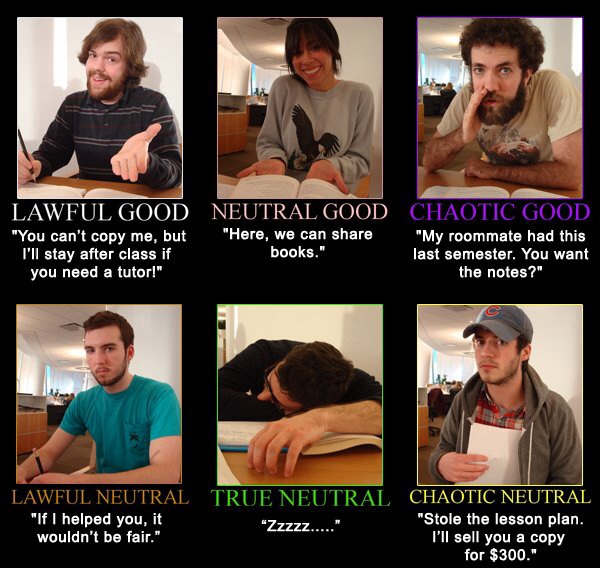
  • Why People Act the Way They Do: Insights from the Alignment Grid

    Why People Act the Way They Do: Insights from the Alignment Grid


    Understanding human motivations and behaviors can feel like navigating a complex maze, especially when people’s actions and values differ from our own. If you’re a student of sociology or psychology, a leader managing a diverse team, or simply someone seeking to improve communication in relationships, the moral alignment matrix offers a fascinating lens to analyze personalities. By exploring the “why,” “what,” and “how” of people’s actions, you’ll uncover patterns that help predict behaviors and adapt your approach to interact effectively. This framework is particularly useful for those curious about balancing structure with spontaneity or altruism with practicality in collaborative settings. Beyond theory, it empowers you to identify dominant alignments, recognize behavioral shifts, and respond to life’s challenges with empathy and strategy. Whether you’re building connections, resolving conflicts, or reflecting on your own tendencies, these insights can guide your path toward greater harmony and understanding in any sphere of life.

    Introduction

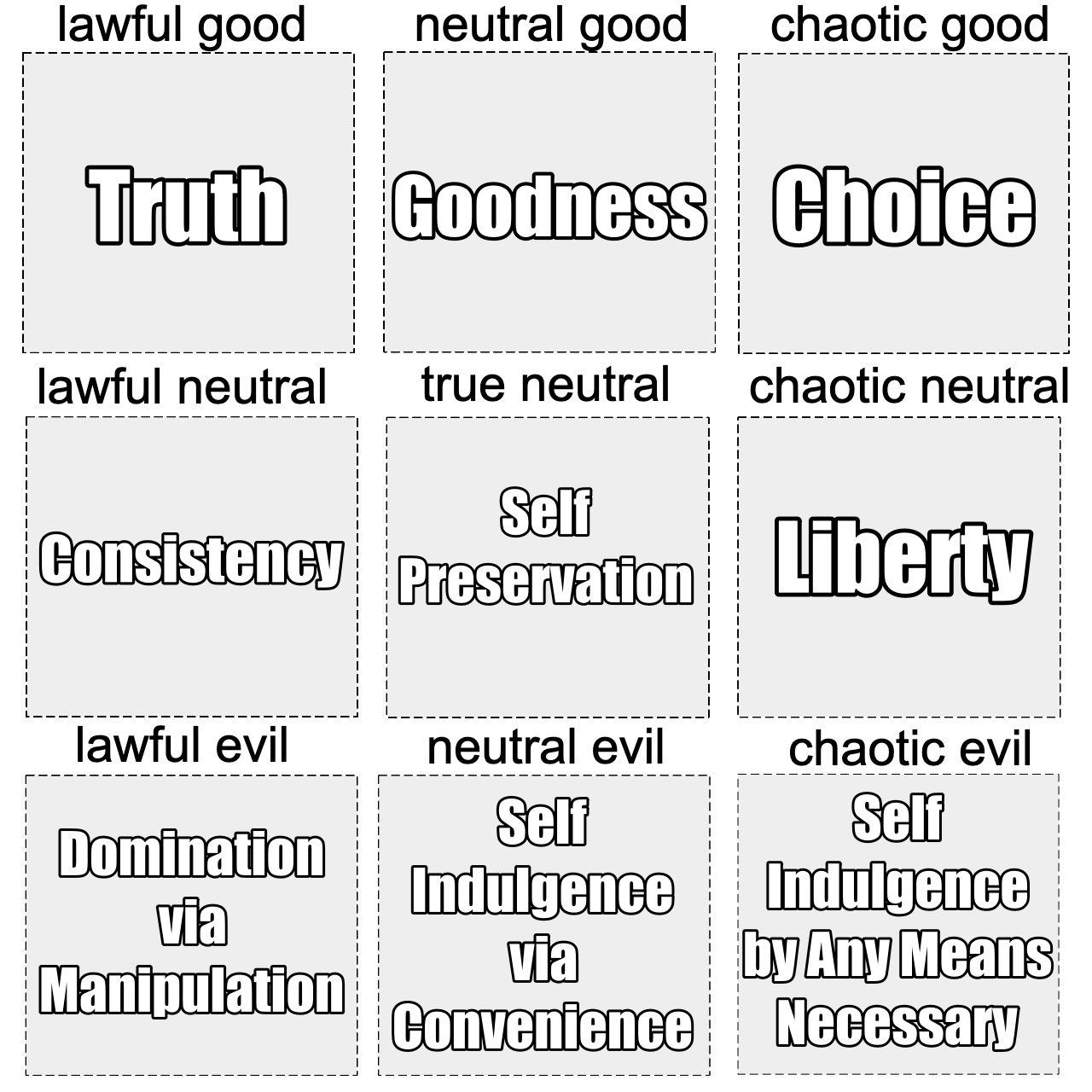
    Understanding human behavior is a complex yet deeply rewarding pursuit. The Moral Alignment Matrix, a concept rooted in the realm of tabletop games like Dungeons & Dragons (D&D), offers an insightful framework for analyzing individual motivations and actions. Originally designed to guide character development in role-playing games, this 3×3 grid has evolved into a broader tool for exploring human morality, ethical inclinations, and behavioral tendencies. It provides a structured way to evaluate how people balance their values—whether they prioritize rules, freedom, altruism, or self-interest.

    At its core, the matrix intersects two key axes: morality (Good-Neutral-Evil) and ethics (Lawful-Neutral-Chaotic). While its origins lie in gaming, its applications extend far beyond. Scholars and enthusiasts in sociology, psychology, and human motivation have embraced it as a lens to better understand personalities, interpersonal dynamics, and societal behavior patterns.

    For individuals interested in these fields, the matrix offers profound insights into why people act the way they do. It serves as a practical framework to decode decision-making processes, predict behavioral shifts, and adapt communication strategies. By recognizing the underlying motivations of diverse alignments, one can foster empathy, improve collaboration, and effectively navigate complex relationships.

    This article delves into the depths of the moral alignment matrix. It explores each of the nine alignments, from the principled “Lawful Good” to the chaotic and destructive “Chaotic Evil,” unraveling their underlying psychology and behaviors. It also provides actionable strategies to identify dominant alignments, track shifts in tendencies, and engage meaningfully with people across the spectrum. Whether you’re a leader, a team member, or simply someone seeking personal growth, these insights will empower you to build stronger, more meaningful connections and understand the world around you with clarity and purpose.

    Part 1: Foundations of the Moral Alignment Matrix

    Defining Key Concepts

    To grasp the essence of the moral alignment matrix, it’s crucial to understand its foundational components. These key concepts—Good, Neutral, Evil, Lawful, and Chaotic—are the building blocks that define how people prioritize values and make decisions.

    1. Good
      Goodness is characterized by altruism, compassion, and a genuine commitment to the welfare of others. Individuals driven by this principle strive to reduce suffering, promote harmony, and act with empathy. Their actions often transcend personal gain, focusing on building a better world for all.

      • Example: Volunteering to help disaster victims or advocating for social justice despite personal risk or sacrifice.
    2. Neutral (Morality)
      Neutrality is about maintaining balance and practicality, often viewing morality as situational rather than absolute. Neutral individuals evaluate actions based on their context and consequences rather than adhering rigidly to a moral code. They value pragmatism and adaptability over extremes.

      • Example: A mediator who prioritizes fairness and resolution over taking sides in a dispute.
    3. Evil
      Evil aligns with selfishness, malice, and a disregard for the well-being of others. It reflects actions that prioritize personal desires, even at the expense of causing harm. However, it’s important to note that evil isn’t always chaotic or anarchic—some forms of evil are calculated and structured.

      • Example: Manipulating others to achieve personal wealth or power, even if it causes widespread harm.
    4. Lawful (Ethics)
      The lawful axis emphasizes adherence to rules, order, and structure. Lawful individuals value systems that provide predictability and stability, whether these are societal laws, cultural norms, or personal codes of honor. They often see order as essential for justice and progress.

      • Example: Following workplace policies even when they’re inconvenient or enforcing laws impartially regardless of personal bias.
    5. Chaotic (Ethics)
      Chaos represents a commitment to freedom, individuality, and challenging norms. Those who lean toward chaos resist control and value personal expression over conformity. They believe in questioning authority and often seek to dismantle systems they see as oppressive or unjust.

      • Example: Protesting unjust laws or defying societal expectations to pursue personal authenticity.

    Why These Definitions Matter

    The moral alignment matrix’s genius lies in its ability to combine morality (Good-Neutral-Evil) and ethics (Lawful-Neutral-Chaotic) into a dynamic framework that captures the complexity of human behavior. Here’s why this interplay is significant:

    1. Comprehensive Classification:
      By blending moral intentions (goodness vs. selfishness) with ethical preferences (order vs. freedom), the matrix provides a nuanced way to classify actions and motivations. It acknowledges that people are rarely “all good” or “all chaotic” but a mix of intersecting values.

    2. Predicting Behavior:
      Understanding where someone falls within the matrix helps anticipate how they might respond in various situations. A Lawful Good individual may enforce rules for collective benefit, while a Chaotic Evil person might exploit a lack of oversight to sow discord.

    3. Empathy and Understanding:
      Recognizing these definitions fosters empathy by showing that actions arise from deeply held values. A Chaotic Neutral individual who disrupts traditions isn’t necessarily malicious—they may simply prioritize personal freedom over societal expectations.

    4. Practical Applications:
      Whether navigating interpersonal relationships, managing teams, or resolving conflicts, the matrix serves as a roadmap to understand motivations, resolve misunderstandings, and align goals effectively.

    By integrating these definitions, the moral alignment matrix transcends its gaming origins to become a robust tool for analyzing and navigating human behavior, paving the way for the detailed exploration of the nine alignments.

    Part 2: The Nine Moral Alignments in Depth

    Overview of the 3×3 Matrix

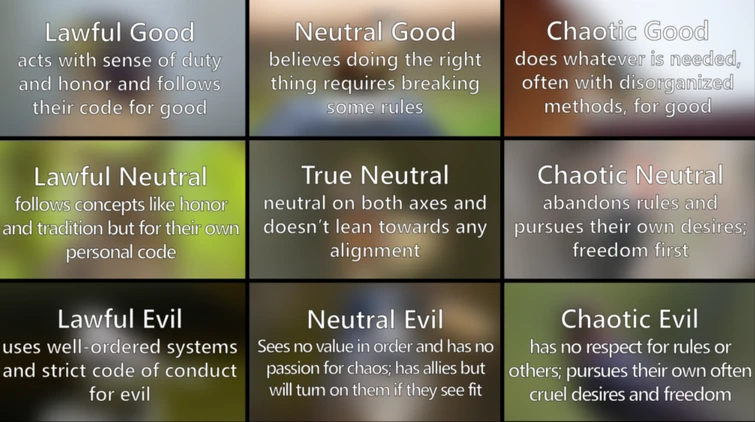
    The Moral Alignment Matrix visualizes human motivations and behaviors in a structured 3×3 grid. It is formed by intersecting two axes:

    • The moral axis (Good-Neutral-Evil), which measures an individual’s concern for others’ welfare.
    • The ethical axis (Lawful-Neutral-Chaotic), which evaluates an individual’s adherence to rules or value for personal freedom.

    Each alignment represents a unique blend of these factors, resulting in nine distinct categories that capture the diversity of human thought and action.


    Detailed Exploration of Each Alignment

    Each alignment reflects a combination of specific traits, motivations, and actions. Below is a structured analysis of each:


    1. Lawful Good: The Principled Do-Gooder

    Definition: Lawful Good individuals strive to promote fairness, order, and altruism. They believe in using rules and systems to achieve the greatest good.
    Examples:

    • Pop Culture: Superman (dedicated to justice, law, and protecting the weak).
    • Real-Life: A community leader advocating for legal reforms to support marginalized groups.
      Why: Their psychological drivers include a strong moral compass, respect for authority, and a belief that societal structures can bring about positive change.
      What & How: They resolve conflicts by mediating, enforcing rules, or upholding justice, often finding themselves at odds with those who prioritize freedom or self-interest.
      Shifting Tendencies: Stress or disillusionment may push them toward Neutral Good (if they question strict adherence to rules) or Lawful Neutral (if they begin valuing order over altruism).

    2. Neutral Good: The Pragmatic Altruist

    Definition: Neutral Good individuals prioritize doing what’s right over rigid systems or chaotic disruption. They value outcomes over methods.
    Examples:

    • Pop Culture: Spider-Man (committed to helping people without rigid adherence to laws or chaos).
    • Real-Life: A humanitarian who works outside traditional systems to bring aid to those in need.
      Why: They are driven by empathy and a focus on practical ways to improve lives.
      What & How: They often navigate complex ethical dilemmas by weighing the immediate needs of others over abstract principles.
      Shifting Tendencies: They may drift toward Lawful Good when inspired by structured efforts or Chaotic Good when rules hinder progress.

    3. Chaotic Good: The Freedom-Loving Hero

    Definition: Chaotic Good individuals value freedom and individuality, striving for change to achieve justice and fairness.
    Examples:

    • Pop Culture: Robin Hood (rebels against oppressive systems to help the poor).
    • Real-Life: An activist challenging unjust laws to promote equality.
      Why: They believe that rigid structures often perpetuate harm and prioritize personal judgment over external rules.
      What & How: They work to dismantle oppressive systems but can struggle to align with structured teams or groups.
      Shifting Tendencies: They may adopt Neutral Good tendencies when collaboration is essential or drift into Chaotic Neutral if their cause loses its moral grounding.

    4. Lawful Neutral: The Impartial Judge

    Definition: Lawful Neutral individuals value order, fairness, and rules, often without prioritizing morality or malice.
    Examples:

    • Pop Culture: The Jedi Council (focused on maintaining order, sometimes at the expense of compassion).
    • Real-Life: A judge delivering verdicts based strictly on legal precedent, regardless of personal feelings.
      Why: They prioritize stability and the collective over personal inclinations.
      What & How: They avoid favoritism, sometimes appearing cold or unfeeling. They excel in structured environments but may clash with more emotive personalities.
      Shifting Tendencies: They may lean toward Lawful Good under compassionate influences or drift into Lawful Evil when rules are weaponized.

    5. True Neutral: The Balanced Observer

    Definition: True Neutral individuals seek balance, staying impartial and focusing on the broader picture.
    Examples:

    • Pop Culture: Treebeard (The Lord of the Rings), who remains neutral in conflicts until personally affected.
    • Real-Life: A mediator or negotiator focused solely on fairness, not emotional or ideological attachments.
      Why: Their motivations stem from pragmatism and a desire to avoid extremes.
      What & How: They often serve as stabilizers but may frustrate others with their lack of strong stances.
      Shifting Tendencies: Significant events may pull them toward alignment with one side, either for personal gain or moral reasons.

    6. Chaotic Neutral: The Unpredictable Maverick

    Definition: Chaotic Neutral individuals value personal freedom and resist any constraints, often acting on impulse.
    Examples:

    • Pop Culture: Jack Sparrow (Pirates of the Caribbean), whose erratic behavior reflects self-interest without malice.
    • Real-Life: An entrepreneur who defies norms to pursue unconventional ventures.
      Why: They seek liberation from control and prioritize personal expression.
      What & How: They thrive in unpredictable environments but can create challenges in structured settings.
      Shifting Tendencies: They may gravitate toward Chaotic Good when inspired by a cause or slip into Chaotic Evil if self-interest becomes destructive.

    7. Lawful Evil: The Tyrannical Schemer

    Definition: Lawful Evil individuals use systems and rules to achieve selfish, often harmful goals.
    Examples:

    • Pop Culture: Darth Vader (initially loyal to order but willing to harm others for power).
    • Real-Life: A corrupt official exploiting laws to consolidate power.
      Why: They value order as a means to control others and secure their position.
      What & How: They act methodically, often manipulating systems to serve their interests while maintaining an outward appearance of legitimacy.
      Shifting Tendencies: They may soften into Lawful Neutral under redemptive circumstances or descend into Neutral Evil when order is no longer a priority.

    8. Neutral Evil: The Selfish Opportunist

    Definition: Neutral Evil individuals prioritize their own gain, regardless of laws or morality.
    Examples:

    • Pop Culture: Littlefinger (Game of Thrones), who manipulates events for personal benefit.
    • Real-Life: A con artist exploiting others without any regard for their well-being.
      Why: Their behavior stems from pure self-interest, unencumbered by loyalty or moral constraints.
      What & How: They adapt quickly to circumstances, often acting covertly and opportunistically.
      Shifting Tendencies: They may align with Lawful Evil if structure offers them power or become Chaotic Evil when order loses value.

    9. Chaotic Evil: The Destructive Anarchist

    Definition: Chaotic Evil individuals thrive on destruction, rejecting order and morality entirely.
    Examples:

    • Pop Culture: The Joker (The Dark Knight), whose chaos stems from a love of destruction.
    • Real-Life: A vandal or cybercriminal sowing chaos for personal gratification.
      Why: They derive satisfaction from chaos, often rooted in deep-seated anger or nihilism.
      What & How: Their actions are unpredictable, often causing harm without a clear objective beyond disorder.
      Shifting Tendencies: They rarely change alignment unless faced with profound consequences or introspection.


    Part 3: Identifying Alignments in People

    Understanding a person’s moral alignment can provide insights into their motivations, decision-making, and behaviors. This section outlines actionable techniques, tools, and considerations for identifying alignments in everyday interactions.


    Observation Techniques

    1. Recognizing Recurring Behaviors:

      • Patterns of Action: Pay attention to consistent responses in different situations. For example, does the person always follow rules (Lawful) or frequently challenge authority (Chaotic)?
      • Approach to Conflict: Note whether they seek compromise (Neutral), self-gain (Evil), or fairness (Good).
    2. Decision-Making Patterns:

      • Rule-Based Thinking: Lawful individuals often justify actions by referencing rules, traditions, or systems.
      • Freedom-Oriented Thinking: Chaotic individuals focus on individuality, creativity, and resistance to control.
      • Outcome-Based Thinking: Neutral individuals prioritize practicality, often seeking the most balanced or effective solution.
    3. Reactions to Moral Dilemmas:

      • Present moral questions or observe their stance on ethical controversies. For example, do they prioritize saving the most lives (Good) or following strict protocols (Lawful)?
    4. Nonverbal Cues:

      • Body language, tone, and expressions can reveal alignment tendencies. For instance, a Chaotic Neutral individual might appear restless or animated, while a Lawful Neutral person often exudes composure and control.

    Interactive Tools

    1. Hypothetical Scenarios:

      • Create thought experiments that challenge ethical and moral values. Example:
        • Scenario: A train is heading toward five people. Do they pull the lever to divert it, killing one person instead?
        • Interpretation: Lawful Good may consider the rules of fairness; Chaotic Good might focus on saving lives regardless of method; Neutral Evil may choose based on personal benefit.
    2. Moral Questions:

      • Ask direct questions like:
        • “Is it okay to break the law for a good cause?”
        • “Would you help someone if it inconvenienced you?”
      • The depth and consistency of their responses offer clues to their alignment.
    3. Journaling Interactions:

      • Record and analyze interactions over time. Patterns will emerge, showcasing their dominant alignment tendencies and any shifts influenced by circumstances.

    Influencing Factors

    1. Upbringing:

      • Early exposure to rigid discipline or permissive environments can incline individuals toward Lawful or Chaotic alignments, respectively.
      • Parental values and cultural norms also shape the moral (Good-Neutral-Evil) axis.
    2. Societal Norms:

      • In collectivist societies, people may lean toward Lawful Good or Lawful Neutral due to an emphasis on harmony and rules.
      • Individualistic societies often foster Chaotic or Neutral tendencies, valuing personal freedom over collective structures.
    3. Authority Figures:

      • Strong leadership can reinforce Lawful tendencies or challenge them depending on the leader’s alignment. For instance, a Chaotic leader might inspire rebellion against oppressive systems.
    4. Stress and Crisis:

      • In high-stress scenarios, alignments often shift temporarily. For example, a Lawful Good person may abandon rigid rules in a crisis to achieve the greater good, displaying Neutral Good tendencies.

    Shifting Alignments

    1. How and Why Alignments Shift:

      • Personal Growth: Education, therapy, or life experiences can lead to alignment shifts.
      • Crisis Events: Major challenges, such as loss or trauma, often push individuals toward Chaotic or Evil tendencies as survival mechanisms.
      • Influence of Others: Prolonged exposure to different alignments can lead to gradual adaptation.
    2. Indicators of Change:

      • Actions: Watch for deviations from their usual behavior. For example, a typically Chaotic Neutral person may suddenly uphold rules, signaling a move toward Lawful Neutral.
      • Language: Subtle changes in how they justify their decisions or express values often reflect alignment shifts.
      • Priorities: Shifts in focus from self-interest to community welfare (or vice versa) are significant indicators.
    3. Rate of Change:

      • Gradual Shifts: Long-term exposure to new values often results in subtle, lasting changes.
      • Rapid Shifts: Extreme circumstances, such as war or personal loss, can cause immediate but potentially reversible alignment shifts.


    Part 4: Working with Diverse Alignments

    Navigating interactions with individuals across the moral alignment spectrum can be challenging but rewarding. Whether in professional, personal, or social contexts, understanding and respecting differing alignments fosters better collaboration and mutual respect. This section provides scenarios, strategies, and examples to help readers work effectively with diverse alignments.


    Scenarios Involving Diverse Alignments

    1. Workplace Collaborations:

      • Challenge: A team comprises a Lawful Good manager focused on strict policies, a Chaotic Neutral creative pushing unconventional ideas, and a Neutral Evil opportunist prioritizing personal gain.
      • Resolution: Align the team’s focus on shared objectives, such as project success or client satisfaction, while addressing individual concerns through clear communication and compromises.
    2. Family Dynamics:

      • Challenge: A Chaotic Good teenager questions traditional rules set by their Lawful Neutral parent, leading to clashes over freedom and responsibility.
      • Resolution: Foster open dialogue to help both parties understand each other’s values. The parent can allow some flexibility, while the teenager respects certain non-negotiable rules.
    3. Social Activism:

      • Challenge: A group advocating for a cause includes a Lawful Evil strategist emphasizing structure and power, a Chaotic Good disruptor focusing on grassroots actions, and a Neutral Good mediator seeking practical solutions.
      • Resolution: Balance structured planning with creative flexibility. The strategist can handle negotiations, the disruptor can mobilize supporters, and the mediator can build consensus.

    Strategies for Communication and Collaboration

    1. Finding Common Ground:

      • Approach: Focus on shared goals rather than conflicting methods. For example, in a workplace setting, highlight how each person’s contribution serves the broader mission.
      • Practical Tip: Use inclusive language like “We’re all working toward…” to reinforce collective objectives.
    2. Conflict Resolution Techniques:

      • Lawful Alignments: Provide evidence-based arguments and appeal to their sense of order and justice.
      • Neutral Alignments: Use logic and practicality to demonstrate how a solution benefits all parties.
      • Chaotic Alignments: Emphasize freedom of choice and how the resolution allows personal expression.
    3. Leveraging Alignment Strengths:

      • Lawful Good: Use their sense of fairness and dedication to ethics to mediate disputes.
      • Chaotic Good: Tap into their creativity and passion for inspiring innovative solutions.
      • Neutral Evil: Assign tasks requiring strategic thinking or navigating competitive environments.

    Case Studies

    1. Fictional Workplace Scenario:

      • Scenario: A marketing team is tasked with creating a campaign.
        • Lawful Good Member: Advocates for adhering to company guidelines and ethical marketing practices.
        • Chaotic Neutral Member: Suggests unconventional tactics to grab attention.
        • Neutral Evil Member: Seeks personal credit for ideas, sometimes at the expense of collaboration.
      • Resolution:
        • Assign roles that play to strengths: The Lawful Good member ensures compliance, the Chaotic Neutral member designs bold concepts, and the Neutral Evil member leads execution with clear boundaries.
        • Regular team meetings foster transparency and mutual respect.
    2. Community Project Scenario:

      • Scenario: A neighborhood group organizes a fundraiser for a local cause.
        • Chaotic Good Member: Proposes a spontaneous flash mob to raise awareness.
        • Lawful Neutral Member: Focuses on legal permits and a detailed event schedule.
        • True Neutral Member: Mediates between the two approaches, suggesting a hybrid event combining structure and spontaneity.
      • Resolution:
        • Combine approaches to create an engaging yet compliant event.


    Part 5: Recognizing and Embracing Complexity

    Human behavior defies simple categorization. While the moral alignment matrix offers a framework for understanding, people often exhibit multi-alignment tendencies depending on their roles, experiences, and environments. Recognizing this complexity is crucial for nuanced interactions and self-growth.


    Multi-Alignment Behaviors

    1. Fluidity Across Roles:

      • Example:
        • A person might embody Lawful Good values as a teacher, adhering to institutional policies and prioritizing student well-being. However, in their personal life, they might lean toward Chaotic Neutral by embracing a free-spirited lifestyle.
      • Insight: Alignment is not static; it adapts to context. Viewing individuals through a situational lens fosters greater understanding and empathy.
    2. Conflicts in Multi-Alignment Behavior:

      • Example: A manager with Lawful Neutral tendencies in the workplace may face conflict if they act Chaotic Good in personal relationships, leading to misunderstandings about priorities and consistency.
      • Actionable Tip: Identify patterns in alignment shifts to better predict behavior across contexts.

    Psychological Roots

    1. Influence of Upbringing and Culture:

      • Example:
        • A child raised in a strict, rule-bound household may lean toward Lawful alignments, valuing structure and authority.
        • Conversely, growing up in a creative or unstructured environment might foster Chaotic tendencies.
      • Takeaway: Alignment tendencies are often rooted in early experiences but remain open to change through exposure and personal development.
    2. Impact of Trauma and Societal Systems:

      • Trauma:
        • A Neutral Good individual may shift toward Chaotic Neutral or Chaotic Evil under the influence of prolonged betrayal or hardship.
      • Societal Systems:
        • Living within oppressive systems may cause an individual to adopt Lawful Evil behaviors to survive, even if their personal beliefs align elsewhere.
      • Reflection Point: Understanding the underlying reasons for someone’s alignment helps in addressing their needs and challenges effectively.

    Growth and Transformation

    1. Recognizing Potential for Change:

      • Observation: Alignments can evolve as individuals gain new experiences, encounter transformative events, or actively pursue self-improvement.
      • Example: A Chaotic Evil individual with a history of destructive behavior may find purpose and shift toward Neutral Good after meaningful mentorship or therapy.
    2. Tools for Self-Awareness:

      • Personality Assessments:
        • Frameworks like the Enneagram or Myers-Briggs can help individuals explore their values, motivations, and tendencies.
      • Therapy and Coaching:
        • Professional guidance can unpack deep-seated behavioral patterns and foster positive transformation.
      • Reflective Practices:
        • Journaling, meditation, or peer feedback encourages self-awareness, helping individuals recognize their alignment tendencies and growth opportunities.


    Conclusion

    Understanding the moral alignment matrix offers profound insights into human behavior, motivation, and action. By categorizing and analyzing the interplay between morality and ethics, this framework helps us better comprehend the complexities of ourselves and those around us. Its value lies not in rigid classification but in fostering empathy, improving communication, and enhancing collaboration across diverse contexts.

    Human behavior is inherently fluid, influenced by circumstances, upbringing, and individual growth. Recognizing this fluidity reminds us to approach interactions with patience and an open mind. Whether you’re navigating personal relationships, building teams, or leading initiatives, using this matrix as a reflective and observational tool can guide meaningful connections and collective progress.

    Take a moment to reflect on your own alignment and consider how it shapes your decisions and relationships. By understanding the alignments of others, you open the door to empathy, cooperation, and shared growth—a cornerstone of thriving communities and impactful leadership.


    Support Meda Foundation

    This article, like many others, has been made possible thanks to the generous support of patrons. If you found the information here valuable, consider donating to keep these resources accessible to all.

    We also value your insights and experiences! Share your thoughts through our feedback form to help us continue improving.


    Resources for Further Research

    Explore these resources for a deeper understanding of the discussed concepts and adjacent ideas:

    1. Moral Alignments Explained (Article):
      plainlanguage.gov/guides/moral-alignments-overview

    2. The Evolution of D&D’s Alignment System (Video):
      youtube.com/watch?v=alignment-in-dd-history

    3. Empathy and Social Dynamics in Psychology (Research Paper):
      sciencedirect.com/social-interactions-and-alignments

    4. Human Motivation and Action (Podcast):
      motivationmatrixpodcast.com

    5. Sociology in Everyday Life (Documentary):
      netflix.com/sociology-through-lens

    6. Historical and Pop Culture Examples of Alignment (Blog):
      popculturealignment.blogspot.com

    7. Conflict Resolution Across Personalities (Article):
      psychcentral.com/blog/how-to-manage-diverse-personality-types

    8. Understanding Fluid Human Behavior (Podcast):
      fluidbehaviorhour.podcast.com

    9. Alignment Quiz and Tools for Teams (Interactive Resource):
      alignmenttools.com/team-dynamics

    10. Ethics and Decision-Making (Research Paper):
      jstor.org/stable/decisionmaking-ethics

    11. Psychology of Self-Awareness (Book):
      goodreads.com/self-awareness-guide

    12. Lawful vs. Chaotic: Cultural Perspectives (Vlog):
      youtube.com/cultural-alignments-vlog

    13. Personality Assessments for Growth (Tool):
      16personalities.com/assessment

    14. Alignments in Literature (Blog):
      literaryalignment.com/fictional-analysis

    15. Societal Systems and Behavior (News Article):
      bbc.com/social-dynamics-alignment-analysis

    16. Empathy and Growth in Leadership (TED Talk):
      ted.com/talks/empathy-alignments-in-leadership

    17. Using Alignments in Gaming and Real Life (Forum):
      reddit.com/r/moralalignmentmatrix

    18. Understanding Interpersonal Dynamics (Video):
      vimeo.com/communication-alignment-skills

    19. Balancing Ethics and Morality in Decision Making (Documentary):
      pbs.org/documentary-moral-ethics-balance